组成图示
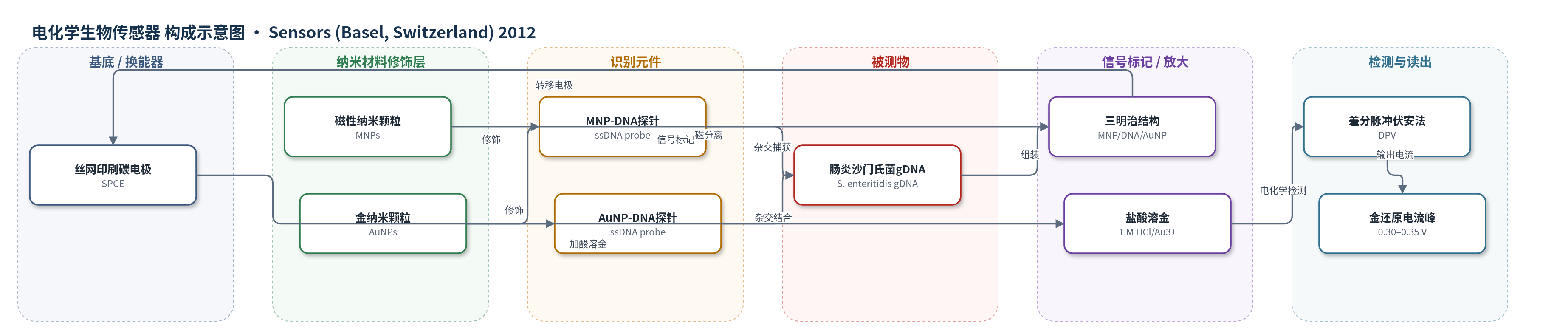
点击图片查看大图 · 依据论文自动绘制
传感器类型
电化学生物传感器
检测对象
非PCR扩增肠炎沙门氏菌基因组DNA(Salmonella enterica serovar Enteritidis genomic DNA, S. enteritidis gDNA);样品基质:纯细菌培养物(PBC)、混合细菌培养物(MBC)、2%牛奶、100%橙汁
检测原理
MNPs和AuNPs表面分别固定两条互补于S. enteritidis Iel插入元件的ssDNA探针。样品中非PCR扩增基因组DNA经变性后,先与MNP上的探针杂交,再与AuNP上的探针杂交,形成MNP/gDNA/AuNP三明治结构。随后通过磁分离收集复合物并洗涤,将其转移到SPCE上干燥。加入1 M HCl溶解AuNPs,释放Au3+离子。DPV在1.25 V至0.0 V扫描时,Au3+在约0.30–0.35 V被还原,产生差分电流峰。理论上目标DNA浓度越高,捕获的AuNPs越多,溶金后Au3+越多,电流峰越大;但高浓度时探针位点饱和,三明治结构形成减少,出现钩状效应,信号反而下降。
检测灵敏度
LOD: 100 ng/mL;原文另报道先前PCR扩增检测灵敏度范围: 7–700 ng/mL
效应效果
该传感器可检测纯培养、混合培养及加标2%牛奶和100%橙汁中的非PCR扩增肠炎沙门氏菌基因组DNA,最低检出约100 ng/mL,与先前PCR扩增AuNP-DNA传感器报道的7–700 ng/mL范围相当。阴性对照B. anthracis非特异性DNA(0.1 ng/μL)差分峰约3.0×10^-6 A,接近水空白2.5×10^-6 A,显示一定选择性。重复样品存在波动,文中未给出RSD;3 ng/μL高浓度出现钩状效应,信号低于0.1和1 ng/μL。作者认为其无需PCR,适合资源有限和现场快速检测,但需优化提取与传感系统以降低至7–50 ng/mL。
传感器的构成
- 换能器基底:丝网印刷碳电极(SPCE),提供电化学检测界面
- 捕获纳米材料:磁性纳米颗粒(MNPs),表面连接特异性ssDNA探针,用于捕获目标DNA并磁分离
- 信号纳米材料:金纳米颗粒(AuNPs),表面连接特异性ssDNA探针,用于形成三明治结构并提供电化学信号
- 识别元件:单链DNA探针(ssDNA probes),分别修饰于MNPs和AuNPs,特异性识别S. enteritidis Iel序列
- 信号标记物:金纳米颗粒(AuNPs)作为电化学标记,经1 M HCl溶解生成Au3+离子
- 检测介质:1 M HCl,溶解AuNPs并产生可还原Au3+,用于DPV检测
中文摘要
细菌病原体威胁食品安全与生物安全。现有纳米DNA生物传感器灵敏度高,但多依赖昂贵耗时的PCR扩增,因此需要更快更经济的检测方法。本研究作为概念验证,考察金纳米颗粒-DNA(AuNP-DNA)生物传感器检测非PCR扩增肠炎沙门氏菌(S. enteritidis)基因组DNA的能力,样品来自纯培养、混合培养及加标液体基质。非PCR扩增DNA杂交形成磁性纳米颗粒/DNA/金纳米颗粒(MNPs/DNA/AuNPs)三明治结构,并用差分脉冲伏安法(DPV)检测金伏安峰。初步结果表明,该传感器可从细菌培养和加标液体基质中检出低至100 ng/mL的非PCR扩增基因组DNA,接近已报道PCR扩增检测水平。结果提示AuNP-DNA生物传感器可用于资源有限条件下的细菌病原体快速检测,未来需优化DNA提取和传感系统以提高低浓度检测灵敏度。
英文摘要
Bacterial pathogens pose an increasing food safety and bioterrorism concern. Current DNA detection methods utilizing sensitive nanotechnology and biosensors have shown excellent detection, but require expensive and time-consuming polymerase chain reaction (PCR) to amplify DNA targets; thus, a faster, more economical method is still essential. In this proof-of-concept study, we investigated the ability of a gold nanoparticle-DNA (AuNP-DNA) biosensor to detect non-PCR amplified genomic Salmonella enterica serovar Enteritidis (S. enteritidis) DNA, from pure or mixed bacterial culture and spiked liquid matrices. Non-PCR amplified DNA was hybridized into sandwich-like structures (magnetic nanoparticles/DNA/AuNPs) and analyzed through detection of gold voltammetric peaks using differential pulse voltammetry. Our preliminary data indicate that non-PCR amplified genomic DNA can be detected at a concentration as low as 100 ng/mL from bacterial cultures and spiked liquid matrices, similar to reported PCR amplified detection levels. These findings also suggest that AuNP-DNA biosensors are a first step towards a viable detection method of bacterial pathogens, in particular, for resource-limited settings, such as field-based or economically limited conditions. Future efforts will focus on further optimization of the DNA extraction method and AuNP-biosensors, to increase sensitivity at lower DNA target concentrations from food matrices comparable to PCR amplified DNA detection strategies.