组成图示
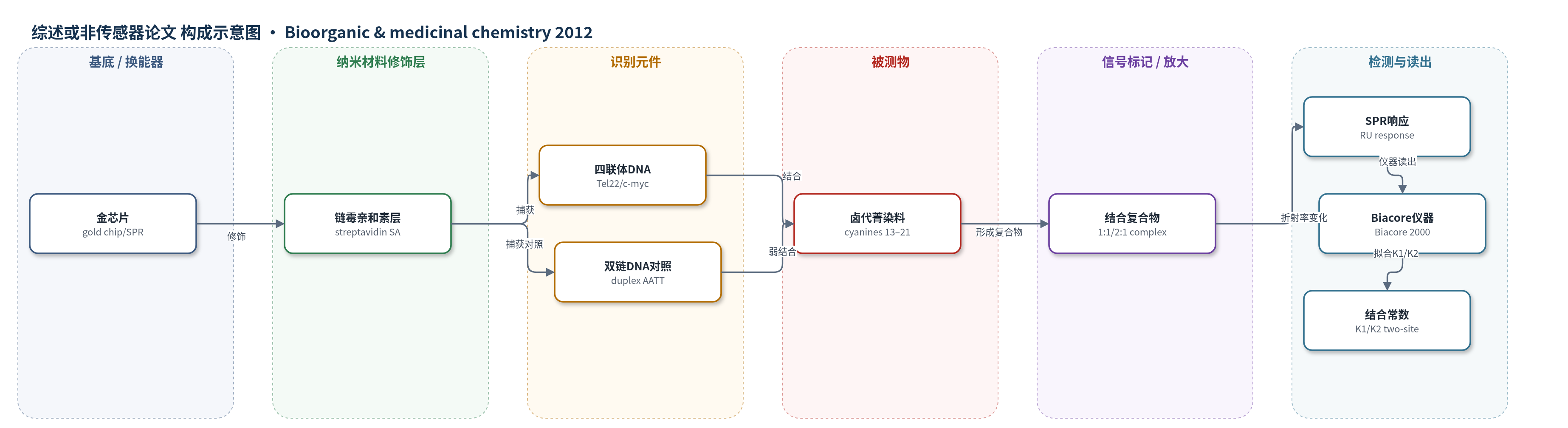
点击图片查看大图 · 依据论文自动绘制
传感器类型
综述或非传感器论文
检测对象
被测物:卤代五亚甲基菁染料(halogenated pentamethine cyanine dyes, 13–21);固定识别靶标:Tel22、c-myc G-四联体及双链AATT DNA;样品基质:HEPES/KCl/EDTA缓冲液(10 mM HEPES、50 mM KCl、3 mM EDTA,pH 7.3)
检测原理
在SPR实验中,5'-生物素化Tel22、c-myc或双链AATT DNA通过链霉亲和素非共价固定于金芯片表面。卤代五亚甲基菁染料随缓冲液注入流动池后,带正电的三甲基铵丙基链与G-四联体沟槽发生静电作用,平面多甲川染料端基堆叠于末端四面体,形成较强的1:1复合物;高浓度下还可形成较弱的2:1次级复合物。结合事件使芯片表面质量与局部折射率改变,引起表面等离子共振响应单位(RU)变化。稳态RU随游离染料浓度升高而增加,按双位点模型拟合得到K1和K2;双链DNA对照几乎无响应,体现对四联体的选择性。该过程无额外化学放大,直接依赖结合质量/折射率变化。
检测灵敏度
原文未报告LOD、线性范围、灵敏度斜率或相关系数。
效应效果
该系列卤代菁染料对G-四联体表现出高选择性:热熔融中Tel22的ΔTm最高约21.0°C(化合物19,6:1),而双链AATT的ΔTm≤2.8°C;SPR中双链结合低于10^5 M^-1或无法检测。与端粒相比,c-myc四联体结合更强约10–25倍,化合物15对c-myc的K1为13.0×10^6 M^-1,对Tel22为1.7×10^6 M^-1;次级结合弱约5–50倍。SPR在不同缓冲条件下获得相似值,结合常数为两次实验平均;热熔融重复性在±0.5°C内。作者认为这些染料可作为开发强效、高选择性四联体特异性抗肿瘤候选分子的平台。
传感器的构成
- 基底/换能器:金芯片(gold chip)与SPR光学换能器,提供表面等离子共振信号
- 捕获/识别层:链霉亲和素(streptavidin)修饰的SA芯片,非共价捕获生物素化DNA
- 识别元件:5'-生物素化Tel22、c-myc或双链AATT寡核苷酸,作为固定靶标序列
- 被测物:卤代五亚甲基菁染料(halogenated pentamethine cyanine dyes, 13–21),注入流动池与固定DNA结合
- 信号读出:Biacore 2000 SPR仪器,监测响应单位(RU)随染料浓度变化
中文摘要
本文报道了一类具有不同卤素取代模式的二甲基吲哚啉五亚甲基菁染料的设计、合成与评价,旨在开发高选择性的G-四联体靶向小分子。作者利用热熔融、生物传感器表面等离子共振(SPR)、圆二色、等温滴定量热和质谱等方法,系统评估了这些染料与端粒Tel22、c-myc G-四联体以及参考双链DNA的相互作用。热熔融结果表明,卤代菁染料可显著稳定G-四联体,而对双链DNA结合很弱,其中二甲基取代对降低双链亲和力尤为关键。圆二色显示染料主要通过端基堆叠与四联体末端四面体结合,两个三甲基铵丙基链进入可及沟槽。SPR和质谱显示先形成较强的1:1复合物,随后出现明显较弱的次级结合;等温量热表明结合主要由熵驱动。该工作为开发强效、高选择性四联体特异性抗肿瘤候选分子提供了新依据。
英文摘要
Design and optimization of quadruplex-specific small molecules is developing into an attractive strategy for anti-cancer therapeutics with some promising candidates in clinical trials. A number of therapeutically favorable features of cyanine molecules can be effectively exploited to develop them as promising quadruplex-targeting agents. Herein, the design, synthesis and evaluation of a series of dimethylindolenine cyanine dyes with varying halogen substitutions are reported. Their interactions with telomeric and c-myc quadruplexes as well as a reference duplex sequence have been evaluated using thermal melting, biosensor-surface plasmon resonance, circular dichroism, isothermal titration calorimetry and mass spectrometry. Thermal melting analysis indicates that these ligands exhibit significant quadruplex stabilization and a very low duplex binding, with the dimethyl incorporation of paramount importance for decreased duplex affinity. Circular dichroism studies showed that the interaction of cyanines with quadruplex structures are primarily through stacking at one or both ends of the terminal tetrads with the two (trimethylammonium)propyl groups interacting in the accessible quadruplex grooves. Surface plasmon resonance and mass spectral studies shows the formation of an initial strong 1:1 complex followed by a significantly weaker secondary binding. Isothermal calorimetry studies show that the interaction of cyanines is predominantly entropy driven. In line with the design principles, this work provides new insights for further developing potent, highly selective cyanines as promising quadruplex-specific agents.