组成图示
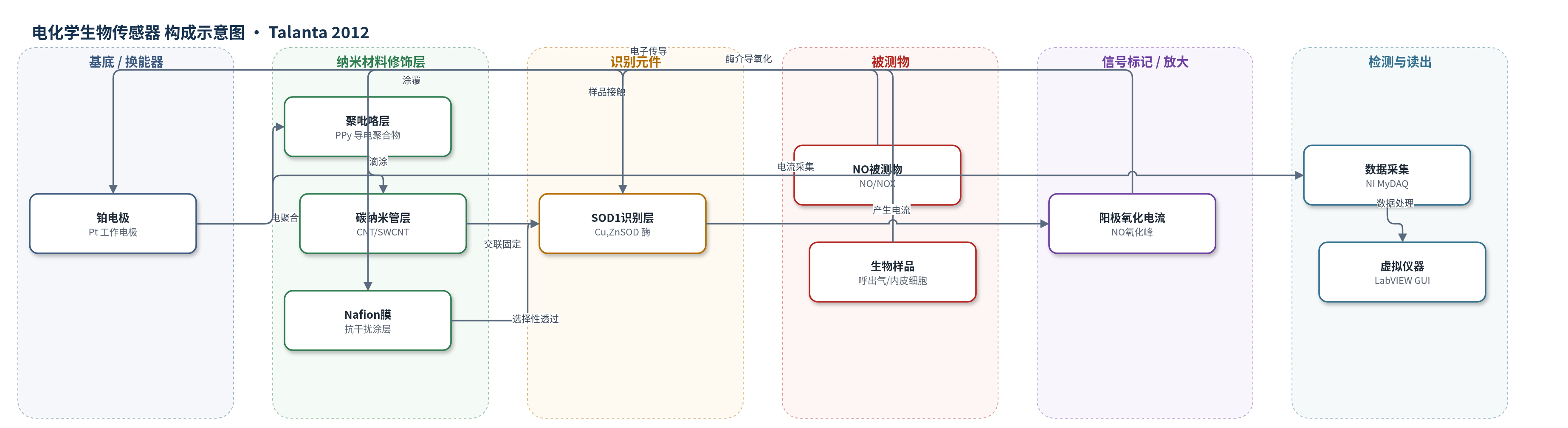
点击图片查看大图 · 依据论文自动绘制
传感器类型
电化学生物传感器
检测对象
一氧化氮(NO,含呼出气中 NO/NOX);样品基质:人呼出气体(NO/NOX 溶解于 PBS)、H2O2 刺激人主动脉内皮细胞培养上清
检测原理
SOD1 固定于 CNT-PPy-Pt 电极,其活性位通道较窄,可选择性允许 NO 进入并发生酶介导氧化。在循环伏安扫描中,NO 在 SOD1 活性位 Cu2+/Cu+ 介导下于约 +0.8 V vs. Ag/AgCl 发生电化学氧化,产生不可逆阳极峰;NO 浓度越高,氧化电子转移越多,阳极峰电流越大。Nafion 膜阻挡抗坏血酸(AsA)和亚硝酸根(NO2-)等干扰物,提高选择性。自制 LM358 电位计控制工作电极电位,NI MyDAQ 将电流转换为电压并采集,LabVIEW 绘制伏安曲线并计算浓度。呼出气中 NO/NOX 先溶解于 PBS,再被电极检测。
检测灵敏度
LOD: 0.1 mM;线性范围: 0.1 mM to 1 mM;sensitivity: 1.1 mA mM^-1;r2=0.999;校准方程: Ipa = -0.063[NO] - 10.49 (r2=0.999)
效应效果
传感器选择性良好:Nafion 涂覆后抗坏血酸(AsA)和亚硝酸根(NO2-)不再引起电流变化,尿酸(UA)和硝酸根(NO3-)本身无干扰。稳定性方面,每日三次测量,电流响应可保持两个月基本恒定;线性相关系数 r2=0.999,数据为三次平均。实际样品中,4 名健康人呼出气 NO 平均 24.5±0.5 ppb,与文献报道一致;H2O2 刺激内皮细胞后,250 mM 和 500 mM 处理分别释放 20.3±0.4 mM 和 50.2±1.0 mM NO,呈剂量依赖,且与参考方法一致。与 CHI 1200B 标准循环伏安仪结果一致,作者认为其低成本、便携、适合现场/原位 NO 检测。
传感器的构成
- 基底/换能器电极:铂电极(Pt),作为工作电极和电子传导基底
- 导电聚合物修饰层:聚吡咯(PPy),由吡咯在 Pt 上电聚合形成,提供导电网络与酶固定基质
- 纳米材料修饰层:单壁碳纳米管(SWCNT/CNT),与 Nafion 乙醇溶液滴涂于 PPy-Pt 表面,增强导电性和电子转移
- 识别元件:铜锌超氧化物歧化酶(Cu,ZnSOD,SOD1),以戊二醛(GA)交联固定于 CNT-PPy-Pt,介导 NO 选择性氧化
- 抗干扰/封闭层:Nafion 膜,涂覆于 SOD1-CNT-PPy-Pt 表面,阻挡抗坏血酸(AsA)和亚硝酸根(NO2-)等干扰物
- 信号标记物:无外加标记物;SOD1 活性位 Cu2+/Cu+ 介导 NO 氧化并直接产生阳极电流
- 检测系统:Ag/AgCl 参比电极、Pt 辅助电极、LM358 自制电位计、NI MyDAQ 与 LabVIEW 10.0,用于电位控制、电流采集和数据处理
中文摘要
本研究设计并开发了一种低成本虚拟电化学分析仪,用于测量呼出气体及过氧化氢刺激内皮细胞中一氧化氮(NO)。系统采用自制电位计,NI MyDAQ 数据采集系统获取由铜锌超氧化物歧化酶(Cu,ZnSOD)介导的 NO 电化学氧化电流;LabVIEW 10.0 开发图形用户界面软件,用于控制电位扫描、采集电流并处理信号。将 Cu,ZnSOD(SOD1)固定于碳纳米管/聚吡咯修饰铂电极,作为 NO 生物传感器。SOD1 修饰电极在 +0.06 V vs. Ag/AgCl 处显示准可逆氧化还原峰,对应活性位 Cu2+/Cu+ 电子转移。Nafion 涂层可消除生物干扰,实现 NO 选择性测定。传感器对 NO 的线性范围为 0.1 mM–1 mM,检出限 0.1 mM,灵敏度 1.1 mA mM^-1。虚拟电化学分析仪结果与标准循环伏安仪一致,可用于呼出气 NO 和细胞 NO 释放检测。
英文摘要
In this work, we have designed and developed a novel and cost effective virtual electrochemical analyzer for the measurement of NO in exhaled breath and from hydrogen peroxide stimulated endothelial cells using home-made potentiostat. Here, data acquisition system (NI MyDAQ) was used to acquire the data from the electrochemical oxidation of NO mediated by copper, zinc superoxide dismutase (Cu,ZnSOD). The electrochemical control programs (graphical user-interface software) were developed using LabVIEW 10.0 to sweep the potential, acquire the current response and process the acquired current signal. The Cu,ZnSOD (SOD1) immobilized on the carbon nanotubes in polypyrrole modified platinum electrode was used as the NO biosensor. The electrochemical behavior of the SOD1 modified electrode exhibited the characteristic quasi-reversible redox peak at the potential, +0.06 V vs. Ag/AgCl. The biological interferences were eliminated by nafion coated SOD1 electrode and then NO was measured selectively. Further, this biosensor showed a wide linear range of response over the concentration of NO from 0.1 μM to 1 mM with a detection limit of 0.1 μM and high sensitivity of 1.1 μA μM(-1). The electroanalytical results obtained here using the developed virtual electrochemical instrument were also compared with the standard cyclic voltammetry instrument and found in agreement with each other.