组成图示
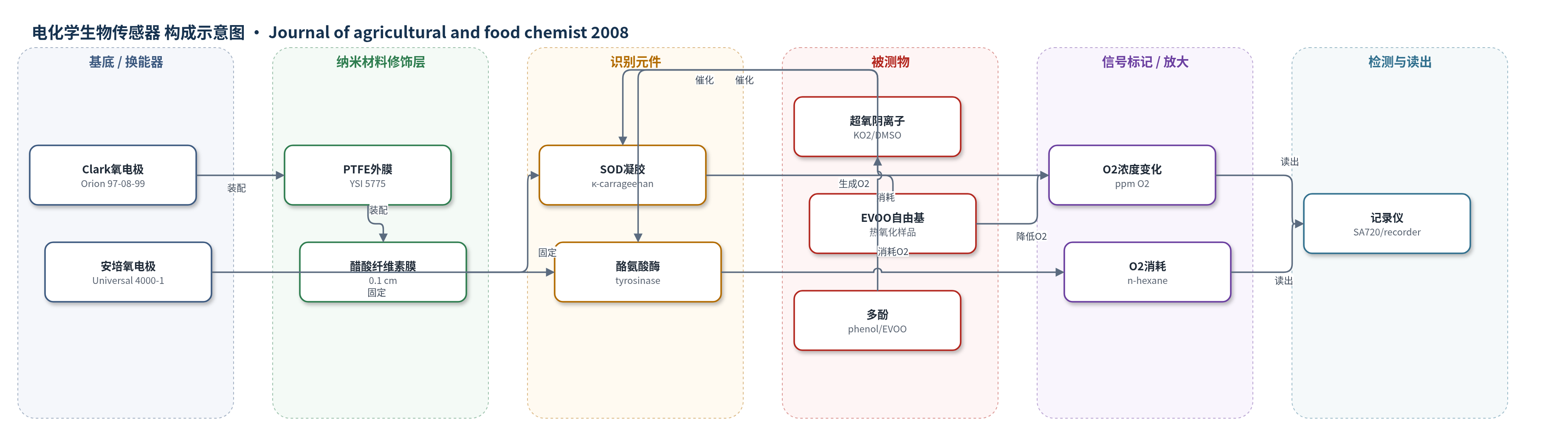
点击图片查看大图 · 依据论文自动绘制
传感器类型
电化学生物传感器
检测对象
自由基(free radicals,EVOO 热氧化样品)、总多酚(total polyphenols,EVOO 样品)、总抗氧化能力(total antioxidant capacity,EVOO 样品);样品基质为特级初榨橄榄油(extra virgin olive oil, EVOO),检测介质为 DMSO 或正己烷(n-hexane)。
检测原理
SOD 生物传感器中,KO2 在 DMSO 中解离生成超氧阴离子 O2•-,其透过 PTFE 膜进入 κ-卡拉胶凝胶,被固定化 SOD 催化歧化为 O2 和 H2O2,Clark 氧电极检测 O2 增加。加入热氧化 EVOO 后,油中自由基 R• 与 O2•- 反应生成过氧自由基并消耗超氧,使 SOD 底物减少,O2 生成下降;b/a 指数随自由基浓度增加而升高。多酚传感器中,酪氨酸酶催化酚类氧化为邻醌并消耗 O2,安培氧电极检测 O2 下降,信号变化与多酚浓度成正比。ORAC 法通过 ABAP 产生过氧自由基,α-PE 荧光淬灭被抗氧化剂抑制,荧光保持率反映总抗氧化能力。
检测灵敏度
—
效应效果
重现性较好:总抗氧化能力 RSD≤0.05,总多酚 RSD≤0.047,b/a 指数在 180 °C 未脱酚、脱酚及 98 °C 条件下 RSD 分别为≤0.04、≤0.03、≤0.05;98 °C 多酚重复测定标准偏差 2–5%(114.2±2.2、48.4±2.0、29.6±1.4 mg/kg)。动力学上,总抗氧化能力与多酚降解 Ea 约 30–37 kJ/mol,k 约 9×10^-3–9×10^-2 min^-1;TACV1/2 由 98 °C 的 12.0 min 降至 180 °C 的 6.8 min。SOD 法受多酚干扰,脱酚(多酚约 10^-3 降至 10^-6 mol/L)后可用于自由基监测;酪氨酸酶 OPEE 比分光光度法更快且适合油相。
传感器的构成
- 换能器电极(SOD传感器):Clark 型氧电极(Orion 97-08-99),检测 O2 浓度变化
- 外部膜(SOD传感器):PTFE 气体渗透膜(YSI 5775),允许 O2/O2•- 透过并阻隔 DMSO
- 内部膜(SOD传感器):醋酸纤维素膜(cellulose acetate,0.1 cm),固定凝胶并隔离有机溶剂
- 识别/催化元件(SOD传感器):κ-卡拉胶凝胶盘(κ-carrageenan,0.5 cm)吸附 SOD(superoxide dismutase),催化超氧歧化
- 信号前体:KO2/DMSO 生成超氧阴离子(O2•-),经 SOD 转化为 O2
- 换能器电极(多酚传感器):改良安培氧电极(Universal Sensor 4000-1),检测 O2 消耗
- 识别/催化元件(多酚传感器):酪氨酸酶(tyrosinase,EC 1.14.18.1),催化酚氧化为邻醌并消耗 O2
- 读出系统:Orion pH-meter SA720、Mitek 万用表与记录仪,输出 O2 ppm 或电流/电位
中文摘要
本文在前期人工等温酸败研究基础上,系统考察特级初榨橄榄油(EVOO)在等温热氧化过程中总抗氧化能力、总多酚浓度及主要动力学参数的变化趋势,并进行相互比较。研究还评估了利用超氧化物歧化酶(SOD)生物传感器间接监测热氧化过程中自由基浓度增加的可能性。通过酪氨酸酶有机相酶电极、ORAC 荧光法和 SOD/Clark 氧电极分别监测多酚消耗、总抗氧化能力和自由基相关指标,并结合 MacCallum 法与模型拟合法获得活化能和速率常数。该工作针对烹调或油炸用 EVOO 的劣变状态随温度变化的问题,可为判断油脂氧化程度、控制加热条件及保障食用安全提供依据。
英文摘要
As a follow-up of the research programs carried out by our group concerning the artificial isothermal rancidification process in extra virgin olive oil (EVOO), in the present work the trends of both the total antioxidant capacity and the total polyphenols concentration as well as the main kinetic parameters of the process during the thermal oxidation of EVOO were studied and compared. In addition, the possibility of evaluating the increase in radicals concentration during the thermal oxidation process using a superoxide dismutase biosensor was also studied. The present investigation concerning this important food product is highly topical as it refers to the state of alteration of the EVOO used for cooking or frying, as a function of the temperature reached.