组成图示
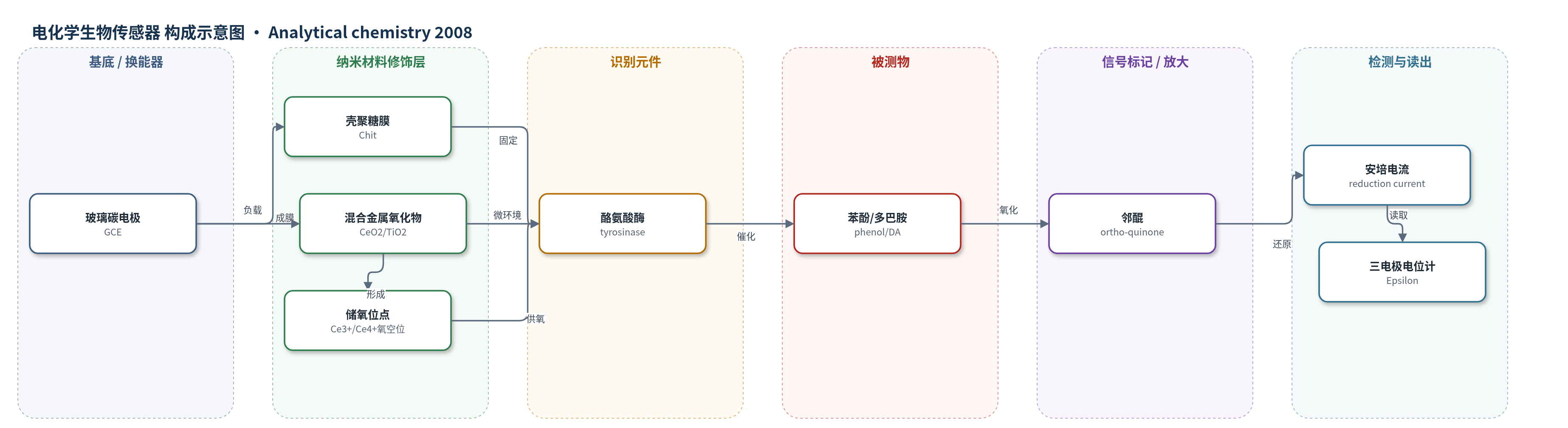
点击图片查看大图 · 依据论文自动绘制
传感器类型
电化学生物传感器
检测对象
苯酚(phenol)、多巴胺(dopamine, DA);样品基质:0.1 mol L-1 磷酸盐缓冲液(PB, pH 6.5),有氧/无氧条件
检测原理
酪氨酸酶以分子氧为共底物,催化苯酚或多巴胺发生邻位羟基化和两电子氧化,生成邻醌。邻醌扩散至玻璃碳电极表面并在负电位下被还原,产生与底物浓度成正比的安培电流。CeO2 通过 Ce3+/Ce4+ 可逆转变和氧空位实现氧的储存与释放,TiO2 增强电催化活性;二者复合后形成富氧微环境,使酶反应在缺氧条件下仍能进行。因此,被测物浓度越高,酶促生成邻醌越多,电极还原电流越大。该设计将氧化酶催化与金属氧化物储氧/电催化功能耦合,实现低氧或无氧环境下的电化学检测。
检测灵敏度
苯酚(有氧): LOD: 9.0(±0.1) × 10-9 M;线性范围: (1.0 × 10⁻⁸)-(5.0 × 10⁻⁵) M;灵敏度: 86.21 ± 1.80 mA M-1。苯酚(无氧): LOD: 5.6(±0.1) × 10-9 M;灵敏度: 64.73 ± 0.91 mA M-1。多巴胺(有氧): LOD: 3.4(±0.1) × 10-8 M;灵敏度: 14.91 ± 0.50 mA M-1。多巴胺(无氧): LOD: 4.20(±0.10) × 10-8 M;灵敏度: 14.79 ± 0.10 mA M-1。
效应效果
传感器对多巴胺选择性良好:-150 mV 下 2.5×10^-4 M 抗坏血酸(AA)无响应,对 5-羟色胺(ST)无响应,低电位减少干扰和电极污染。6 个独立电极对 3×10^-6 M 苯酚平均稳态电流 1.71 µA,RSD 1.25%。连续 50 次测定保留 71–75% 响应,约 15 次内变化 <5%;4 °C 保存 7 天活性基本不变,2 周保留 75%。无氧连续运行约 50 min 信号保留 94%,250 min 后 58%。响应时间 t90% <2 s。与 Chit 对照相比,CeO2/TiO2 传感器灵敏度和线性范围提高约 2 倍,苯酚检测限降低近 2 个数量级;比 Chen 等 TiO2/接枝共聚物电极灵敏度高 18 倍。作者认为可用于低氧/无氧环境和体内微电极监测。
传感器的构成
- 基底/换能器电极:玻璃碳电极(GCE),抛光后作为工作电极,提供电子传导与信号读出界面
- 固定化/结合层:壳聚糖(chitosan, Chit),作为生物相容性成膜结合剂,固定酶与金属氧化物
- 纳米材料修饰层:氧化铈(CeO2)与二氧化钛(TiO2)纳米粉体混合分散液(CeO2/TiO2),提供氧储存/释放、电催化活性及酶固定化微环境
- 识别元件:酪氨酸酶(tyrosinase, EC 1.14.18.1),催化酚类底物氧化
- 信号标记物:酶催化生成的邻醌(ortho-quinone),在电极表面还原产生安培电流
- 电子供体/共底物:分子氧(O2)或 CeO2/TiO2 内部储存氧,作为酪氨酸酶反应共底物
中文摘要
本文利用氧化铈(CeO2)及 CeO2/TiO2 混合金属氧化物独特的催化、电化学和储氧性能,制备了一种新型电化学酶生物传感器。以酪氨酸酶为模型氧化酶,首先通过循环伏安法研究有/无氧条件下酶促反应,明确 CeO2 与 TiO2 在固定化基质中的作用,进而构建用于检测苯酚和多巴胺的安培法酪氨酸酶生物传感器。CeO2/TiO2 通过氧储存/释放和电催化作用,使传感器可在缺氧环境中工作。优化后的传感器对苯酚的检测限达纳摩尔级:有氧条件下为 9.0×10^-9 M,灵敏度 86 mA M^-1;无氧条件下为 5.6×10^-9 M,灵敏度 65 mA M^-1。对多巴胺的检测限为 3.4×10^-8 M(有氧)和 4.2×10^-8 M(无氧),灵敏度分别为 14.9 和 14.8 mA M^-1。该策略可提高氧化酶传感器灵敏度,并拓展至其他酶传感器。
英文摘要
The unique catalytic, electrochemical, and oxygen storage properties of ceria and mixed ceria/titania hybrid composites were used to fabricate a new type of electrochemical enzyme biosensor. These materials provided increased analytical performance and possibilities for operation in oxygen-free conditions of an oxidase enzyme biosensor using tyrosinase as a model example. The investigation of the enzymatic reaction in the presence and absence of oxygen was first carried out using cyclic voltammetry. The results were used to identify the role of each metal oxide in the immobilization matrix and fabricate a simple amperometric tyrosinase biosensor for the detection of phenol and dopamine. The biosensor was optimized and characterized with respect to response time, detection limit, linear concentration range, sensitivity, and kinetic parameters. The detection limit for phenol was in the nanomolar range, with a detection limit of 9.0 x 10(-9) M and a sensitivity of 86 mA M(-1) in the presence of oxygen and of 5.6 x 10(-9) M and a sensitivity of 65 mA M(-1) in the absence of oxygen. The optimized biosensor also showed selective determination of the neurotransmitter dopamine with a detection limit of 3.4 x 10(-8) M and a sensitivity of 14.9 mA M(-1) in the presence of oxygen and of 4.2 x 10(-8) M and 14.8 mA M(-1) in the absence of oxygen. This strategy shows promise for increasing the sensitivity of oxidase enzyme sensors and provides opportunities for operation in oxygen limited conditions. It can also be extended for the development of other enzyme biosensors.