组成图示
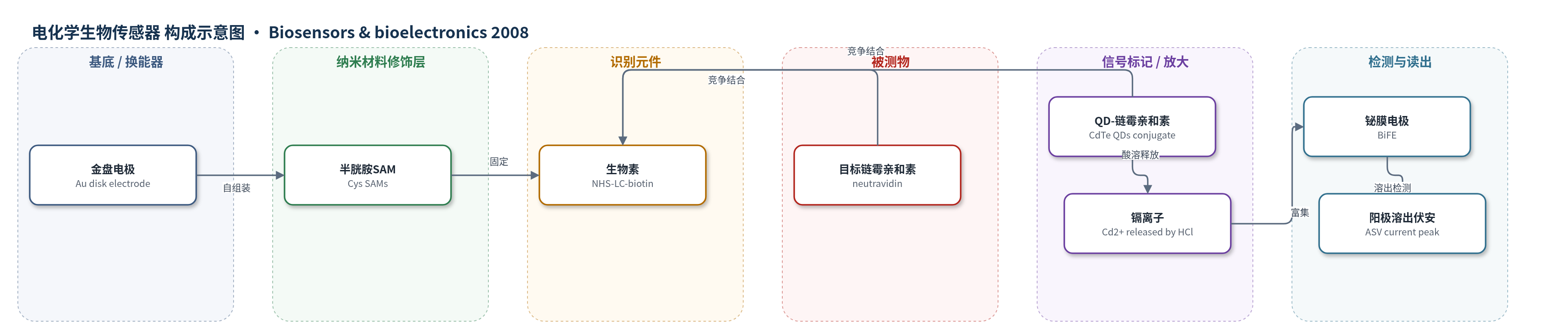
点击图片查看大图 · 依据论文自动绘制
传感器类型
电化学生物传感器
检测对象
链霉亲和素(neutravidin),样品基质:PBS/醋酸缓冲液
检测原理
金电极表面先形成半胱胺自组装单分子层,再共价固定生物素作为识别元件。检测时,目标链霉亲和素与 CdTe 量子点标记的链霉亲和素共同孵育,竞争结合有限的生物素位点。目标浓度越高,被电极捕获的量子点偶联物越少。随后用 1 M HCl 溶解捕获的 CdTe QDs,释放 Cd2+;Cd2+ 在铋膜电极上于 −1.2 V 富集 3 min,再经阳极溶出伏安扫描产生镉溶出峰。峰电流与捕获量子点量成正比,因此随目标链霉亲和素浓度升高而降低。量子点提供多金属信号和溶出富集放大。
检测灵敏度
LOD: 0.3 ng L−1 (5 nM);线性范围: 0.5–100 ng L−1;R = 0.994
效应效果
该传感器对链霉亲和素具有良好选择性,100 ng L−1 的辣根过氧化物酶(HRP)、血红蛋白(Hb)和肌红蛋白(Mb)均未引起明显电流变化。批间精密度为 4.2%(5 个电极测定 20 ng L−1),批内精密度 RSD 为 3.9%(单电极 5 次重复)。电极 4 ℃ 干燥保存 5 天内响应无明显下降,30 天后仍保留 90% 初始电流。检出限 5 nM 明显低于此前碳糊电极方法的 120 nM。一步竞争法避免两步夹心法的繁琐步骤,作者认为其快速、简便、低成本,适用于蛋白分析。
传感器的构成
- 基底/换能器电极:金盘电极(Au disk electrode),提供导电基底并用于固定识别元件
- 自组装修饰层:半胱胺自组装单分子层(Cys SAMs),在金表面形成含氨基有序单层,用于连接生物素
- 识别元件:生物素(biotin,NHS-LC-biotin),通过氨基与半胱胺反应固定,作为链霉亲和素结合位点
- 信号标记/竞争探针:CdTe 量子点-链霉亲和素偶联物(CdTe QDs–neutravidin conjugate),与目标链霉亲和素竞争结合生物素并提供镉信号
- 溶解/释放试剂:1 M HCl,溶解捕获的 CdTe QDs 并释放 Cd2+
- 检测换能层:铋膜电极(BiFE),在 −1.2 V 富集 Cd2+ 后进行阳极溶出伏安检测
- 抗非特异吸附/封闭:牛血清白蛋白(BSA,0.04%),降低非特异吸附并稳定偶联物
中文摘要
本文报道了一种基于碲化镉量子点(CdTe QDs)的电化学生物传感器,用于识别模型蛋白链霉亲和素(neutravidin)。该传感器将生物素作为识别元件,通过半胱胺自组装单分子层固定于金电极表面;捕获的量子点-链霉亲和素偶联物经 1 M HCl 溶解后释放镉离子,并在铋膜电极(BiFE)上于 −1.2 V 富集 3 min,随后用阳极溶出伏安法(ASV)定量金属成分。电化学阻抗谱和原子力显微镜证实了修饰过程。CdTe QDs 作为信号标签,可放大输出并监测标记链霉亲和素与目标链霉亲和素对有限生物素结合位点的竞争程度。竞争机制下,镉溶出电流峰随目标链霉亲和素浓度升高而降低。优化条件下,响应在 0.5–100 ng L−1 范围内高度线性,检出限为 0.3 ng L−1(5 nM)。与两步夹心法相比,该一步竞争法更准确、灵敏,有望用于快速、简便、低成本的蛋白分析。
英文摘要
CdTe quantum dots (QDs)-based electrochemical sensor for recognition of neutravidin, as a model protein, using anodic stripping voltammetry at electrodeposited bismuth film is presented. This biosensor involves the immobilization of the captured QDs conjugates which was dissolved with 1M HCl solution to release cadmium ions and metal components were quantified by anodic stripping voltammetry after a 3-min accumulation at -1.2V on bismuth-film electrode (BiFE) of the biotin, served as recognition element, onto the gold surface in connection with a cysteamine self-assembled monolayer. The modification procedure was characterized by electrochemical impedance spectroscopy and atomic force microscopy. We exploit QDs as labels for amplifying signal output and monitoring the extent of competition process between CdTe-labeled neutravidin and the target neutravidin for the limited binding sites on biotin. As expected for the competitive mechanism, the recognition event thus yields distinct cadmium stripping voltammetric current peak, whose response decreases upon increasing the level of target neutravidin concentrations. Under optimal conditions, the voltammetric response is highly linear over the range of 0.5-100 ngL(-1) neutravidin and the limit of detection is estimated to be 0.3 ngL(-1) (5 nM). Unlike earlier two-step sandwich bioassays, the present protocol relies on a one-step competitive assay, which is more accurate and sensitive, showing great promise for rapid, simple and cost-effective analysis of protein.