组成图示
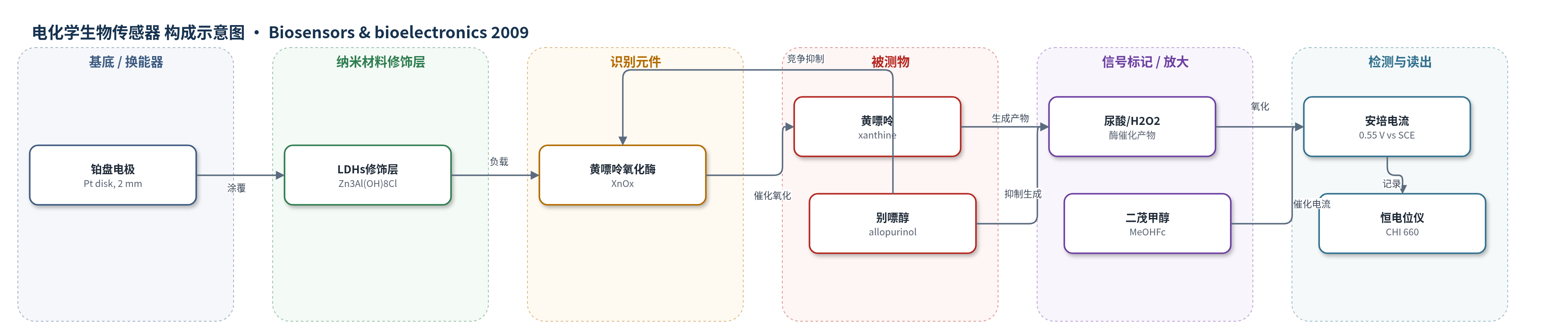
点击图片查看大图 · 依据论文自动绘制
传感器类型
电化学生物传感器
检测对象
黄嘌呤 (xanthine)、别嘌醇 (allopurinol,抑制法);样品基质:0.05 M PBS (pH 7.5) 含 2 mM EDTA,文中提及可应用于血液、血浆、尿液及肉类/鱼类食品
检测原理
黄嘌呤进入XnOx/LDHs修饰电极后,被固定化黄嘌呤氧化酶(XnOx)催化氧化为尿酸(UA)和过氧化氢(H2O2),同时氧气被还原。在+0.55 V(vs SCE)恒电位下,酶促生成的尿酸和H2O2在工作电极表面发生电化学氧化,产生与黄嘌呤浓度成正比的安培电流。LDHs层状结构在溶液中溶胀,形成亲水凝胶,具有高孔隙率和阴离子交换能力,可促进底物扩散、酶活性保持及阴离子产物富集,从而提高灵敏度。在别嘌醇抑制实验中,别嘌醇与黄嘌呤竞争XnOx活性位点,减少UA/H2O2生成,使电流下降;二茂甲醇(MeOHFc)作为可逆氧化还原介质,用于监测催化电流变化。
检测灵敏度
LOD: 1 × 10⁻⁷ M (S/N = 3);线性范围: 1 × 10⁻⁶ M–2 × 10⁻⁴ M;灵敏度: 220 mA M−1 cm−2 (6.6 mA M−1)
效应效果
该传感器重现性良好,8个电极测定黄嘌呤的RSD为4.5%;70次连续测定200 μM黄嘌呤的RSD为5.0%;4 ℃保存15天无明显失活,52天后仍保留约80%响应。抗干扰方面,0.1 mM抗坏血酸和尿酸分别造成25%和30%干扰。其检出限0.1 μM低于HPLC(3.2 μM、0.2 μM)和HPCE(0.5 μM),灵敏度220 mA M−1 cm−2,约为超分子组装传感器的27倍,高于聚TTCA(5.35 mA M−1)和聚吡咯/金胶体(5.01 mA M−1)。别嘌醇抑制呈准可逆竞争性,洗涤后保留85%响应,IC50为310 μM。未报告实际样品加标回收率。
传感器的构成
- 工作电极基底:铂盘电极(Pt disk electrode,直径2 mm),作为电化学换能器
- 纳米材料修饰层:层状双氢氧化物(LDHs,Zn3Al(OH)8Cl,[Zn3–Al–Cl])胶体涂覆,提供阴离子交换、高孔隙、溶胀和稳定微环境
- 识别元件:黄嘌呤氧化酶(XnOx,EC 1.1.3.22),催化黄嘌呤氧化生成尿酸和H2O2
- 交联固定剂:戊二醛(glutaraldehyde)饱和蒸气处理,使相邻酶分子部分共价交联,增强生物涂层
- 电解质缓冲液:0.05 M PBS(pH 7.5)含2 mM EDTA,维持酶活性与电导
- 电子介质(抑制实验):二茂甲醇(MeOHFc,0.1 mM),作为可逆氧化还原探针指示酶催化电流
中文摘要
黄嘌呤测定在临床诊断和食品质量控制中具有重要意义。本文报道了一种基于层状双氢氧化物(LDHs)负载黄嘌呤氧化酶(XnOx)的新型黄嘌呤生物传感器。LDHs具有化学惰性、机械与热稳定性、阴离子交换能力、高孔隙率和溶胀特性,可为酶提供生物相容性微环境。在0.55 V(对饱和甘汞电极,SCE)下对黄嘌呤进行安培检测。该传感器在1×10⁻⁶ M至2×10⁻⁴ M范围内对黄嘌呤呈线性响应,灵敏度为220 mA M−1 cm−2,检出限为1×10⁻⁷ M(S/N=3)。原子力显微镜在空气和液体环境中表征了XnOx/LDHs膜,观察到LDHs的溶胀现象。利用该传感器研究了别嘌醇对XnOx的抑制作用,结果表明别嘌醇以准可逆竞争性方式抑制酶活性。
英文摘要
The determination of xanthine has considerable importance in clinical and food quality control. Therefore, in this present work, we developed a novel xanthine biosensor based on immobilization of xanthine oxidase (XnOx) by attractive materials layered double hydroxides (LDHs). Amperometric detection of xanthine was evaluated by holding the modified electrode at 0.55V (versus saturated calomel electrode (SCE)). Due to the special properties of LDHs, such as chemical inertia, mechanical and thermal stability, anionic exchange ability, high porosity and swelling properties, XnOx/LDHs-modified electrode exhibited a developed analytical performance. The biosensor provided a linear response to xanthine over a concentration range of 1 x 10(-6)M to 2 x 10(-4)M with a sensitivity of 220 mAM(-1)cm(-2) and a detection limit of 1x10(-7)M based on S/N=3. In addition, the immobilized XnOx layers have been characterized using atomic force microscopy under both air atmosphere and liquid environment, which exhibited the interesting swelling phenomenon of LDHs. The investigation of inhibition of XnOx by allopurinol was carried out using this XnOx/LDHs-modified electrode. The experimental results indicated that inhibitory effect could be achieved by allopurinol with a quasi-reversible competitive type.