组成图示
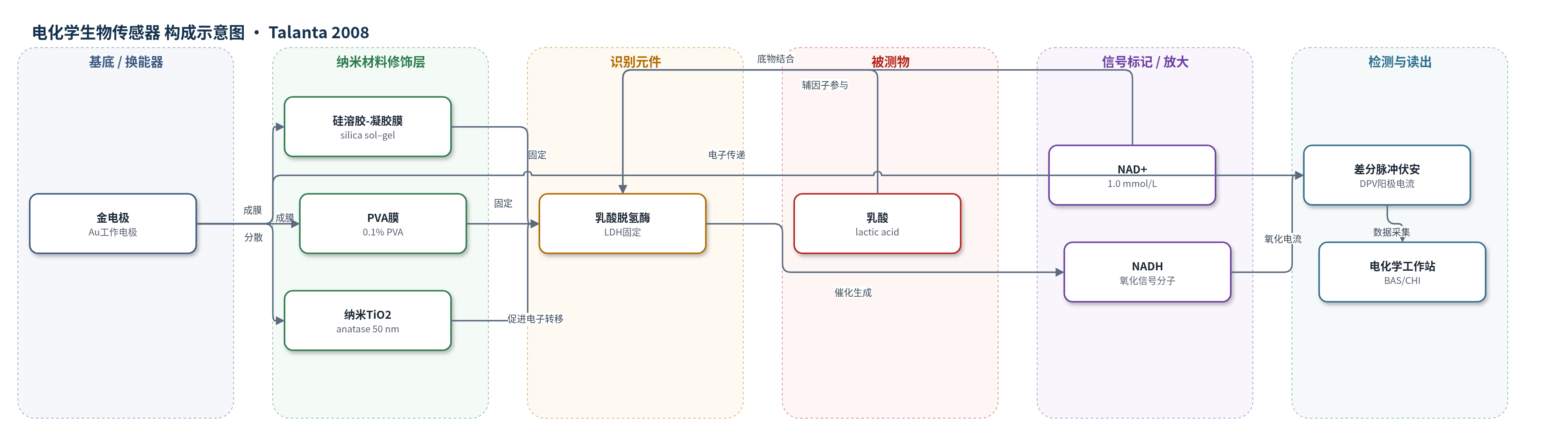
点击图片查看大图 · 依据论文自动绘制
传感器类型
电化学生物传感器
检测对象
乳酸(lactic acid/lactate);样品基质:PBS缓冲液(0.03 mol/L,pH 7.0,37 °C,含1.0 mmol/L NAD+)
检测原理
该传感器以金电极为换能器,LDH固定于硅溶胶-凝胶/PVA/纳米TiO2复合膜中。纳米TiO2改善LDH在电极界面的取向与电子通路,使LDH与金电极间发生准可逆直接电子转移。检测时,乳酸作为底物进入膜内,在LDH催化下与NAD+反应生成丙酮酸和NADH;生成的NADH在电极表面被氧化,产生阳极电流。乳酸浓度越高,NADH生成量越多,差分脉冲伏安阳极电流越大,从而实现定量。该过程属于酶催化间接电化学检测,纳米TiO2通过促进电子转移、提高酶活性和底物亲和力增强信号。
检测灵敏度
LOD: 0.4 μmol L−1;线性范围: 1.0–20 μmol L−1;灵敏度: 0.0493 μA/(μmol L−1);R^2 = 0.9988
效应效果
该传感器在pH 7.0、37 °C下表现最佳。电极制备重现性良好,阴极峰电流相对标准偏差为5.6%(n=8);连续测定乳酸的相对标准偏差为7.5%(n=5)。4 °C储存1周后保留约92%初始直接电化学信号,1个月后保留约86%;间歇使用1个月后乳酸催化响应保留约85%。与未加nano-TiO2的LDH电极相比,乳酸检出限由2.0 μmol/L降至0.4 μmol/L,表观米氏常数由6.4 μmol/L降至2.2 μmol/L,表明nano-TiO2提高了酶活性和底物亲和力。论文未报告选择性、抗干扰、实际样品回收率或与ELISA/HPLC/qPCR的对比,但作者认为该电极稳定、灵敏,可用于乳酸测定及生物系统机制研究。
传感器的构成
- 基底/换能器电极:金电极(Au electrode,直径2 mm),经抛光、Piranha溶液和电化学预处理,作为工作电极。
- 溶胶-凝胶基质:硅溶胶(silica sol–gel,由Na2SiO3·9H2O制备)与0.1%聚乙烯醇(PVA)混合成膜,提供三维固定环境并提高稳定性。
- 纳米促进层:纳米二氧化钛(nano-TiO2,anatase,50 nm),分散于修饰液中,促进LDH与金电极间直接电子转移并减少酶变性。
- 识别元件:L-乳酸脱氢酶(l-LDH,bovine heart),固定于溶胶-凝胶/PVA/TiO2膜中,催化乳酸与NAD+反应。
- 辅因子/信号分子:NAD+(1.0 mmol/L,溶液中加入),参与LDH催化反应并生成NADH;NADH氧化产生阳极电流。
- 缓冲介质:磷酸盐缓冲液(PBS,0.03 mol/L,pH 7.0,37 °C,N2除氧),维持酶活性与电化学测量环境。
中文摘要
本文研究了纳米二氧化钛(nano-TiO2,50 nm)对乳酸脱氢酶(LDH)与硅溶胶-凝胶修饰金电极之间直接电子转移的促进作用。将nano-TiO2加入硅溶胶-凝胶/聚乙烯醇(PVA)修饰过程中,制备了nano-TiO2-LDH电极。循环伏安法显示该电极呈现一对准可逆氧化还原峰,形式电位为70 mV(vs. SCE);与仅LDH修饰电极只出现不可逆阴极峰相比,出现阳极峰且阴极峰正移,表明nano-TiO2显著增强了LDH的直接电化学。作者推测该直接电化学可能源于LDH分子中某些电活性氨基酸的氧化还原反应。扫描电镜结果表明LDH成功固定于溶胶-凝胶基质中,并与nano-TiO2存在相互作用。该电极可用于乳酸测定,校准范围为1.0–20 μmol/L,检出限为0.4 μmol/L;表观米氏常数Kapp_m为2.2 μmol/L,说明固定化LDH具有较高的酶活性和对乳酸的良好亲和力。
英文摘要
The promotion effect of titania nanoparticles (nano-TiO(2)) on the direct electron transfer between lactate dehydrogenase (LDH) and the silica sol-gel modified gold electrode was investigated by adding nano-TiO(2) (50 nm) in the modification process. This nano-TiO(2)-LDH electrode showed a pair of quasi-reversible cyclic voltammetry peaks with the formal potential of 70 mV (vs. SCE). Compared to the previous result of LDH modified electrode with only an irreversible cathodic peak, an anodic peak appeared and the cathodic peak potential shifted to the positive direction on this nano-TiO(2)-LDH electrode, which demonstrated that the direct electrochemistry of LDH was enhanced by nano-TiO(2). We supposed that the direct electrochemistry of LDH may be due to the redox reaction of some electroactive amino acids in the LDH molecule. The surface morphologies of electrodes characterized by SEM indicated that LDH was successfully immobilized on the sol-gel matrix and also had some interactions with nano-TiO(2). This electrode can be used as a biosensor for the determination of lactic acid. The calibration range of lactic acid was from 1.0 to 20 micromolL(-1) and the detection limit was 0.4 micromolL(-1). Meanwhile, the small K(m)(app) value (2.2 micromolL(-1)) suggested that LDH possessed high enzymatic activity and good affinity to lactic acid owing to the promotion effect of nano-TiO(2).