组成图示
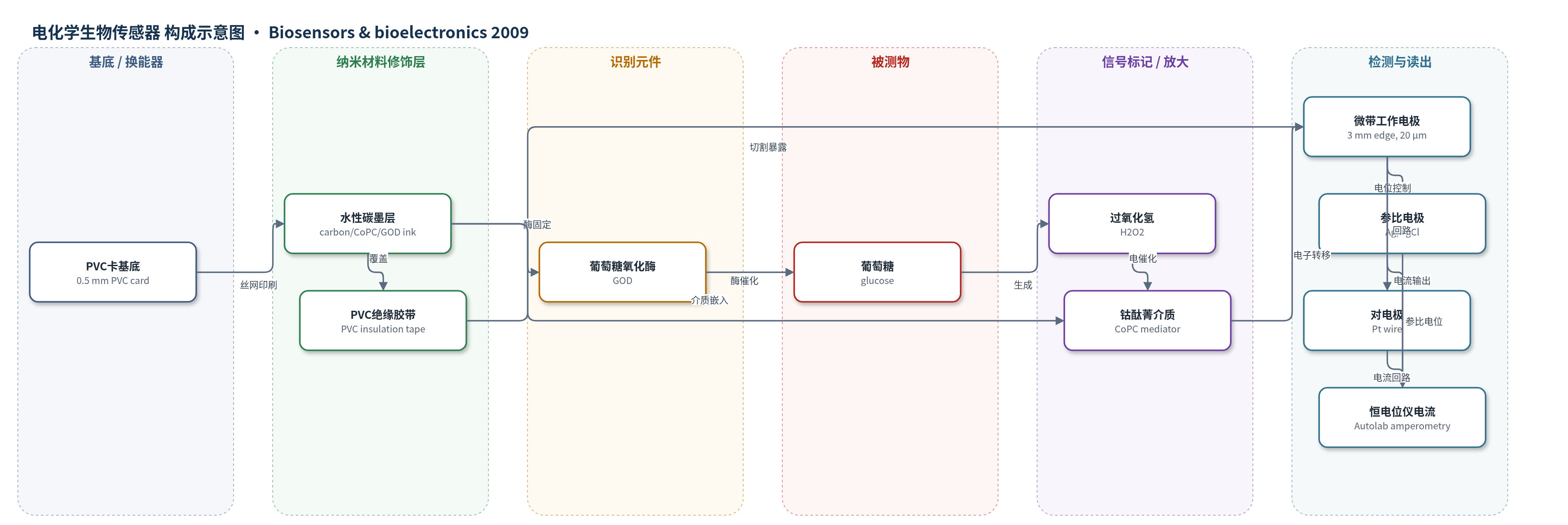
点击图片查看大图 · 依据论文自动绘制
传感器类型
电化学生物传感器
检测对象
葡萄糖(glucose);样品基质:磷酸盐缓冲液、人血清(human serum)
检测原理
葡萄糖氧化酶(GOD)特异性催化葡萄糖与氧气反应生成葡萄糖内酯和过氧化氢(H2O2)。H2O2在钴酞菁(CoPC)中心Co2+作用下发生电催化氧化,生成Co+;Co+在+0.4 V(vs Ag/AgCl)工作电位下被重新氧化为Co2+并释放电子,形成安培电流。由于工作电极被切割为3 mm长、20 μm厚的微带边缘,至少一维小于50 μm,传质以径向扩散为主,在静置溶液中可获得稳态电流。稳态电流随葡萄糖浓度增加而线性增大,低工作电位可抑制血清中其他电活性物质干扰。
检测灵敏度
LOD: 0.27 mM;线性范围: 0.27–2.0 mM;工作范围: >7 mM;灵敏度: 26 nA/mM(搅拌)、10 nA/mM(静置)、16.4 nA/mM(pH 9.0)
效应效果
传感器在+0.4 V低电位下工作,可抑制血清中电活性干扰物;血清未改变校准斜率,表明无明显基质效应,并用热灭活酶空白扣除干扰电流。静置条件下连续8 h保持完全活性。重复传感器精密度(CV)在缓冲液中为2.2%–11.1%,在人血清中为6.2%–10.7%;标准添加法CV分别为7.0%和3.8%。人血清内源葡萄糖测得5.4 mM,与分光光度法5.7 mM一致;加标5 mM后测得10.4 mM,回收率100%。作者认为该微带传感器制备简单、成本低,适合静置、低电流实时监测和连续过程监测。
传感器的构成
- 基底:0.5 mm厚预收缩PVC卡(PVC card),承载丝网印刷电极
- 工作电极/换能器:丝网印刷水性碳墨(water-based carbon ink),含碳、粘结剂、CoPC和GOD,形成2 mm宽导电轨道和方形工作区,厚约20 μm
- 氧化还原介质:钴酞菁(CoPC),电催化氧化GOD产生的H2O2,降低工作电位
- 识别元件:葡萄糖氧化酶(GOD),特异性催化葡萄糖氧化生成H2O2
- 绝缘层:PVC绝缘胶带(PVC insulation tape),覆盖工作区大部分,切割后形成微带边缘
- 参比电极:丝网印刷Ag/AgCl墨(Ag/AgCl ink, 60:40),提供参比电位
- 对电极:Pt线(Pt wire counter electrode),完成三电极回路
- 微带结构:横向切割暴露3 mm长、20 μm厚工作电极边缘,几何面积0.06 mm2
中文摘要
通过丝网印刷含钴酞菁(CoPC)氧化还原介质和葡萄糖氧化酶(GOD)的水性碳墨,制备微带葡萄糖生物传感器,随后对厚约20 μm的膜进行绝缘和切割,暴露3 mm长工作电极边缘。在25 °C下研究其葡萄糖分析性能。含葡萄糖缓冲液中的伏安法表明,+0.4 V(vs Ag/AgCl)在搅拌和静置条件下均适合分析。考察pH影响并选择工作pH 8.0。静置条件下获得稳态响应,表明以径向扩散为主的混合传质机制,具有微电极行为。校准研究显示,稳态电流与葡萄糖浓度在检出限0.27 mM至2.0 mM范围内线性相关,重复传感器精密度为6.2%–10.7%。用于人血清葡萄糖测定时,结果与分光光度法比较良好。该工作展示了制备葡萄糖生物传感器的简便方法,适用于低电流、静置条件下实时监测。
英文摘要
Microband glucose biosensors were fabricated by screen-printing a water-based carbon ink formulation containing cobalt phthalocyanine redox mediator and glucose oxidase (GOD) enzyme, then insulating and sectioning through the thick (20mum) film to expose a 3mm-long working electrode edge. The performance of these biosensors for glucose analysis was investigated at 25 degrees C. Voltammetry in glucose-containing buffer solutions established that an operating potential of +0.4V vs. Ag/AgCl was suitable for analysis under both stirring and quiescent conditions. The influence of pH on biosensor performance was established and an operational pH of 8.0 was selected. Steady-state responses were obtained under quiescent conditions, suggesting a mixed mechanism predominated by radial diffusion, indicative of microelectrode behaviour. Calibration studies obtained with these biosensors showed steady-state currents that were linearly dependent on glucose concentration from the limit of detection (0.27mM) up to 2.0mM, with a precision for replicate biosensors of 6.2-10.7%. When applied to the determination of glucose in human serum, the concentration compared favourably to that determined by a spectroscopic method. These results have demonstrated a simple means of fabricating biosensors for glucose measurement and determination in situations where low-current real-time monitoring under quiescent conditions would be desirable.