组成图示
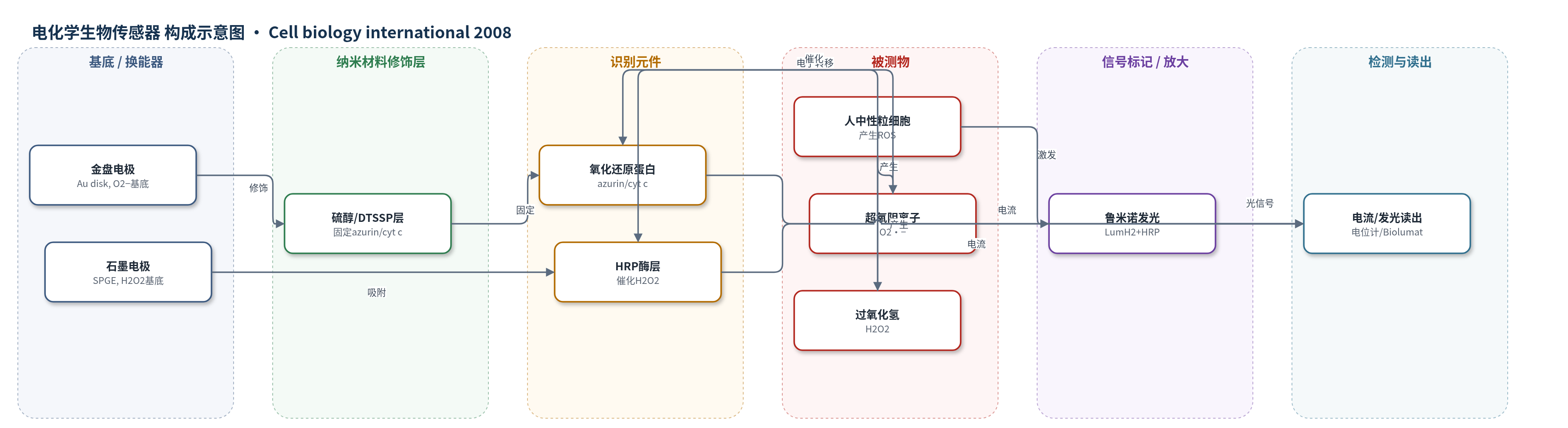
点击图片查看大图 · 依据论文自动绘制
传感器类型
电化学生物传感器
检测对象
人中性粒细胞释放的超氧阴离子自由基(superoxide anion radical, O2•−)、过氧化氢(hydrogen peroxide, H2O2);样品基质为 KRG/PBS 细胞悬液。
检测原理
人中性粒细胞在 fMLF 刺激或温度应激下经 NADPH 氧化酶产生 O2•−,部分 O2•− 在胞外自发歧化为 H2O2。O2•− 传感器中,O2•− 与金电极表面固定的 azurin 或 cyt c 发生直接电子转移,使氧化还原蛋白状态改变,并在固定电位下产生安培电流;由于 O2•− 半衰期短,主要反映贴近电极的细胞释放。H2O2 传感器中,H2O2 被 HRP 催化还原,电子经 HRP 传递至石墨电极,产生与 H2O2 浓度相关的还原电流。鲁米诺化学发光通道中,ROS(在 HRP 催化下主要为 O2•−)氧化 LumH2,生成激发态产物并发射光,光强反映胞内外总 ROS。两通道同步记录,可区分胞外 O2•−/H2O2 与总 ROS。
检测灵敏度
灵敏度(Sensitivity, A m−2 M−1):HRP-SPGE 5.0×10^2;Azurin-DTSSP 6.0×10^2;Cyt-DTSSP 0.5×10^2;Cyt-MU 2.5×10^2。
效应效果
HRP-SPGE 对 H2O2 选择性良好,加入过氧化氢酶后电流迅速回到背景;azurin/cyt c 电极对 O2•− 的响应可被超氧化物歧化酶显著降低,但因细胞贴附的空间位阻未完全回到背景。DPI 抑制 NADPH 氧化酶后,总化学发光面积降低超过 150 倍,最大光信号降低约 70 倍,而 H2O2 总量仅降低约 10 倍、安培峰仅降低约 2 倍,表明抑制后细胞主要释放 H2O2。稳定性:HRP-SPGE >8 h、Azurin-DTSSP 约 5 h、Cyt-DTSSP 6–8 h、Cyt-MU 约 8 h。信号随细胞数在 1–5×10^6 cells/ml 变化,O2•− 响应在高细胞密度下饱和。作者认为可用于多种细胞和组织中 ROS 及其他代谢物研究。
传感器的构成
- 基底/换能器电极:金盘电极(Au disk, Bioanalytical Systems MF-2014)或光谱石墨电极(SPGE),分别作为 O2•− 和 H2O2 安培检测的导电基底。
- 连接/自组装层:DTSSP 修饰金表面或 11-巯基-1-十一烷醇(MU)长链硫醇层,用于共价或吸附固定氧化还原蛋白。
- 识别/电子介导元件:铜蓝蛋白(azurin)或细胞色素 c(cyt c),通过直接电子转移响应 O2•−。
- 识别/催化元件:辣根过氧化物酶(HRP),吸附于石墨电极表面,催化 H2O2 还原并传递电子。
- 光学信号试剂:鲁米诺(LumH2)与 HRP,在 ROS 存在下发生氧化发光,提供总 ROS 化学发光信号。
- 缓冲介质:Krebs-Ringer 磷酸盐缓冲液(KRG)或 PBS,维持中性粒细胞活性和电化学/光学测量环境。
中文摘要
本文报道了一种同时采用光学与电化学方法检测人中性粒细胞产生的活性氧(ROS)的新方法。该系统将鲁米诺(LumH2)依赖的化学发光测定与两种安培生物传感器联用,分别对超氧阴离子自由基(O2•−)和过氧化氢(H2O2)敏感。方法可实时、直接地体外测定刺激后中性粒细胞胞内外释放的 O2•− 和 H2O2。计算表明,受刺激中性粒细胞的 O2•− 产生速率约为 10−17 mol·s−1·cell−1;当 NADPH 氧化酶被抑制时,细胞主要释放 H2O2 而非 O2•−,速率约为 3×10⁻¹⁸ mol·s−1·cell−1。中性粒细胞与氧化还原蛋白修饰金电极直接接触可诱发局部呼吸爆发,使 fMLF 刺激后 O2•− 安培响应增加不明显;而基于辣根过氧化物酶(HRP)修饰石墨电极的 H2O2 传感器能反映体相 H2O2 浓度。作者认为该系统经轻微电极修饰即可用于其他细胞类型和组织中多种代谢物的检测。
英文摘要
A novel approach for the simultaneous optical and electrochemical detection of biologically produced reactive oxygen species has been developed and applied. The set-up consists of a luminol-dependent chemiluminescence assay combined with two amperometric biosensors sensitive to superoxide anion radicals (O(2)(-)) and hydrogen peroxide (H(2)O(2)), respectively. The method permits direct, real-time in vitro determination of both extra- and intracellular O(2)(-) and H(2)O(2) produced by human neutrophil granulocytes. The rate of O(2)(-) production by stimulated neutrophils was calculated to about 10(-17)mol s(-1) per single cell. With inhibited NADPH oxidase, a distinct extracellular release of H(2)O(2) instead of O(2)(-) was obtained from stimulated neutrophils with the rate of about 3 x 10(-18)mol s(-1) per single cell. When the H(2)O(2) release was discontinued, fast H(2)O(2) utilisation was observed. Direct interaction with and possibly attachment of neutrophils to redox protein-modified gold electrodes, resulted in a spontaneous respiratory burst in the population of cells closely associated to the electrode surface. Hence, further stimulation of human neutrophils with a potent receptor agonist (fMLF) did not significantly increase the O(2)(-) sensitive amperometric response. By contrast, the H(2)O(2) sensitive biosensor, based on an HRP-modified graphite electrode, was able to reflect the bulk concentration of H(2)O(2), produced by stimulated neutrophils and would be very useful in modestly equipped biomedical research laboratories. In summary, the system would also be appropriate for assessment of several other metabolites in different cell types, and tissues of varying complexity, with only minor electrode modifications.