组成图示
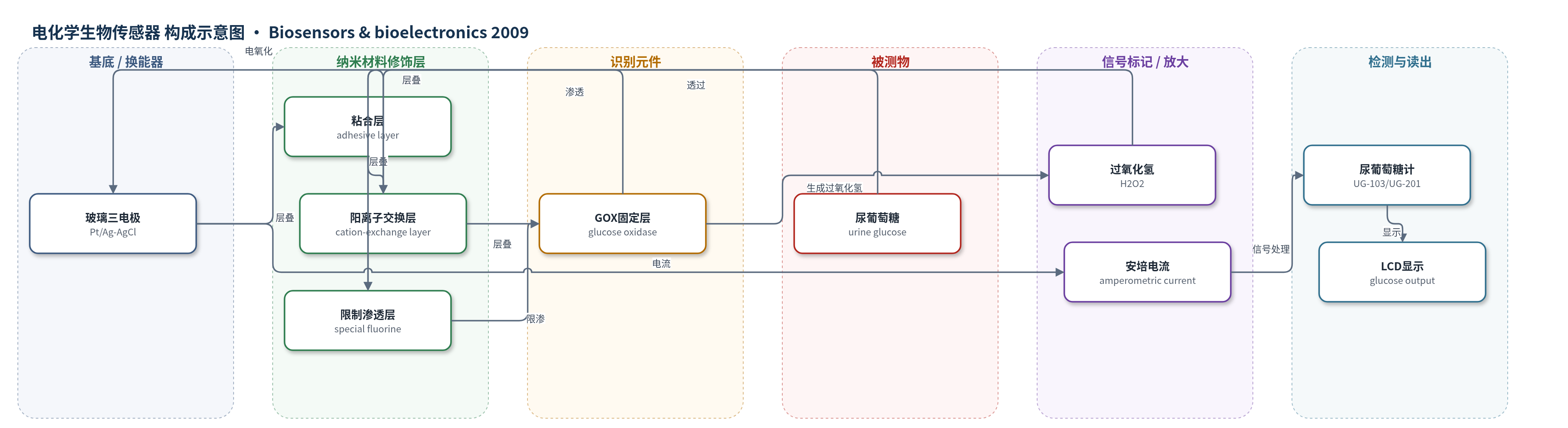
点击图片查看大图 · 依据论文自动绘制
传感器类型
电化学生物传感器
检测对象
尿葡萄糖(glucose in urine);样品基质:尿液
检测原理
尿样中的葡萄糖经顶部限制渗透层选择性进入酶固定层,葡萄糖氧化酶(GOX)催化葡萄糖与氧气反应生成葡萄糖内酯和过氧化氢。过氧化氢穿过阳离子交换层到达工作电极,在约450 mV(vs. Ag/AgCl)下发生氧化反应,释放电子形成安培电流;对电极同步进行还原反应。限制渗透层通过控制葡萄糖渗透速率,相当于对高浓度尿样进行稀释,从而扩展线性范围;阳离子交换层可阻挡抗坏血酸、对乙酰氨基酚等负电荷干扰物。葡萄糖浓度越高,生成的过氧化氢越多,工作电极电流越大,仪器据此换算尿葡萄糖浓度。
检测灵敏度
线性范围: 0–2000 mg dl−1;与临床分析仪线性关系: y = 0.968x + 40.4, R = 0.987 (N = 118)
效应效果
重复性良好,低、中、高浓度CV分别为3.6%、3.4%、3.6%,整体CV为2.0%;抗坏血酸<20 mg/dl或对乙酰氨基酚<15 mg/dl影响很小,30 mg/dl抗坏血酸使信号降4%,50 mg/dl降13%。8台仪器连续62天测500 mg/dl标准液,输出稳定。与临床分析仪A&T GA03R比较,y=0.968x+40.4,R=0.987(N=118),低浓度几乎无差异。临床显示餐后120 min尿葡萄糖可反映瞬时高血糖,如某受试者达658 mg/dl而血葡萄糖恢复至109 mg/dl;减少米饭后120 min尿葡萄糖降486–1439 mg/dl。作者认为可用于糖尿病和糖耐量异常患者餐后血糖管理。
传感器的构成
- 基底/换能器电极:玻璃基板上的平面三电极,工作电极与对电极为铂(Pt),参比电极为Ag/AgCl,用于过氧化氢电氧化与电位控制
- 粘合层:adhesive layer,增强有机膜与玻璃/电极的粘附
- 阳离子交换层:cation-exchanging layer,阻挡负电荷干扰物(抗坏血酸、对乙酰氨基酚)并传导过氧化氢
- 酶固定层:enzyme immobilized layer,固定葡萄糖氧化酶(GOX),催化葡萄糖生成过氧化氢
- 限制渗透层:restricted permeable layer,特殊氟材料(special fluorine),控制葡萄糖渗透并阻挡尿中粘附物,扩大线性范围
中文摘要
本文报道了一种基于安培葡萄糖传感器的高灵敏度尿葡萄糖计的开发与商业化应用。该传感器采用微平面工艺制备,通过固定葡萄糖氧化酶将尿中葡萄糖催化转化为过氧化氢,并在平面过氧化氢电极上进行安培检测。仪器具有0–2000 mg/dl的宽测量范围、6 s的快速响应时间,并能抵抗抗坏血酸和对乙酰氨基酚等尿中常见干扰物的影响。与已商品化的临床用尿葡萄糖分析仪比较,二者呈优良线性关系。作者利用该仪器对实际受试者餐后尿葡萄糖进行监测,评估其对餐后血糖水平的反映能力。结果表明,餐后120 min尿葡萄糖水平可作为糖尿病或糖耐量异常患者控制血糖的合适指标。此外,作者还开发了便携式尿葡萄糖计,期望其可在家庭或办公室以外场所灵活使用。
英文摘要
The highly sensitive urine glucose meter based on amperometric glucose sensor was developed and commercialized. It shows remarkable performances of wide measurement range in 0-2000 mgdl(-1), rapid response time as 6s and robustness against influence by interferents like ascorbic acid or acetaminophen. Correlation between the developed urine glucose meter and commercialized clinical-use urine glucose analyzer showed excellent linear relationship. The monitoring of postmeal blood glucose levels by assess of urine glucose of actual subjects was performed with the developed urine glucose meter. The experimental results suggest the urine glucose level 120 min following the meal should be the appropriate index for diabetes or impaired glucose tolerance to control blood glucose level. The new portable meter was developed, and is expected for flexible use at places other than home or office.