组成图示
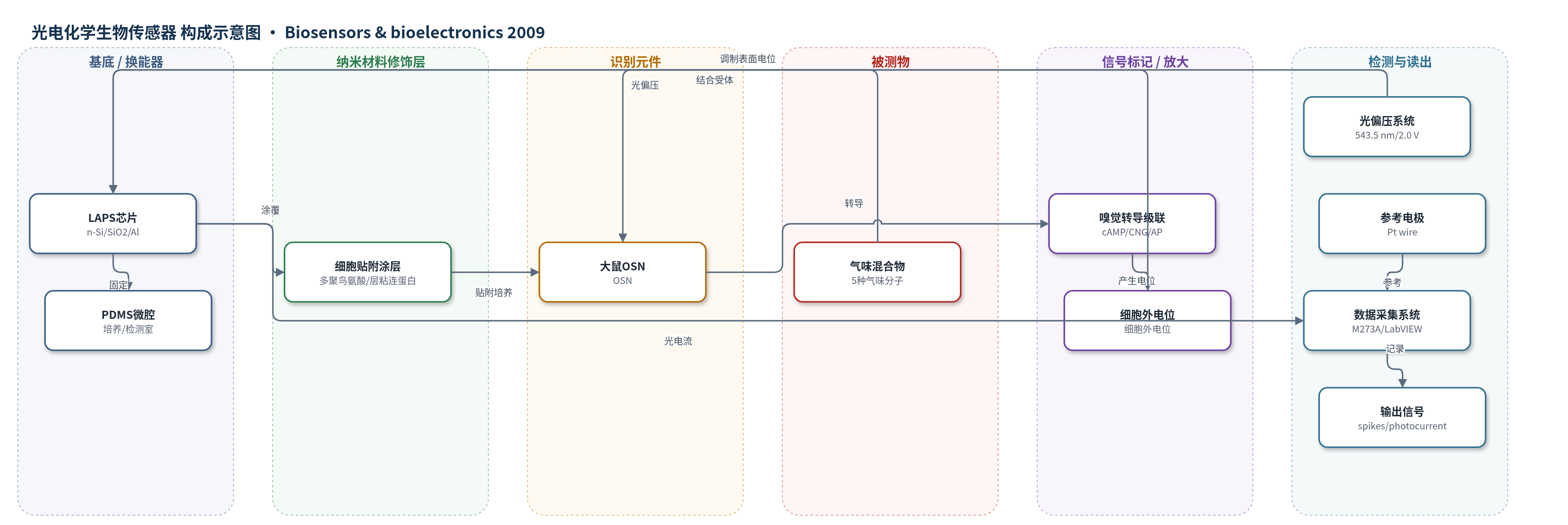
点击图片查看大图 · 依据论文自动绘制
传感器类型
光电化学生物传感器
检测对象
气味混合物(odor mixture:乙酸 acetic acid、辛醛 octanal、桉叶油素 cineole、己醛 hexanal、2-庚酮 2-heptanone),样品基质为哺乳动物 Ringer 溶液/细胞培养液
检测原理
气味分子与 OSN 树突纤毛上的嗅觉受体结合后,激活 G 蛋白并进一步激活腺苷酸环化酶(AC),使胞内 cAMP 升高;cAMP 打开环核苷酸门控阳离子通道(CNG),Ca2+ 内流并激活钙激活氯通道,最终产生动作电位。OSN 培养在 LAPS 的 SiO2/Si 表面,动作电位引起细胞外电位变化,改变 SiO2/Si 界面表面电位。在 543.5 nm 光照射和 2.0 V 偏压下,LAPS 耗尽层宽度随表面电位变化,导致交流光电流波动,经恒电位仪和数据采集系统读出。MDL12330A 抑制 AC 可降低反应,LY294002 抑制 PI3K 可增强反应,因此信号随气味刺激及通路调节而变化。
检测灵敏度
原文未报告 LOD、线性范围、灵敏度斜率或相关系数。
效应效果
该传感器可非侵入、长期记录单个 OSN 对气味混合物的电生理反应。84 个 OSN 中 26 个响应,MDL12330A 抑制效应在所有响应细胞中可见;62 个 OSN 中 17 个响应,LY294002 增强效应均可见。刺激后 firing spikes 为 55.2±4.95 spikes/5 s,高于对照 10.3±1.20 spikes/5 s(p=8.66×10⁻⁹);MDL12330A 处理后为 20.5±4.80 spikes/5 s(p=3.41×10⁻⁴)。LY294002 组刺激反应 13.3±1.30 spikes/s,对照 2.10±0.65 spikes/s(p=4.78×10−5),增强后 17.9±2.00 spikes/s(p=3.40×10−3)。信噪比约 3,低于 FET 系统可达 25,作者认为其非侵入、低成本,适合 OSN 电生理与嗅觉转导研究。
传感器的构成
- 基底/换能器:n型硅片(n-type Si, ⟨100⟩, 10–15 Ω cm)热氧化 SiO2(约30 nm)构成 EIS 结构,背面 Al 欧姆接触作工作电极,用于光寻址表面电位检测。
- 微腔:聚二甲基硅氧烷(PDMS)微腔,固定 LAPS 芯片并容纳培养液/刺激液,实现细胞培养与检测。
- 表面修饰层:多聚-L-鸟氨酸(poly-l-ornithine, 100 μg/ml)与层粘连蛋白(laminin, 8 μg/ml)1:1 混合涂覆,提高硅表面生物相容性并促进 OSN 贴附。
- 识别元件:大鼠嗅觉感觉神经元(OSNs),培养于 LAPS 表面,作为气味识别和动作电位产生元件。
- 刺激/被测物:气味混合物(odor mixture:乙酸 acetic acid、辛醛 octanal、桉叶油素 cineole、己醛 hexanal、2-庚酮 2-heptanone,各 0.1 mM,Ringer 溶液),用于激发 OSN 嗅觉转导。
- 参考电极:铂丝(Pt wire)浸入检测室溶液,作为电化学参考电极。
- 读出系统:He-Ne 激光(543.5 nm, 5 mW)、4 kHz 斩波器、2.0 V 偏压、恒电位仪(EG&G M273A)与 16 位数据采集卡/LabVIEW,用于记录交流光电流。
中文摘要
本文报道了一种基于光寻址电位传感器(LAPS)的新型仿生嗅觉生物传感器,用于研究嗅觉转导机制。该传感器以大鼠嗅觉感觉神经元(OSNs)作为传感元件,将其培养在 LAPS 芯片表面。为验证 LAPS 所记录电信号的来源,作者测试了腺苷酸环化酶特异性抑制剂 MDL12330A 对 OSNs 嗅觉信号的抑制作用,以及磷脂酰肌醇 3-激酶(PI3K)特异性抑制剂 LY294002 对 OSNs 反应的增强作用。结果表明,该混合生物传感器能够以非侵入方式长期、高效地记录 OSNs 对气味刺激的电生理反应,且这些反应可被 MDL12330A 抑制、被 LY294002 增强。上述结果证明该传感器可用于非侵入监测 OSNs 的电生理活动,并提示其可作为研究嗅觉转导机制、进行 OSNs 电生理或药物特征分析的有前景工具。
英文摘要
This paper presents a novel biomimetic olfactory biosensor for the study of olfactory transduction mechanisms on the basis of light addressable potentiometric sensor (LAPS), in which rat olfactory sensory neurons (OSNs) are used as sensing elements. Rat OSNs are cultured on the surface of LAPS chip. To validate the origin of the electrical signals recorded by LAPS, the inhibitory effect of MDL12330A to the olfactory signals of OSNs is tested, which is the specific inhibitor of adenylyl cyclase. The enhancive effect of LY294002 to the responses of OSNs is also investigated, which is the specific inhibitor of phosphatidylinositol 3-kinase (PI3K). The results show that this hybrid biosensor can record the responses of OSNs to odours efficiently in a non-invasive way for a long term, and the responses can be inhibited by MDL12330A and enhanced by LY294002. All these results demonstrate that this hybrid biosensor can be used to monitor electrophysiology of OSNs in a non-invasive way and suggest it could be a promising tool for the study of olfactory transduction mechanisms.