组成图示
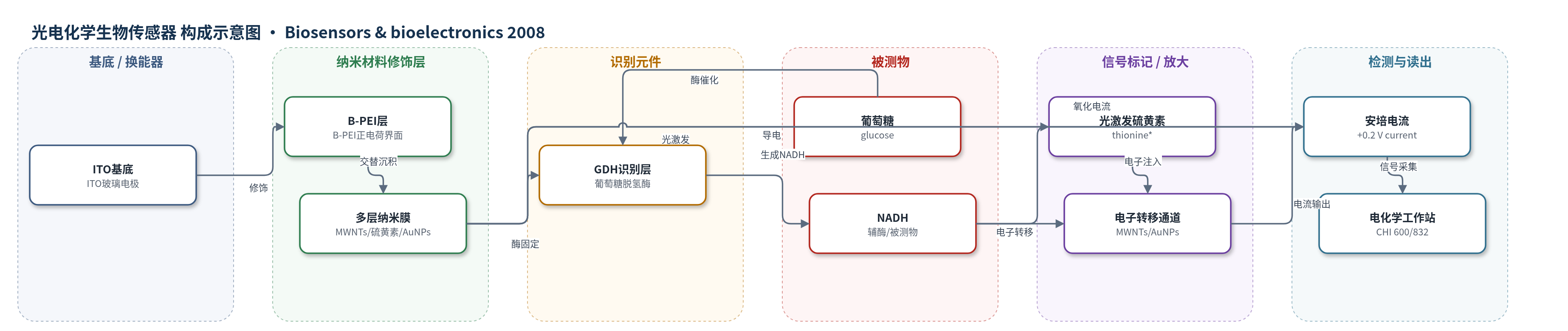
点击图片查看大图 · 依据论文自动绘制
传感器类型
光电化学生物传感器
检测对象
NADH(还原型烟酰胺腺嘌呤二核苷酸,NADH)、葡萄糖(glucose);样品基质:PBS缓冲液、健康成人尿液(pH调至7.5)。
检测原理
葡萄糖在GDH催化下被氧化,NAD+被还原为NADH;NADH在+0.2 V低电位下于多层膜表面发生电催化氧化,电子经MWNTs和AuNPs传导至ITO电极,产生阳极电流。硫黄素作为光敏交联剂,在可见光激发后产生光电压/光催化效应,激发态电子注入MWNTs,随后被NADH还原再生,从而加速NADH氧化并放大电流。间歇光照可逆切换光化学过程,使传感器在低、高响应状态间切换。
检测灵敏度
NADH(暗): LOD 0.1 μM;线性范围 0.5–237 μM;灵敏度 17 nA μM−1。NADH(光照): LOD 0.05 μM;线性范围 0.2–135 μM;灵敏度 115 nA μM−1。葡萄糖(暗): LOD 5.0 μM;线性范围 10 μM–2.56 mM;灵敏度 7.8 μA mM−1。葡萄糖(光照): LOD 0.7 μM;线性范围 1 μM–3.25 mM;灵敏度 18.5 μA mM−1。
效应效果
该传感器抗污性好,在2 mM NADH中浸泡30 min响应仅下降0.3%。NADH传感器六个电极校准斜率RSD为4.1%,葡萄糖传感器RSD为3.7%。NADH传感器4 ℃保存2个月响应下降5.2%;葡萄糖传感器保存30天保留96%,连续使用30天保留89.2%。葡萄糖响应时间约10 s。尿液加标回收率为95.0%、103.8%、98.8%和96.3%。光照使NADH灵敏度提高约7倍、检出限降低2倍,葡萄糖灵敏度提高约2倍、检出限降低7倍,表明其可用于光控脱氢酶生物传感器和生物燃料电池。
传感器的构成
- 基底/换能器电极:ITO玻璃(indium-doped tin oxide, ITO),经清洗提供负电荷表面,作为导电基底和电化学换能器。
- 阳离子界面层:B-PEI(branched-poly-ethylenimine,2 mg mL−1,0.1 M NaCl)浸渍,提供正电荷界面以启动层状组装。
- 纳米多层修饰层:(MWNTs/thionine/AuNPs)n(n=8)多层膜,MWNTs(multiwalled carbon nanotubes)提供导电通道和电子陷阱,Au NPs(gold nanoparticles)促进电子转移,thionine(硫黄素)作为交联剂和光敏染料。
- 识别元件:GDH(glucose dehydrogenase,1 mg mL−1,pH 3.0)吸附/包埋于多层膜中,催化葡萄糖氧化并产生NADH;NADH传感器中无酶识别,直接检测NADH。
- 信号放大/光调控元件:thionine(硫黄素)作为光敏染料和交联剂,在可见光激发下产生光电压/光催化氧化NADH,增强阳极电流并实现光开关。
- 辅因子/电解质:PBS(0.1 M,pH 7.5)含NAD+(5 mM)用于葡萄糖检测,作为GDH辅因子;NADH检测使用pH 7.0 PBS。
中文摘要
本文报道了一种基于硫黄素(thionine)交联多壁碳纳米管(MWNTs)和金纳米粒子(Au NPs)多层膜修饰的掺锡氧化铟(ITO)电极的NADH和葡萄糖生物传感器。该多层膜通过B-PEI界面和交替浸渍自组装形成,具有多孔导电结构,可固定葡萄糖脱氢酶(GDH)并促进NADH的低过电位氧化。在暗态下,NADH传感器在0.5–237 μM范围内线性响应,检出限0.1 μM,灵敏度17 nA μM−1;可见光照射后,灵敏度提高至115 nA μM−1,检出限降至0.05 μM,灵敏度约提高7倍。葡萄糖传感器在暗态下线性范围为10 μM–2.56 mM,灵敏度7.8 μA mM−1,检出限5.0 μM;光照后线性范围为1 μM–3.25 mM,灵敏度18.5 μA mM−1,检出限0.7 μM。结果表明,硫黄素的光电压效应可逆调控生物电催化性能,为光控脱氢酶生物电子器件提供了新途径。
英文摘要
A NADH and glucose biosensor based on thionine cross-linked multiwalled carbon nanotubes (MWNTs) and Au nanoparticles (Au NPs) multilayer functionalized indium-doped tin oxide (ITO) electrode were presented in this paper. The effect of light irradiation on the enhancement of bioelectrocatalytic processes of the biocatalytic systems by the photovoltaic effect was investigated. This bioelectrode exhibited excellent catalytic activity of the oxidation towards dihydronicotinamide adenine dinucleotide (NADH). Most interesting, the performance of this NADH sensor could be tuned by the visible light. When the biosensor was performed in the dark, the anodic current increased linearly with NADH concentration over the range from 0.5 to 237 microM with detection limit 0.1 microM and sensitivity 17 nA microM(-1). The sensitivity became 115 nA microM(-1) with detection limit 0.05 microM with the light irradiation. Compared with the reaction in dark, the sensitivity increased around 7 folds while the detection limit decreased 2 folds. The glucose biosensor also exhibited the same behavior. The linear range was from 10 microM to 2.56 mM with the sensitivity of 7.8 microAmM(-1) and detection limit 5.0 microM in the dark. After the light irradiation, the linear range was from 1 microM to 3.25 mM with the sensitivity of 18.5 microA mM(-1) and detection limit 0.7 microM. It indicated a potential to provide an operational access to develop new kinds of photocontrolled dehydrogenase enzyme-based bioelectronics.