组成图示
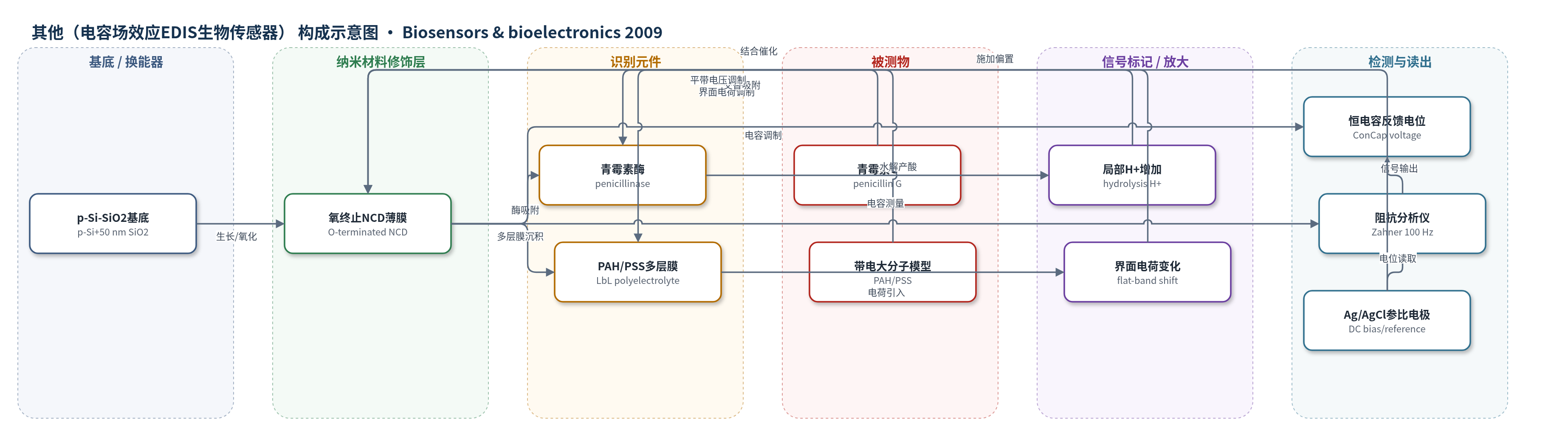
点击图片查看大图 · 依据论文自动绘制
传感器类型
其他(电容场效应EDIS生物传感器)
检测对象
pH(pH value)、青霉素G(penicillin G)、带电聚电解质(polyelectrolytes, PAH/PSS);样品基质:缓冲液(Titrisol、polymix或磷酸盐缓冲液,含100 mM KCl)
检测原理
氧终止NCD表面含有羟基,随溶液pH发生质子化或去质子化,形成pH依赖的表面电荷,并调制p-Si空间电荷区电容。恒电容(ConCap)模式通过反馈控制保持电容恒定,因此界面电位变化表现为反馈电位变化。青霉素检测中,吸附在NCD表面的青霉素酶催化青霉素G水解,释放H+,使NCD/溶液界面局部pH下降,表面电荷改变,平带电压和电容随之变化;反馈电压随青霉素浓度升高而增大,酶催化水解提供化学放大。聚电解质检测中,PAH和PSS逐层吸附在NCD表面,引入交替正负界面电荷,改变平带电压,ConCap信号呈锯齿状;随着层数增加,聚电解质内部离子屏蔽和电荷再分布使电位偏移逐渐减小。
检测灵敏度
pH灵敏度: 40 mV/pH;pH线性范围: pH 4–12;青霉素G LOD: 5 μM;青霉素G线性范围: 0.025–2.5 mM;青霉素G灵敏度: 65–70 mV/decade;两个月后青霉素G线性范围: 0.005–2.5 mM;两个月后青霉素G灵敏度: 32 mV/decade
效应效果
该EDIS平台在pH 4–12范围内平均灵敏度为40 mV/pH,响应时间t90%约60 s,高于SiO2的25–35 mV/pH,低于Si3N4、Al2O3和Ta2O5。青霉素传感器在两个月内完成超过30次周期检测,新制备传感器在0.025–2.5 mM青霉素G范围内灵敏度为65–70 mV/decade,检测限为5 μM;两个月后灵敏度降至约32 mV/decade,线性范围为0.005–2.5 mM,检测限仍为5 μM,响应时间2–4 min,略慢于Ta2O5门FET的0.5–3 min。聚电解质多层膜传感中,前几层电位偏移为35–40 mV,14–15层时降至2–4 mV。作者认为NCD具有化学惰性、生物相容性和无标记监测带电大分子的能力,适合多参数传感。
传感器的构成
- 基底/换能器电极:p-Si-SiO2衬底(50 nm热氧化SiO2)与背面Al接触层,提供半导体空间电荷电容和电接触。
- 换能薄膜:氧终止纳米晶金刚石(O-terminated NCD)薄膜(约100 nm),由微波等离子体增强CVD生长并经H2SO4/KNO3氧化处理,形成表面羟基,作为pH/电荷敏感界面。
- 识别元件(青霉素传感器):吸附固定的青霉素酶(penicillinase,β-lactamase,Bacillus cereus,Sigma),催化青霉素G水解。
- 识别/模型层(大分子传感):聚电解质多层膜(PAH/PSS LbL),正电PAH与负电PSS交替吸附,模拟带电大分子结合。
- 工作介质:缓冲液(Titrisol、polymix或磷酸盐缓冲液,含100 mM KCl),维持pH和离子强度。
- 参比/偏置电极:Ag/AgCl液接参比电极,施加直流偏置并作为电位参考。
- 信号读出:阻抗分析仪(Zahner Elektrik)恒电容(ConCap)模式,100 Hz、20 mV AC,监测反馈电位。
中文摘要
本文报道了一种电容场效应EDIS(电解质-金刚石-绝缘体-半导体)多参数传感平台,采用氧终止纳米晶金刚石(O-terminated NCD)薄膜作为换能材料,用于检测pH和青霉素浓度,并对聚电解质等带电大分子的吸附与结合进行无标记电学监测。NCD薄膜通过微波等离子体增强化学气相沉积生长在p-Si-SiO2基底上,并在氧化性介质中处理以获得氧终止表面。传感器采用恒电容法进行表征。氧终止NCD薄膜的平均pH灵敏度为40 mV/pH。对于吸附固定青霉素酶的EDIS青霉素生物传感器,获得了5 μM的低检测限和65–70 mV/decade的青霉素G高灵敏度。以正电PAH和负电PSS为模型体系,通过逐层沉积聚电解质多层膜后,观察到交替电位变化,且电位偏移随吸附层数增加而减小。文章讨论了所开发EDIS传感器的响应机制。
英文摘要
The feasibility of a capacitive field-effect EDIS (electrolyte-diamond-insulator-semiconductor) platform for multi-parameter sensing is demonstrated by realising EDIS sensors with an O-terminated nanocrystalline-diamond (NCD) film as transducer material for the detection of pH and penicillin concentration as well as for the label-free electrical monitoring of adsorption and binding of charged macromolecules, like polyelectrolytes. The NCD films were grown on p-Si-SiO(2) substrates by microwave plasma-enhanced chemical vapour deposition. To obtain O-terminated surfaces, the NCD films were treated in an oxidising medium. The NCD-based field-effect sensors have been characterised by means of constant-capacitance method. The average pH sensitivity of the O-terminated NCD film was 40 mV/pH. A low detection limit of 5 microM and a high penicillin G sensitivity of 65-70 mV/decade has been obtained for an EDIS penicillin biosensor with the adsorptively immobilised enzyme penicillinase. Alternating potential changes, having tendency to decrease with increasing the number of adsorbed polyelectrolyte layers, have been observed after the layer-by-layer deposition of polyelectrolyte multilayers, using positively charged PAH (poly (allylamine hydrochloride)) and a negatively charged PSS (poly (sodium 4-styrene sulfonate)) as a model system. The response mechanism of the developed EDIS sensors is discussed.