组成图示
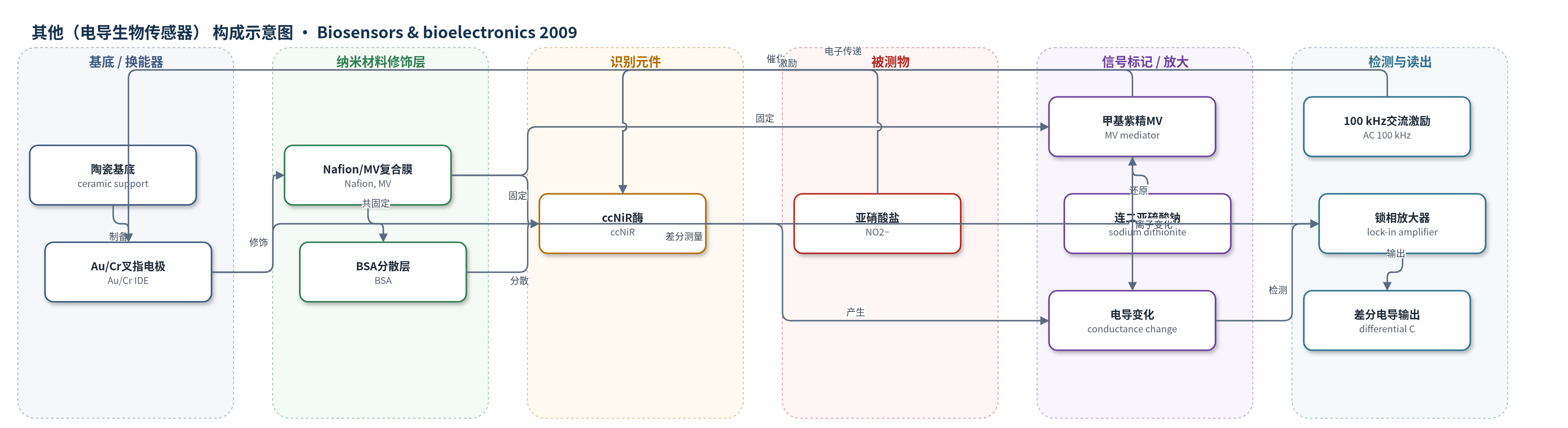
点击图片查看大图 · 依据论文自动绘制
传感器类型
其他(电导生物传感器)
检测对象
亚硝酸盐(nitrite, NO2−);样品基质:自然水样(法国河水/真实水样)
检测原理
该传感器以ccNiR为生物识别与催化元件。加入连二亚硫酸钠后,MV2+被还原为MV•+,MV•+将电子传递给ccNiR使其处于活性态,并催化亚硝酸盐还原:NO2−+6MV•++8H+→NH4++6MV2++2H2O。反应消耗H+并生成NH4+和MV2+,使酶膜内离子组成和局部电导发生变化。叉指电极施加100 kHz、10 mV交流信号,锁相放大器测量工作电极与参考电极之间的差分电导。亚硝酸盐浓度越高,酶促反应速率越快,膜内电导变化越大,稳态电导响应C=(Cn−C0)随之线性增加。Nafion通过离子交换固定MV并阻挡阴离子干扰,BSA分散酶分子,甘油维持膜湿度。
检测灵敏度
LOD: 0.05 μM;线性范围: 0.2–120 μM;灵敏度: 0.194 μS/μM [NO2−];回归方程: C (μS) = 0.1250 + 0.1972 [NO2−] (μM);R^2 = 0.9993
效应效果
传感器重现性良好,5个不同传感器灵敏度RSD约6%。在4 ℃、100 mM pH 7.6 PBS中保存1个月仍保持约75%初始响应。对NH4+、NO3−、Ca2+、SO42−、SO32−、CO32−、HCO3−(均50 μM)无明显或可忽略干扰(<5%)。四个法国真实水样加标回收率为105%–109%。与文献ccNiR安培传感器相比,本传感器线性范围0.2–120 μM、检出限0.05 μM、响应约10 s,兼具较宽线性范围、快速响应和较好稳定性,适合现场水样监测。
传感器的构成
- 基底/换能器电极:陶瓷基底上50 nm Cr/150 nm Au叉指电极,叉指宽度和间距20 μm,敏感面积约1.0 mm²,用于施加交流信号并测量电导。
- 绝缘层:环氧树脂覆盖芯片焊盘,用于绝缘和固定电极区域。
- 酶识别/催化层:ccNiR(细胞色素c亚硝酸盐还原酶)催化NO2−还原为NH4+,作为生物识别与催化元件。
- 分散/稳定蛋白:BSA(牛血清白蛋白)与ccNiR按1:1共固定,分散酶分子、保持适当间距并维持酶活性。
- 电子媒介层:MV(甲基紫精,10% w/v)作为人工电子媒介,传递电子并在Nafion中固定。
- 离子交换/阻隔膜:Nafion(3% v/v)磺酸型聚电解质,通过离子交换固定MV,限制阴离子干扰并允许NO2−适度渗透。
- 保湿保护剂:甘油(10% v/v)维持酶膜湿度并保护ccNiR活性。
- 交联固定剂:饱和GA(戊二醛)蒸气交联酶混合物,形成稳定酶膜。
- 外部电子供体:连二亚硫酸钠(sodium dithionite,1 mM)将MV2+还原为MV•+,启动酶促还原反应。
中文摘要
本文报道了一种用于检测亚硝酸盐的电导生物传感器。该传感器以从脱硫弧菌(Desulfovibrio desulfuricans ATCC 27774)中提取的细胞色素c亚硝酸盐还原酶(ccNiR)为识别元件,与牛血清白蛋白(BSA)、甲基紫精(MV)、Nafion和甘油混合后,通过饱和戊二醛(GA)蒸气交联固定在平面叉指电极上。研究优化了酶浓度、ccNiR/BSA比例、MV浓度和Nafion浓度,并考察了连二亚硫酸钠用量、工作缓冲液和温度对电导响应的影响。在室温(约25 ℃)最优条件下,传感器对亚硝酸盐响应迅速(约10 s),线性范围为0.2–120 μM,灵敏度为0.194 μS/μM [NO2−],检出限为0.05 μM,重现性良好(RSD 6%,n=5),表观米氏常数为338 μM。传感器在4 ℃、100 mM pH 7.6磷酸盐缓冲液中保存1个月仍保持良好稳定性,对自然水中常见离子无明显干扰,并可用于真实水样分析。
英文摘要
A conductometric biosensor for nitrite detection was developed using cytochrome c nitrite reductase (ccNiR) extracted from Desulfovibrio desulfuricans ATCC 27774 cells immobilized on a planar interdigitated electrode by cross-linking with saturated glutaraldehyde (GA) vapour in the presence of bovine serum albumin, methyl viologen (MV), Nafion, and glycerol. The configuration parameters for this biosensor, including the enzyme concentration, ccNiR/BSA ratio, MV concentration, and Nafion concentration, were optimized. Various experimental parameters, such as sodium dithionite added, working buffer solution, and temperature, were investigated with regard to their effect on the conductance response of the biosensor to nitrite. Under the optimum conditions at room temperature (about 25 degrees C), the conductometric biosensor showed a fast response to nitrite (about 10s) with a linear range of 0.2-120 microM, a sensitivity of 0.194 microS/microM [NO(2)(-)], and a detection limit of 0.05 microM. The biosensor also showed satisfactory reproducibility (relative standard deviation of 6%, n=5). The apparent Michaelis-Menten constant (K(M,app)) was 338 microM. When stored in potassium phosphate buffer (100mM, pH 7.6) at 4 degrees C, the biosensor showed good stability over 1 month. No obvious interference from other ionic species familiar in natural waters was detected. The application experiments show that the biosensor is suitable for use in real water samples.