组成图示
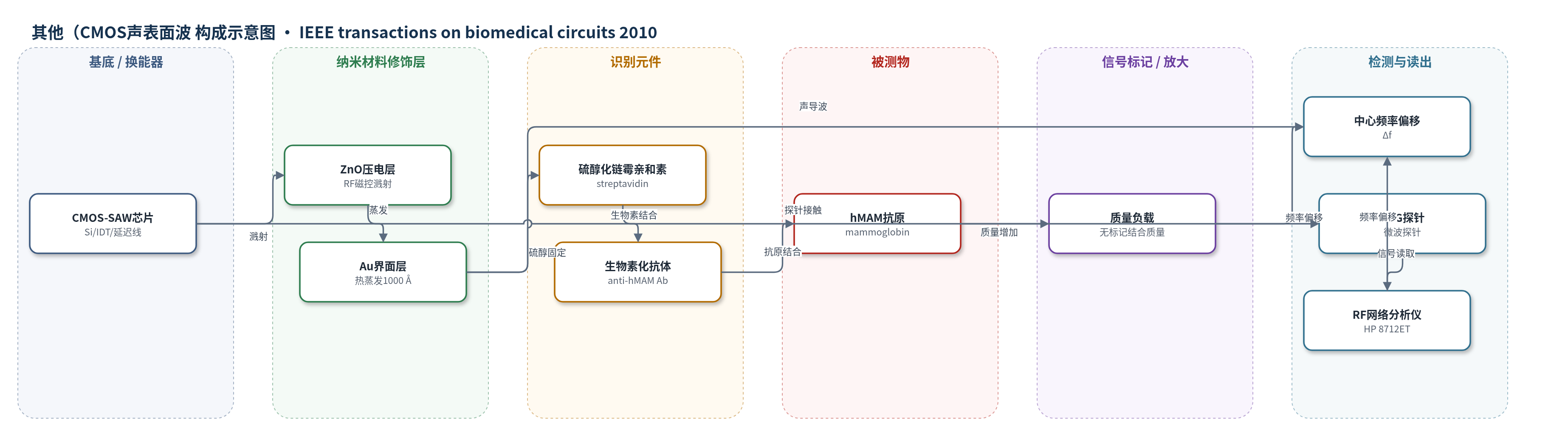
点击图片查看大图 · 依据论文自动绘制
传感器类型
其他(CMOS声表面波(SAW)生物传感器)
检测对象
人乳腺球蛋白(mammoglobin/mammaglobin,hMAM);样品基质:血清(应用目标)及PBS/缓冲液(实验)
检测原理
CMOS-SAW传感器通过输入IDT施加交变电压,在ZnO压电层表面激发声表面波,Au层作为声导波层增强表面相互作用。Au表面经硫醇化链霉亲和素固定,再结合生物素化抗hMAM抗体,形成识别层。当hMAM抗原与抗体特异性结合时,传感表面发生质量负载,改变SAW传播特性与谐振中心频率,通常表现为频率下降。RF网络分析仪通过GSG探针读取中心频率偏移,偏移量与结合质量及抗原浓度相关。该检测为无标记质量传感,未使用HCR、RCA或CRISPR-Cas等信号放大策略,选择性主要依赖抗体-抗原识别。
检测灵敏度
频率灵敏度: 8.704 pg/Hz(圆形器件);频率灵敏度: 12.495 pg/Hz(矩形器件);质量灵敏度: 2810.25 m2 kg
效应效果
实验采用蘸干法,链霉亲和素覆盖率达80%–90%,加样后中心频率偏移约312.5 kHz,多次读数波动为1–8 ppm。圆形器件结合位点更集中,抗体结合偏移大于矩形器件。选择性实验中,BSA浓度高于hMAM时未出现显著频率偏移,表明抗hMAM抗体可区分目标蛋白。与文献相比,CMOS-SAW质量灵敏度2810.25 m2 kg高于3.58 m2 kg,频率灵敏度8.704 pg/Hz优于0.232 pg/Hz。作者认为其可低成本、可重复用于血清hMAM检测,但干法测试和温度系数仍限制性能。
传感器的构成
- 基底/换能器:CMOS-SAW芯片(AMI 0.5 μm 3-metal 2-poly工艺,Si基底,IDT与延迟线),产生并接收声表面波
- 压电层:ZnO(氧化锌,RF磁控溅射),将IDT电信号转换为表面声波
- 界面/波导层:Au(金,热蒸发约1000 Å),提供硫醇自组装界面并增强声导波
- 固定层:thiolated streptavidin(硫醇化链霉亲和素,Alexa Fluor 405偶联用于观察),通过硫醇-Au结合固定,提供生物素结合位点
- 识别元件:biotinylated anti-hMAM antibody(生物素化抗人乳腺球蛋白多克隆抗体,Abcam),结合链霉亲和素,特异性识别hMAM
- 孵育/洗涤介质:PBS、0.05% Tween、5% milk(用于抗体与抗原孵育及洗涤,降低非特异结合)
- 读出接口:GSG探针与RF网络分析仪(HP 8712ET),测量中心频率偏移
中文摘要
本文报道了一种在互补金属氧化物半导体(CMOS)工艺中设计、制备和表征的新型声表面波(SAW)生物传感器。该传感器采用链霉亲和素/生物素五层免疫检测体系,用于检测乳腺癌重要血清生物标志物人乳腺球蛋白(mammoglobin,hMAM)。由于乳腺癌早期筛查、预后判断和治疗监测需要高灵敏度且特异的血清标志物检测方法,CMOS-SAW器件有望以更高灵敏度、更低成本替代现有生物传感器技术。作者开发了圆形和矩形两种CMOS-SAW架构,并通过中心频率偏移分析其灵敏度,分别获得8.704 pg/Hz和12.495 pg/Hz的频率灵敏度以及2810.25 m2 kg的质量灵敏度。选择性实验以牛血清白蛋白(BSA)作为竞争蛋白,结果表明传感器可功能化固定癌症生物标志物并选择性检测hMAM抗原,具有提高灵敏度、降低成本和增强制造重复性的应用潜力。
英文摘要
Design, fabrication, and characterization of a novel surface acoustic wave (SAW) biosensor in complementary metal-oxide semiconductor (CMOS) technology are introduced. The biosensor employs a streptavidin/biotin-based five-layer immunoassay for detecting a prominent breast cancer biomarker, mammoglobin (hMAM). There is a growing demand to develop a sensitive and specific assay to detect biomarkers in serum that could be used in the early detection of breast cancer, determining prognosis and monitoring therapy. CMOS-SAW devices present a viable alternative to the existing biosensor technologies by providing higher sensitivity levels and better performance at low costs. Two architectures (circular and rectangular) were developed and respective tests were presented for performance comparison. The sensitivities of the devices were analyzed primarily based on center frequency shifts. A frequency sensitivity of 8.704 pg/Hz and a mass sensitivity of 2810.25 m(2) /kg were obtained. Selectivity tests were carried out against bovine serum albumin. Experimental results indicate that it is possible to attach cancer biomarkers to functionalized CMOS-SAW sensor surfaces and selectively detect hMAM antigens with improved sensitivities, lowered costs, and increased repeatability of fabrication.