组成图示
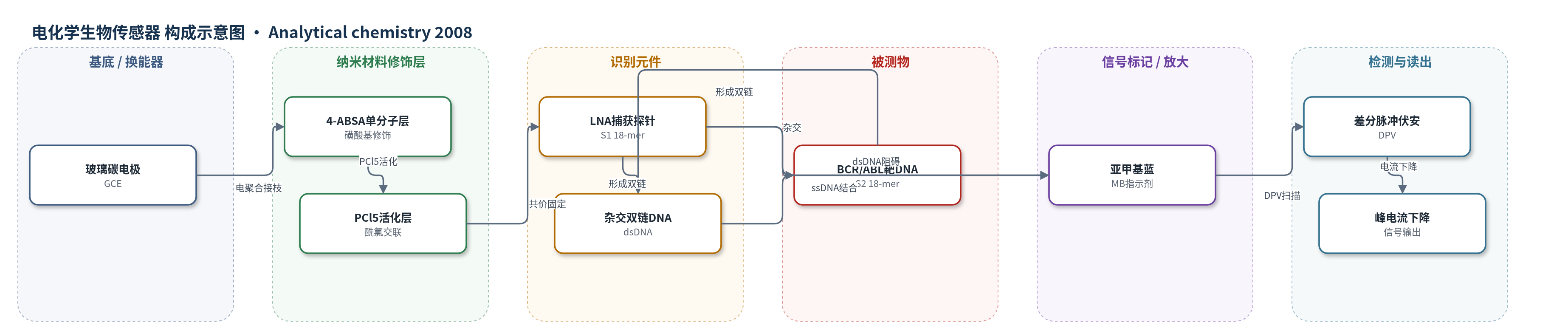
点击图片查看大图 · 依据论文自动绘制
传感器类型
电化学生物传感器
检测对象
BCR/ABL融合基因(BCR/ABL fusion gene);样品基质:慢性髓系白血病(CML)真实样品PCR产物、K562细胞PCR产物
检测原理
该传感器以玻璃碳电极为基底,先通过循环伏安将4-ABSA共价接枝形成磺酸基单分子层,再用PCl5将末端磺酸基活化为酰氯,使18-mer LNA捕获探针经碱基游离氨基共价固定。当BCR/ABL靶DNA存在时,LNA探针与其互补序列杂交形成dsDNA。LNA的锁核结构提高杂交亲和力和单碱基错配区分能力。亚甲基蓝作为电化学指示剂,可结合单链DNA鸟嘌呤并嵌入双链DNA;杂交形成dsDNA后,鸟嘌呤可及性降低并产生空间位阻,使MB还原峰电流下降。DPV监测MB峰电流,随靶DNA浓度增加,峰电流线性下降,从而实现检测。
检测灵敏度
LOD: 9.4 × 10^-13 M;线性范围: 1.0 × 10^-12–1.1 × 10^-11 M;回归方程: I(µA) = -0.0444CdsDNA(pM) + 10.234;R = 0.9936
效应效果
该传感器选择性良好:互补靶DNA杂交后MB峰电流显著下降,单碱基错配序列信号明显高于互补序列,非互补序列无显著变化;LNA探针Tm为62.8 °C,较DNA探针48.3 °C提高14.5 °C,单碱基错配Tm降至38.3 °C。对7.0×10^-12 M靶DNA的重现性RSD为7.26%(n=8)。真实PCR样品中,探针电极平均信号9.14 µA(RSD 6.29%),阳性样品4.86 µA(RSD 7.91%),阴性样品8.76 µA(RSD 8.45%),与凝胶电泳一致。作者认为其快速、简便、低成本,可用于CML诊断与预后监测。
传感器的构成
- 基底/换能器电极:玻璃碳电极(GCE),提供导电基底与电子转导
- 修饰层:4-氨基苯磺酸(4-ABSA)单分子层,经循环伏安电聚合接枝于GCE,提供磺酸基团并阻碍Fe(CN)6电子转移
- 活化交联层:五氯化磷(PCl5)活化4-ABSA末端磺酸基形成酰氯,用于与DNA碱基游离氨基共价连接
- 识别元件:18-mer锁核酸(LNA)修饰单链DNA捕获探针(S1),与BCR/ABL靶DNA杂交
- 信号标记物:亚甲基蓝(MB),电化学指示剂,结合/嵌入DNA并在杂交后峰电流下降
中文摘要
本研究开发了一种用于检测慢性髓系白血病中BCR/ABL融合基因的电化学DNA生物传感器。该传感器以18-mer锁核酸(LNA)修饰的单链DNA作为捕获探针,并通过酰氯交联反应将探针经DNA碱基游离氨基共价固定于磺酸基终止的4-氨基苯磺酸(4-ABSA)单分子层修饰的玻璃碳电极(GCE)表面。共价固定的捕获探针可与其靶DNA选择性杂交,在LNA/4-ABSA/GCE表面形成双链DNA(dsDNA)。采用差分脉冲伏安法(DPV)监测捕获探针电极上的杂交反应。探针与靶DNA杂交后,电化学指示剂亚甲基蓝(MB)的峰电流下降。结果表明,在pH 7.0 Tris-HCl缓冲液中,峰电流与互补链浓度在1.0×10^-12至1.1×10^-11 M范围内呈线性关系,检出限为9.4×10^-13 M。该方法对单碱基错配和互补dsDNA杂交后具有优异特异性,并已成功用于PCR真实样品检测,结果令人满意。
英文摘要
In this study, an electrochemical DNA biosensor was developed for detection of the breakpoint cluster region gene and the cellular abl (BCR/ABL) fusion gene in chronic myelogenous leukemia by using 18-mer locked, nucleic acid-modified, single-stranded DNA as the capture probe. The capture probe was covalently attached on the sulfonic-terminated aminobenzenesulfonic acid monolayer-modified glassy carbon electrode through the free amines of DNA bases based on the acyl chloride cross-linking reaction. The covalently immobilized capture probe could selectively hybridize with its target DNA to form double-stranded DNA (dsDNA) on the LNA/4-ABSA/GCE surface. Differential pulse voltammetry was used to monitor the hybridization reaction on the capture probe electrode. The decrease of the peak current of methylene blue, an electroactive indicator, was observed upon hybridization of the probe with the target DNA. The results indicated that, in pH 7.0 Tris-HCl buffer solution, the peak current was linear with the concentration of complementary strand in the range of 1.0 x 10 (-12)1.1 x 10 (-11) M with a detection limit of 9.4 x 10 (-13) M. This new method demonstrates its excellent specificity for single-base mismatch and complementary dsDNA after hybridization, and this probe has been used for assay of PCR real sample with satisfactory results.