组成图示
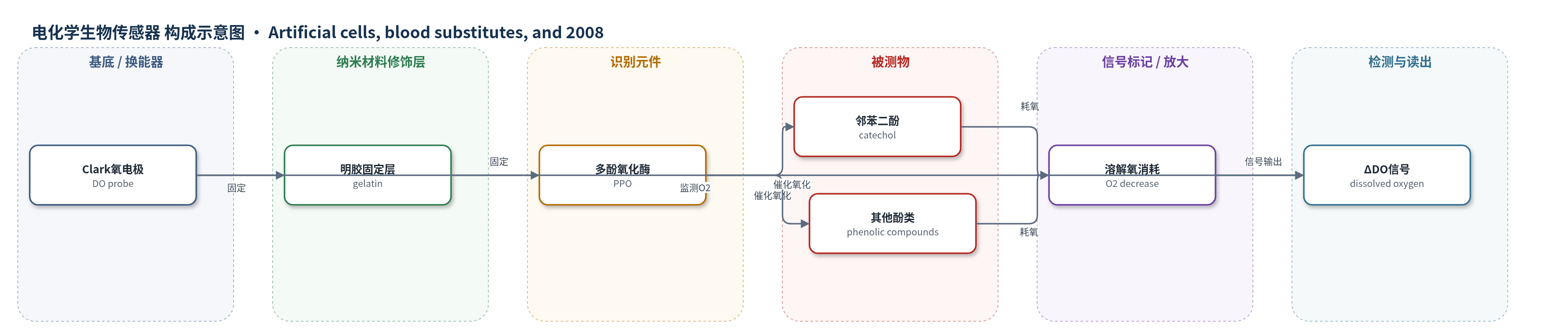
点击图片查看大图 · 依据论文自动绘制
传感器类型
电化学生物传感器
检测对象
酚类化合物(phenolic compounds):邻苯二酚(catechol)、没食子酸(pyrogallol)、咖啡酸(caffeic acid)、苯酚(phenol)、sinapinic acid(英文)、鞣花酸(ellagic acid)、萘酚(naphthol)、阿魏酸(ferulic acid);样品基质:0.05 M sodium phosphate buffer 标准溶液/反应池(未报道实际食品或环境样品)
检测原理
该传感器以月桂叶组织匀浆中的多酚氧化酶(PPO)为识别与催化元件。酚类底物(如邻苯二酚)进入生物膜后,被 PPO 催化发生邻位羟基化/氧化反应,生成邻醌并消耗溶解氧,反应式可表示为 catechol + 1/2 O2 → o-quinone + H2O。随着酚类浓度升高,单位时间内 O2 消耗量增加,Clark 型氧电极测得的溶解氧下降值 ΔDO 增大,从而实现定量检测。制备过程中,竞争性抑制剂硫脲先与 PPO 活性中心结合,形成酶-抑制剂复合物,再经明胶承载和戊二醛交联固定,最后洗去硫脲;该生物印迹过程保护酶活性位点,提高稳定性,但不参与信号放大。
检测灵敏度
LOD: 25 mM(正文;图坐标为 µM);线性范围: 25 mM–400 mM(正文;图坐标为 µM);R^2 = 0.9939 / 0.9985;灵敏度斜率: 0.0033 / 0.0054
效应效果
传感器对邻苯二酚响应最高,对没食子酸、咖啡酸、苯酚等有较低响应,印迹型对萘酚和阿魏酸无响应,显示一定选择性。重现性:200 mM 邻苯二酚 n=10,未印迹 CV 4.9%,印迹 CV 2.9%。稳定性:pH 8.5 20 h 后未印迹保留 94%、印迹 100%;35°C 20 h 后未印迹 80%、印迹 94%;连续 20 次测量后未印迹 67%、印迹 80%;4°C 储存 15 d 后未印迹 56%、印迹 70%。未报道实际样品加标回收率及与 ELISA/HPLC 等方法的对比。作者认为生物印迹简单、低成本,可显著提高酶生物传感器稳定性。
传感器的构成
- 换能器电极:Clark-type oxygen electrode / YSI 5700 dissolved oxygen (DO) probe,监测溶解氧浓度变化
- 载体固定层:gelatin (type 3, 225 Bloom),与月桂叶组织匀浆混合形成生物膜并固定酶
- 识别/催化元件:polyphenol oxidase (PPO) in Bay leaf (Laurus nobilis L.) tissue homogenate,催化酚类氧化并消耗 O2
- 生物印迹模板:thiourea,竞争性抑制剂,临时占据 PPO 活性中心以保护固定过程
- 交联剂:glutaraldehyde (2.5% v/v),交联 gelatin 与 PPO,提高生物膜稳定性
中文摘要
酶作为生物传感器中广泛使用的生物催化剂,其稳定性不足是限制应用的主要问题。为改善酶稳定性,本研究采用简单的生物印迹技术制备了基于月桂叶(Laurus nobilis L.)组织匀浆的生物传感器。月桂叶中富含多酚氧化酶(PPO),先在水相中与竞争性抑制剂硫脲复合,使酶活性中心被暂时占据;随后将含 PPO 的组织匀浆与明胶混合,涂覆于 Clark 型氧电极表面,并用戊二醛交联固定,最后洗去硫脲。同时制备未与硫脲复合的对照传感器。该传感器通过 PPO 催化酚类化合物氧化并消耗溶解氧,利用氧电极监测溶解氧下降实现检测。结果表明,生物印迹技术可显著提高传感器的热稳定性、pH 稳定性和储存稳定性,是一种简单、低成本且有效的酶稳定性改善方法。
英文摘要
Although enzymes are effective biocatalysts that are widely used in biosensors, a major drawback that hampers many of these biotechnological applications of enzymes is their limited stability. Applications that use very pure, high value proteins need to employ effective stabilization technology, primarily due to cost considerations and availability of the proteins used. For this purpose, interest in bio-imprinting techniques increases because it allows stability characteristics of enzymes to be improved. In this study, a bio-imprinted Bay leaf (Laurus nobilis L.) tissue homogenate biosensor was devised by a very simple way. For this purpose, the enzymes, polyphenol oxidases in the bay leaf tissue, were first complexed by using their competitive inhibitor, thiourea, in aqueous medium and then this enzyme was immobilized on gelatin by crosslinking with glutaraldehyde on a Clark-type oxygen electrode surface. Similarly, noncomplexed polyphenol oxidase with thiourea was also immobilized on a Clark-type oxygen electrode in the same conditions. The aim of the study was to prepare a new biosensor-based Bay leaf tissue homogenate and to improve the stability characteristics such as thermal stability, pH stability, and storage stability, of the biosensor by bio-imprinting method. The results showed that this simple technique should be effectively used to improve the stabilities of a biosensor.