组成图示
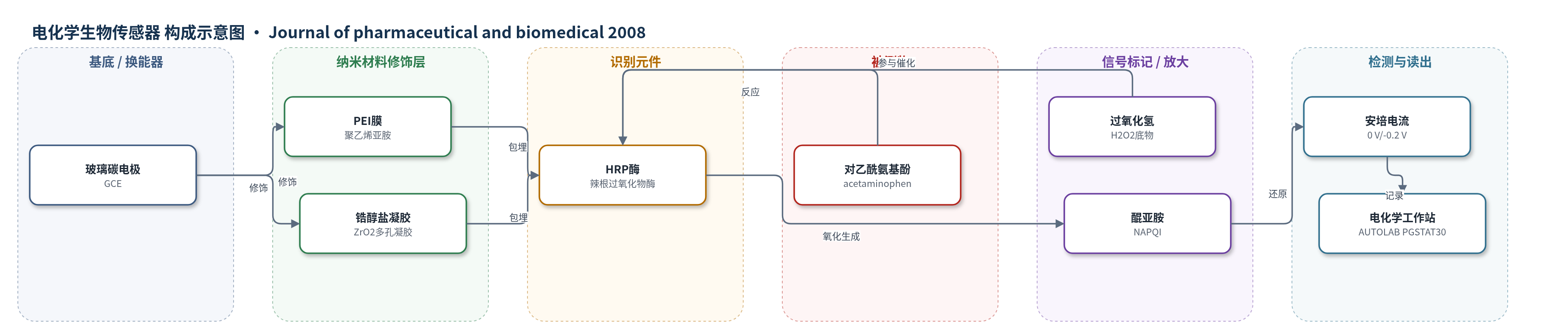
点击图片查看大图 · 依据论文自动绘制
传感器类型
电化学生物传感器
检测对象
对乙酰氨基酚(acetaminophen, APAP);样品基质:磷酸盐缓冲液(phosphate buffer, pH 7.4)、药品制剂(Perdolan®及仿制药片剂)
检测原理
该传感器为酶促安培型生物传感器。HRP 被固定在 PEI/锆醇盐多孔凝胶膜中,凝胶提供水合微环境并维持酶活性。检测时,APAP 扩散进入修饰膜,在 H2O2 存在下被 HRP 催化氧化,生成醌亚胺(NAPQI)。NAPQI 在玻璃碳电极表面发生电化学还原,电子经电极传递形成安培电流。由于酶催化反应使 APAP 转化为可还原产物,醌亚胺生成量与 APAP 浓度相关,因此稳态还原电流随 APAP 浓度升高而增大。该过程利用 HRP 的过氧化物酶活性实现生物放大,无需额外化学标记或核酸扩增。
检测灵敏度
LOD: 1.17 × 10⁻⁷ M;线性范围: 1.96 × 10⁻⁵ M–2.55 × 10⁻⁴ M;R^2 = 0.9983
效应效果
传感器具有较好稳定性与重现性。29 天内,0.3 mg 与 0.6 mg HRP 电极相关系数分别为 0.9411–0.9961 和 0.9818–0.9983;0.3 mg HRP 电极第 1 天 RSD ±7%,第 2/5 天 ±5%,第 8/13/22 天 ±2%。储存 60 天后信号下降 30%。实际样品采用标准加入法测定 Perdolan® 和仿制药片剂中 APAP;加入 2×10⁻³ M APAP 标准液与含 2×10⁻³ M APAP 的回收制剂响应完全重叠,药品分析线性范围 2.0×10⁻⁵–1.6×10⁻⁴ M,R^2=0.9996,斜率 RSD=20%(n=5)。未报告选择性、抗干扰及与 HPLC/ELISA 对比,作者认为可用于其他可被过氧化物酶氧化的化合物。
传感器的构成
- 工作电极:玻璃碳电极(GCE),导电基底与电化学换能器
- 聚合物修饰层:聚乙烯亚胺(PEI),阳离子聚合物,包埋酶并促进电子转移
- 无机多孔凝胶层:锆醇盐多孔凝胶(zirconium alcoxide porous gel, ZrO2),形成水合微环境并固定酶
- 识别/催化元件:辣根过氧化物酶(HRP),催化对乙酰氨基酚氧化
- 反应底物:过氧化氢(H2O2),参与 HRP 催化氧化反应
- 信号产物:醌亚胺(quinoneimine, NAPQI),在电极表面还原产生安培电流
中文摘要
本文报道了一种用于检测对乙酰氨基酚(acetaminophen, APAP)的新型复合电极生物传感器。该传感器以玻璃碳电极为基底,将辣根过氧化物酶(HRP)包埋于聚乙烯亚胺(PEI)与锆醇盐多孔凝胶构成的复合膜中。PEI 与锆醇盐凝胶共同形成多孔、水合的微环境,既能有效固定酶,又能保护生物组分活性并促进电子转移。传感器工作原理为:在过氧化氢(H2O2)存在下,HRP 催化氧化 APAP 生成醌亚胺(quinoneimine, NAPQI),后者在电极表面发生电化学还原,产生安培电流。该电流随 APAP 浓度增加而增大。所得传感器对 APAP 呈线性响应,线性范围为 1.96×10⁻⁵ M 至 2.55×10⁻⁴ M,检出限为 1.17×10⁻⁷ M,并表现出良好的长期稳定性和重现性。作者将该传感器用于药品制剂中 APAP 的测定。
英文摘要
The development of composite electrodes for biosensors construction based on HRP and zirconium alcoxide film for acetaminophen detection and finally, acetaminophen determination in pharmaceutical products is described. The enzyme immobilization is performed by retention in a polyetilenimine and zirconium alcoxide porous gel film, technique that offers a good entrapping and in the mean times a "protective" environment for the biocomponent. The operation principle of the biosensor is based on monitoring the amperometric signal generated by reduction at the electrode surface of the enzymatically generated quinoneimine from acetaminophen. The resulting biosensor shows a linear response towards acetaminophen with a linear range of 1.96 x 10(-5)M and 2.55 x 10(-4)M and a limit of detection of 1.17 x 10(-7)M. The proposed biosensor shows long term stability and good reproducibility.