组成图示
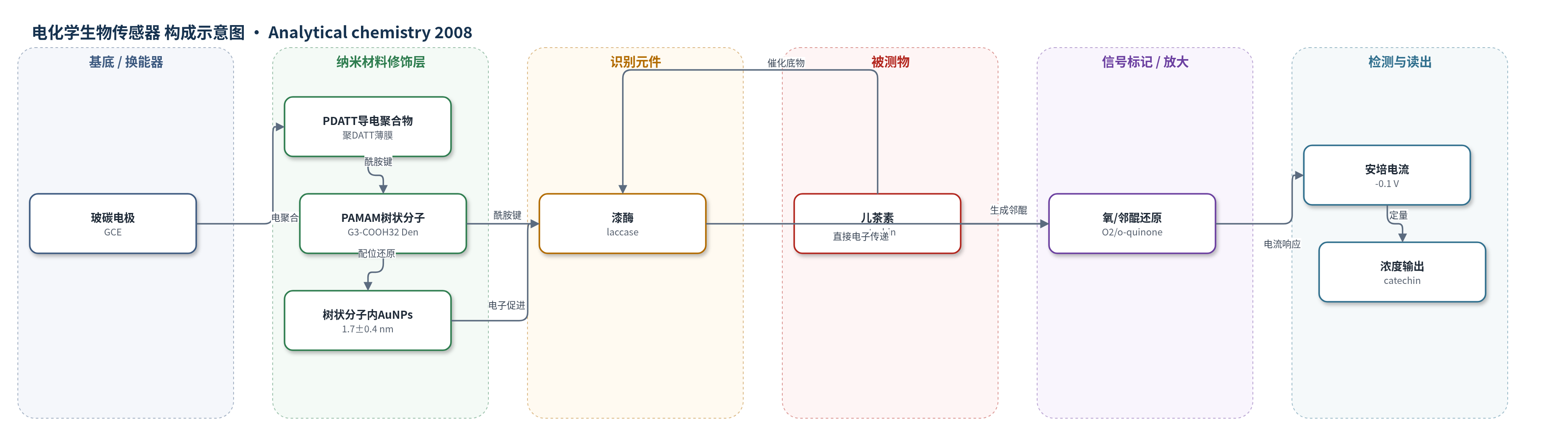
点击图片查看大图 · 依据论文自动绘制
传感器类型
电化学生物传感器
检测对象
儿茶素(catechin);样品基质:PBS缓冲液、绿茶浸提液、人尿
检测原理
该传感器为第三代电化学生物传感器。PDATT导电聚合物通过电聚合修饰在玻碳电极上,其胺基与PAMAM树状分子表面羧基形成酰胺键;Au(III)在树状分子内部叔胺配位后被还原为AuNPs,形成电子传递通道。漆酶通过氨基与树状分子表面羧基共价固定,保持有利取向。检测时,儿茶素被漆酶催化氧化生成邻醌,O2参与漆酶铜中心的直接电子传递(DET)。在-0.1 V下,电极对氧化产物发生电催化还原,产生还原电流。AuNPs增强界面电子传递,使电流随儿茶素浓度升高而增大,从而实现无介质检测。
检测灵敏度
LOD: 0.05 ± 0.003 µM;线性范围: 0.1–10 µM;灵敏度斜率: 9.6 ± 0.13 µA/µM;相关系数: 0.997;无AuNPs对照: LOD 0.30 ± 0.05 µM,线性范围 0.5–10 µM,斜率 2.14 ± 0.06 µA/µM,相关系数 0.996
效应效果
传感器在pH 6.5、30 °C、-0.1 V下响应时间小于10 s,0.5 µM儿茶素RSD约4.3%。酚、间甲酚、3-氨基酚、4-硝基酚、2,4-二硝基酚以及没食子酸、芦丁、槲皮素、马鞭草素、间苯二酚、咖啡酸在1.0 mM下不干扰;100倍儿茶酚使电流降低约19%,但实际样品中儿茶酚含量低。4 °C PBS保存两个月保留>92%初始响应,连续30次测量仅损失4.6%。200倍稀释绿茶样品中儿茶素为4.3±0.69 µM,与Folin-Ciocalteu法4.7±0.85 µM一致;人尿加标0.1、0.5、1.0 µM回收率93–105%。
传感器的构成
- 基底/工作电极:玻碳电极(GCE),抛光后作为导电基底与换能器
- 导电聚合物修饰层:3′,4′-二胺-2,2′;5′,2′′-三噻吩(DATT)电聚合形成的聚DATT(PDATT)薄膜,提供胺基并共价连接树状分子
- 树状分子层:第三代聚酰胺胺(PAMAM, G3-COOH32)树状分子(Den),表面羧基与PDATT胺基形成酰胺键,内部叔胺配位Au(III)
- 金纳米颗粒层:Au(III)在树状分子内部配位后被NaBH4还原为AuNPs(约1.7±0.4 nm),增强导电性和电子传递
- 识别/催化元件:漆酶(laccase),其氨基与树状分子表面羧基形成酰胺键共价固定,催化儿茶素氧化并发生直接电子传递
中文摘要
本文报道了一种基于漆酶直接电子传递(DET)的电化学生物传感器,用于检测儿茶素。为增强电学性能,作者将金纳米颗粒(AuNPs)包埋于树状分子(Den)内部,而非附着在其外围。制备时,Au(III)离子先与树状分子内部氮配体配位,再被还原形成AuNPs,包埋于树状分子内部的AuNPs粒径为1.7±0.4 nm。随后,AuNPs包埋树状分子通过树状分子表面羧基与漆酶氨基形成酰胺键,共价固定漆酶,构建PDATT/Den(AuNPs)/laccase探针。各层结构经循环伏安、电化学阻抗、石英晶体微天平、XPS、SEM和TEM表征。该探针呈现明确的漆酶DET过程,漆酶铜中心的准可逆氧化还原峰位于-0.03/+0.13 V(vs Ag/AgCl),电子传递速率常数为1.28 s^-1。基于漆酶直接电化学的电催化过程建立了儿茶素传感器,线性范围为0.1–10 µM,检出限为0.05±0.003 µM。研究还考察了多种酚类和多元酚类化合物的干扰,并通过真实样品分析评价了传感器的适用性。
英文摘要
The direct electrochemistry of laccase was promoted by Au nanoparticle (AuNP)-encapsulated dendrimers (Den), which was applied for the detection of catechin. To increase the electrical properties, AuNPs were captured in the interiors of the dendrimer (Den-AuNPs) as opposed to attachment at the periphery of dendrimer. To prepare Den-AuNPs, the Au(III) ions were first coordinated in the interior of dendrimer with nitrogen ligands and then reduced to form AuNPs. The size of AuNPs encapsulated within the interior of the dendrimer was determined to be 1.7 +/- 0.4 nm. AuNPs-encapsulated dendrimers were then used to covalently immobilize laccase (PDATT/ Den(AuNPs)/laccase) through the formation of amide bonds between carboxylic acid groups of the dendrimer and the amine groups of laccase. Each layer of the PDATT/Den(AuNPs)/laccase probe was characterized using CV, EIS, QCM, XPS, SEM, and TEM. The PDATT/Den(AuNPs)/laccase probe displayed a well-defined direct electron-transfer (DET) process of laccase. The quasi-reversible redox peak of the Cu redox center of the laccase molecule was observed at -0.03/+0.13 V vs Ag/AgCl, and the electron-transfer rate constant was determined to be 1.28 s (-1). A catechin biosensor based on the electrocatalytic process by direct electrochemistry of laccase was developed. The linear range and the detection limit in the catechin analysis were determined to be 0.1-10 and 0.05 +/- 0.003 microM, respectively. Interference effects from various phenolic and polyphenolic compounds were also studied, and the general applicability of the biosensor was evaluated by selective analysis of real samples of catechin.