组成图示
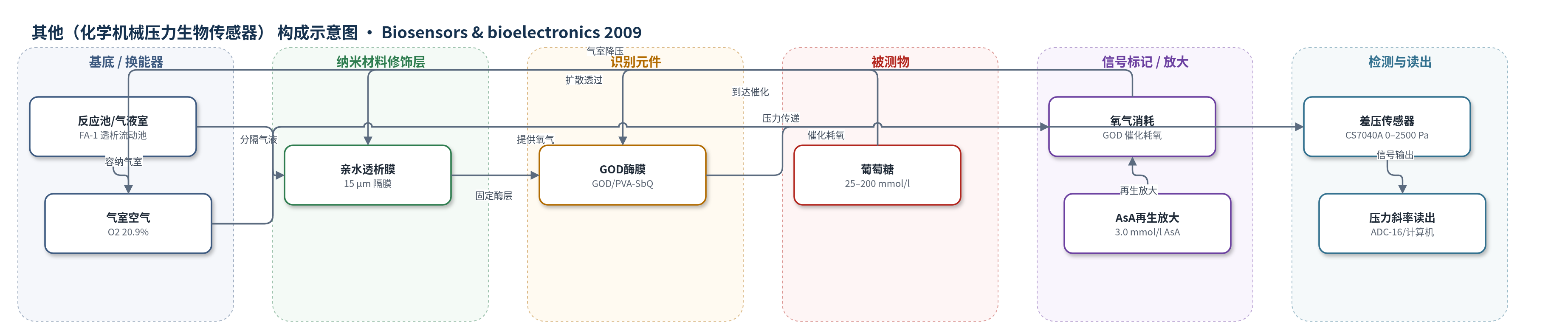
点击图片查看大图 · 依据论文自动绘制
传感器类型
其他(化学机械压力生物传感器)
检测对象
葡萄糖(glucose, Glc);样品基质为磷酸盐缓冲液(50 mmol/l,pH 7.0)流动样品,可含 L-抗坏血酸(AsA)
检测原理
葡萄糖从液室样品中透过亲水性透析膜微孔扩散至气侧 GOD 固定层。GOD 催化葡萄糖氧化,消耗气室中的 O2,使封闭气室气体分压下降,形成持续负压。差压传感器检测气室出口压力变化,稳态降压斜率随葡萄糖浓度升高而增大,在 25.0–200.0 mmol/l 范围内线性。加入 L-抗坏血酸(AsA)后,AsA 作为还原剂与 GOD 偶联形成底物再生循环,提高酶催化耗氧速率,从而放大压力信号;3.0 mmol/l AsA 时放大效果最佳。
检测灵敏度
线性范围: 25.0–200.0 mmol/l;相关系数: 0.998;灵敏度斜率: −0.031 Pa/s/(mmol/l)(原文方程 pressure slope (Pa/s) = −0.839 −0.031 [glucose (mmol/l)]);最低可测浓度: 5.0 mmol/l(压力变化不稳定)
效应效果
空白磷酸盐缓冲液不引起压力变化,显示基本选择性。50.0 mmol/l葡萄糖多次测量C.V.为3.6%(n=5),不同传感器间C.V.为14.7%(n=5)。线性上限受差压传感器0–2500 Pa量程限制为200 mmol/l,最低可测5.0 mmol/l但不稳定。3.0 mmol/l AsA使信号放大超过2.5倍;AsA高于3.0 mmol/l时输出下降,10 mmol/l及以上基本不变,可能因絮凝物降低底物扩散。作者认为可用于化学机械、可动/可视生物传感器及智能仿生机器。
传感器的构成
- 反应池/换能腔:Sanplatec 透析流动池 FA-1(1.0 mL),分隔并容纳气室与液室,构成化学机械反应单元
- 隔膜/扩散层:亲水性透析膜(Technicon 157-0144-02,15 μm),分隔气液两室并允许葡萄糖分子透过
- 识别催化层:葡萄糖氧化酶 GOD(Amano AM,EC 1.1.3.4)与光交联 PVA-SbQ(SPP-H-13 Bio)按 1:100 固定于膜气侧,催化葡萄糖氧化并耗氧
- 气室:空气(O2 20.9%),提供反应氧并因耗氧产生压力下降
- 液室:磷酸盐缓冲液(50 mmol/l,pH 7.0)样品流,携带葡萄糖及可选 L-抗坏血酸 AsA
- 信号放大剂:L-抗坏血酸 AsA(0–50 mmol/l,最优 3.0 mmol/l),作为还原剂/底物再生循环提高耗氧速率
- 压力换能器:差压传感器 CS7040A(0–2500 Pa),将气室压力变化转换为电信号
- 读出系统:ADC-16 与计算机,记录并分析压力下降斜率
中文摘要
本文报道了一种用于葡萄糖检测的压力(tonometric)生物传感器,其由化学机械反应单元和差压传感器构成。反应单元由液室和气室组成,两者以酶隔膜分隔;葡萄糖氧化酶(GOD)被固定在透析膜的气室单侧。将不同浓度葡萄糖溶液(0、25.0、50.0、100、150和200 mmol/l)加入液室后,葡萄糖透过多孔隔膜到达酶侧,GOD催化反应消耗气室中的氧气,使封闭气室压力持续下降,并呈现稳定的降压斜率。气室稳态降压斜率与液室葡萄糖浓度在25.0–200.0 mmol/l范围内呈线性关系,相关系数为0.998。为放大输出信号,作者将GOD与L-抗坏血酸(AsA,0、1.0、3.0、10.0和50.0 mmol/l,作为还原剂体系)偶联,引入底物再生循环。结果表明,3.0 mmol/l AsA可最优放大传感器信号,较无AsA体系提高2.5倍以上。
英文摘要
A tonometric biosensor for glucose was constructed using a chemo-mechanical reaction unit and a differential pressure sensor. The reaction unit was fabricated by using both liquid and gas cells separated by an enzyme diaphragm membrane, in which glucose oxidase was immobilized onto the single (gas cell) side of the dialysis membrane. By applying glucose solution (0, 25.0, 50.0, 100, 150 and 200 mmol/l) into the liquid cell of the chemo-mechanical reaction unit, the pressure in the gas cell decreased continuously with a steady de-pressure slope because the oxygen consumption in the gas cell was induced by the glucose oxidase (GOD) enzyme reaction at the enzyme side of the porous diaphragm membrane. The steady de-pressure slope in the gas cell showed the linear relationship with the glucose concentration in the liquid cell between 25.0 and 200.0 mmol/l (correlation coefficient of 0.998). A substrate regeneration cycle coupling GOD with l-ascorbic acid (AsA: 0, 1.0, 3.0, 10.0 and 50.0 mmol/l; as reducing reagent system) was applied to the chemo-mechanical reaction unit in order to amplify the output signal of the tonometric biosensor. 3.0 mmol/l concentration of AsA could optimally amplify the sensor signal more than 2.5 times in comparison with that of non-AsA reagent.