组成图示
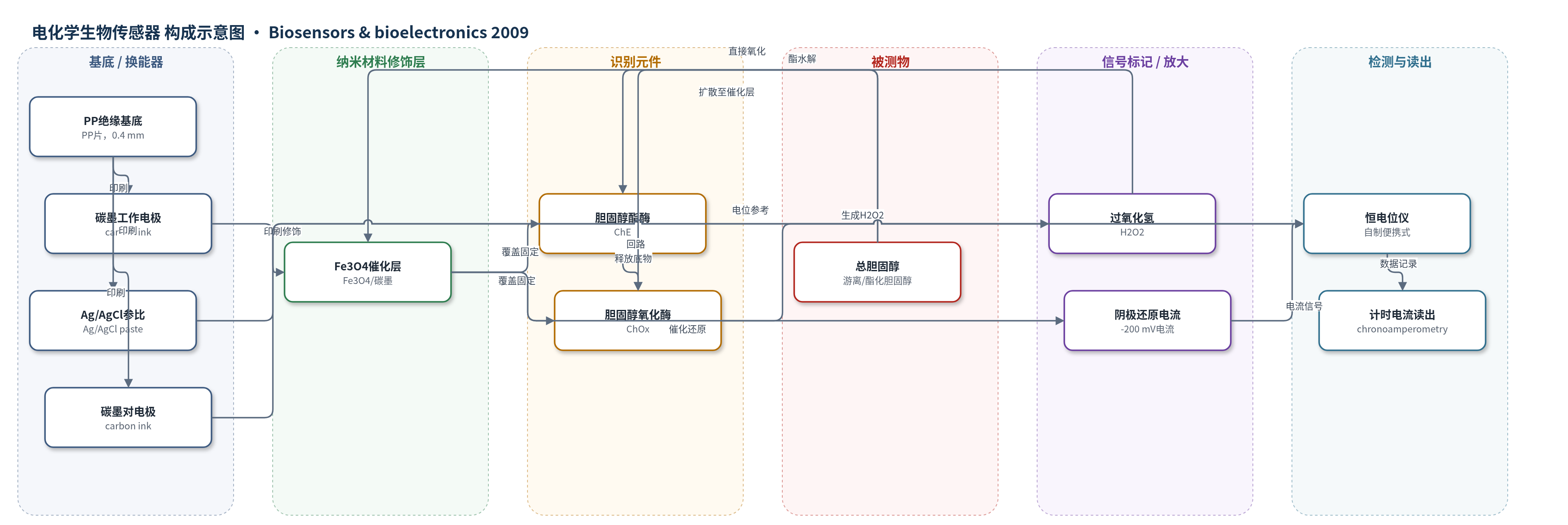
点击图片查看大图 · 依据论文自动绘制
传感器类型
电化学生物传感器
检测对象
总胆固醇(total cholesterol,含游离胆固醇与胆固醇酯;标准品为油酸胆固醇酯 cholesteryl oleate);实验样品基质:0.05 M磷酸盐缓冲液(pH 5.5,含0.1 M NaCl、1% Triton X-100和2% Tween 85),应用目标为血清/全血等生物样品。
检测原理
传感器采用双酶识别与Fe3O4催化换能。样品中的胆固醇酯先被胆固醇酯酶(ChE)水解为游离胆固醇和脂肪酸;游离胆固醇再被胆固醇氧化酶(ChOx)在氧气存在下氧化为4-胆甾烯-3-酮,并等摩尔生成过氧化氢(H2O2)。H2O2扩散至工作电极表面的Fe3O4催化层,在-200 mV(vs. Ag/Ag+)低阴极电位下被还原,产生与H2O2浓度成正比的阴极电流。由于Fe3O4可在低过电位下催化H2O2还原,避免了高电位下抗坏血酸、尿酸等易氧化物干扰,也避开-250 mV以下氧还原干扰。检测采用计时电流法,滴加10 μL样品后预反应15 s,再采样5 s,电流大小反映总胆固醇浓度。
检测灵敏度
LOD: 19.4 mg/dL (S/N = 3);线性范围: 100–400 mg/dL(R^2 = 0.999);分段线性: 25–100 mg/dL,y = 1.544 + 0.00878x(R^2 = 0.9998);100–400 mg/dL,y = 2.021 + 0.00397x(R^2 = 0.999);非线性范围: 25–500 mg/dL,y = 4.304 − 2.71 × (0.9968)^x(R^2 = 0.993)。
效应效果
该传感器在100 mg/dL油酸胆固醇酯下20次测定变异系数为5.06%,显示良好重现性。试纸在4 ℃保存1个月内响应稳定,相对新鲜试纸为100.4 ± 1.8%(N = 7,95%置信水平),各数据CV小于7.2%。选择性方面,在100 mg/dL胆固醇溶液中加入20 mg/dL抗坏血酸、尿酸、多巴胺、水杨酸、对乙酰氨基酚等及100 mg/dL葡萄糖,干扰分别为+3.08%、+1.25%、+1.88%、+3.18%、+2.20%和+1.53%,尿素、肌酸、肌酐、乳酸干扰在−2.20%至−0.55%之间,未见显著干扰。单次检测总时间20 s(15 s酶反应+5 s采样),适合低成本、快速、床旁总胆固醇检测。
传感器的构成
- 基底/绝缘载体:聚丙烯(PP)片,厚度0.4 mm,承载丝网印刷电极并制成一次性试纸
- 工作电极导电层:碳墨(carbon ink)印刷,提供电子传导与电极基底
- 催化修饰层:Fe3O4与碳墨混合印刷于工作电极,催化H2O2在低阴极电位下还原
- 识别元件层:胆固醇酯酶(ChE)和胆固醇氧化酶(ChOx)固定于滤纸片,覆盖工作电极,分别水解胆固醇酯和氧化游离胆固醇
- 参比电极:银/氯化银浆(Ag/AgCl paste)丝网印刷,提供稳定电位参考
- 对电极:碳墨丝网印刷,完成电化学回路
- 样品接触层:酶滤纸片兼作样品接触层,使10 μL样品与酶及催化层接触
中文摘要
本文报道了一种用于总胆固醇检测的一次性计时电流生物传感器原型。该传感器由自制便携式恒电位仪和一次性试纸条组成,试纸条工作电极上固定有Fe3O4、胆固醇氧化酶(ChOx)和胆固醇酯酶(ChE)。检测原理基于两步酶促反应中产生的过氧化氢的还原信号:ChE将胆固醇酯水解为游离胆固醇,ChOx氧化游离胆固醇生成4-胆甾烯-3-酮和H2O2,Fe3O4在低阴极电位下催化H2O2还原。通过优化催化剂、酶量、电位和缓冲液pH,实现一步法检测:取10 μL样品滴加到试纸感应区,在-200 mV(vs. Ag/Ag+)下读取还原电流,预反应15 s、采样5 s。对油酸胆固醇酯在100–400 mg/dL范围内线性响应(R2=0.999),100 mg/dL的变异系数为5.06%(N=20),检出限为19.4 mg/dL(S/N=3)。生物基质中常见干扰物未引起显著响应。
英文摘要
A prototype chronoamperometric biosensor for the determination of total cholesterol was developed that consists of a homemade potentiostat and disposable strips immobilized with Fe(3)O(4), cholesterol oxidase (ChOx), and cholesterol esterase (ChE). The principle of sensing cholesterol is based on the detection of reduction signal of hydrogen peroxide generated in two enzymatic reactions. The co-immobilization of ChE and ChOx allows the sensor to detect both concentrations of esterified and free cholesterol. The effects of biosensor on catalyst, enzymes, applied potential, and buffer pH was investigated, and the operation conditions were optimized. The detection of cholesterol can be accomplished in one step, a 10 microL of sample was dropped onto the area of sensing strip and the reduction signal was obtained at an applied potential of -200 mV (vs. Ag/Ag(+)). The pre-reaction time was set at 15s before applying potential on the strip and the sampling time was 5s. The sensing device displays a linear response over the range of 100-400mg/dL (R(2)=0.999) for cholesteryl oleate. The coefficient variation was determined as 5.06% (N=20) for 100mg/dL cholesteryl oleate and the detection limit is 19.4 mg/dL (S/N=3). The probable interferences in bio-matrix were selected to test the selectivity and no significant response was observed in the biosensor.