组成图示
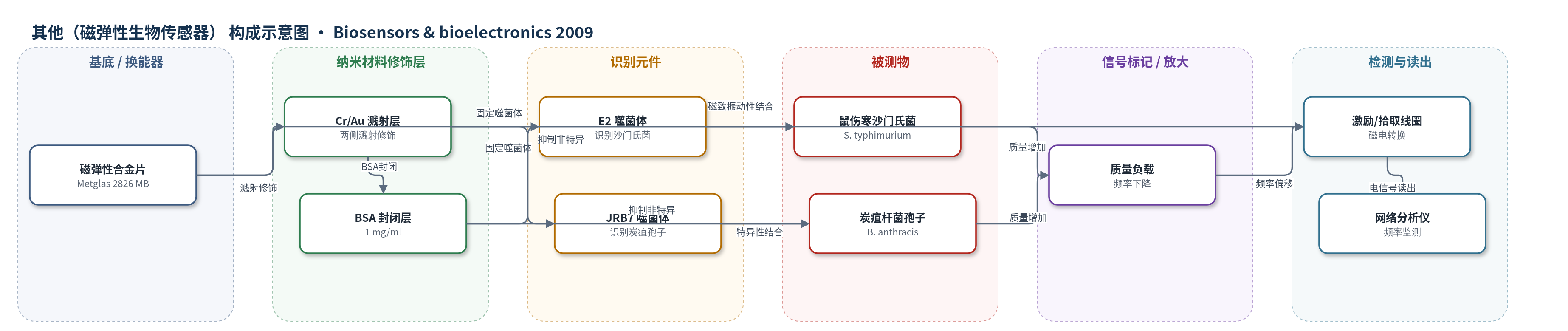
点击图片查看大图 · 依据论文自动绘制
传感器类型
其他(磁弹性生物传感器)
检测对象
鼠伤寒沙门氏菌(Salmonella typhimurium)、炭疽杆菌孢子(Bacillus anthracis spores,Sterne 株);样品基质:水溶液/细菌或孢子悬浮液
检测原理
磁弹性(ME)传感器以 2826 MB Metglas 合金片为谐振换能器。交变磁场由激励线圈施加,使合金片在特征频率下发生磁致伸缩机械振动,同一拾取线圈将振动转换为电流信号。目标鼠伤寒沙门氏菌或炭疽杆菌孢子被表面特异性 E2 或 JRB7 噬菌体捕获后,传感器表面质量增加。根据 Δf = -f/2(Δm/M),附加质量导致谐振频率下降;频率偏移随捕获质量/浓度增大而增大,在 5×10^3–5×10^7 cfu/ml 呈线性,>5×10^8 cfu/ml 饱和。BSA 封闭减少非特异结合,参考传感器用于校正环境干扰。
检测灵敏度
LOD: 5 × 10^3 cfu/ml(E2 噬菌体传感器;JRB7 噬菌体传感器);线性范围: 5 × 10^3–5 × 10^7 cfu/ml(S. typhimurium);R^2 = 0.995(E2 噬菌体传感器对 S. typhimurium);R^2 = 0.965(JRB7 噬菌体传感器对 B. anthracis spores)
效应效果
系统表现出良好选择性:顺序暴露 5×10^8 cfu/ml 的鼠伤寒沙门氏菌或炭疽杆菌孢子时,仅对应噬菌体传感器响应,E2 传感器频率偏移约 1280 Hz,JRB7 传感器约 1120 Hz;参考传感器最大偏移约 70 Hz,JRB7 对沙门氏菌约 30 Hz,E2 对孢子无明显响应,表明 1 mg/ml BSA 有效抑制非特异结合。传感器在流动液体中显示良好环境稳定性且无腐蚀,SEM 证实目标物结合。作者认为该无线、可丢弃、低成本系统可用于食品中多种病原体同时检测,但当前尺寸可能需要 2–3 h 预富集。
传感器的构成
- 基底/换能器:2826 MB Metglas 磁弹性合金带(Fe40Ni38Mo4B18,Honeywell),抛光切割成约 15 μm 厚、2 mm 或 1.9 mm 长谐振片,提供磁弹性谐振换能
- 金属修饰层:两侧溅射 Cr 和 Au,用于增强生物分子固定
- 识别元件:E2 丝状噬菌体(5×10^11 vir/ml,1× TBS),物理吸附固定,特异性识别鼠伤寒沙门氏菌
- 识别元件:JRB7 丝状噬菌体(5×10^11 vir/ml,1× TBS),物理吸附固定,特异性识别炭疽杆菌孢子
- 封闭层:1 mg/ml BSA(牛血清白蛋白),封闭非特异性结合位点
- 对照传感器:仅 BSA 封闭、无噬菌体,用于校正环境变化与非特异性结合
中文摘要
本研究同时监测多个基于噬菌体的磁弹性(ME)生物传感器,用于顺序引入测量系统的不同生物病原体的检测。传感器通过在磁弹性谐振器表面固定噬菌体和 1 mg/ml 牛血清白蛋白(BSA,封闭剂)制成。检测系统包括作为对照的参考传感器、特异性识别鼠伤寒沙门氏菌的 E2 噬菌体涂层传感器,以及特异性识别炭疽杆菌孢子的 JRB7 噬菌体涂层传感器。测试中传感器自由悬浮,由磁场固定。顺序暴露于单一病原体溶液时,仅涂覆相应特异性噬菌体的传感器发生响应。当细胞或孢子被特异性噬菌体捕获后,传感器质量增加,导致其谐振频率下降。此外,BSA 封闭有效消除了非特异性结合,并由未发生频率偏移的参考传感器验证。扫描电子显微镜用于直观验证各传感器与目标分析物之间的相互作用。结果表明,多个磁弹性传感器可同时监测,以良好选择性检测特定目标病原菌。该研究是在复杂分析物中同时检测多种病原体存在的持续工作的第一阶段。
英文摘要
Multiple phage-based magnetoelastic (ME) biosensors were simultaneously monitored for the detection of different biological pathogens that were sequentially introduced to the measurement system. The biosensors were formed by immobilizing phage and 1mg/ml BSA (blocking agent) onto the magnetoelastic resonator's surface. The detection system included a reference sensor as a control, an E2 phage-coated sensor specific to S. typhimurium, and a JRB7 phage-coated sensor specific to B. anthracis spores. The sensors were free standing during the test, being held in place by a magnetic field. Upon sequential exposure to single pathogenic solutions, only the biosensor coated with the corresponding specific phage responded. As the cells/spores were captured by the specific phage-coated sensor, the mass of the sensor increased, resulting in a decrease in the sensor's resonance frequency. Additionally, non-specific binding was effectively eliminated by BSA blocking and was verified by the reference sensor, which showed no frequency shift. Scanning electron microscopy was used to visually verify the interaction of each biosensor with its target analyte. The results demonstrate that multiple magnetoelastic sensors may be simultaneously monitored to detect specifically targeted pathogenic species with good selectivity. This research is the first stage of an ongoing effort to simultaneously detect the presence of multiple pathogens in a complex analyte.