组成图示
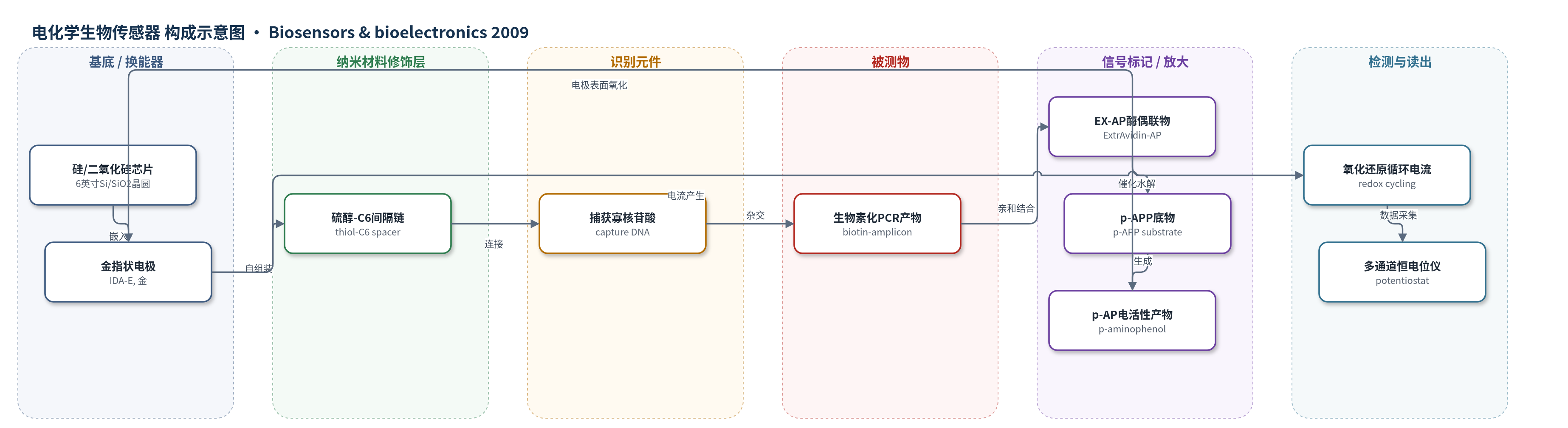
点击图片查看大图 · 依据论文自动绘制
传感器类型
电化学生物传感器
检测对象
炭疽杆菌(Bacillus anthracis, BA)、鼠疫耶尔森菌(Yersinia pestis, YP)、土拉弗朗西斯菌(Francisella tularensis, FT)、正痘病毒(orthopoxviruses, OPV)的PCR产物;样品基质为质粒DNA/PCR产物(模拟生物战剂核酸样品)
检测原理
检测采用非对称PCR,其中一条引物5′端生物素标记,使扩增产物带有生物素。PCR产物稀释后与金电极上硫醇-C6捕获寡核苷酸杂交,目标DNA被固定在电极表面。ExtrAvidin-碱性磷酸酶偶联物(EX-AP)通过亲和素-生物素作用结合到生物素化PCR产物上,使酶靠近电极。加入4-氨基苯基磷酸酯(p-APP)后,碱性磷酸酶催化其水解生成电活性4-氨基苯酚(p-AP)。p-AP在互指金电极表面发生氧化还原循环(redox cycling),被反复氧化和还原,从而放大电流。停流模式下电流斜率随杂交生物素化PCR产物量增加而增大,与模板浓度或实时PCR CT值相关,实现无荧光探针标记的电化学检测。
检测灵敏度
LOD: 10–50 ge;线性范围: 0.5–25 μL PCR产物(CT=24,约2×10^5 ge);R^2 = 0.9998
效应效果
系统全自动分析不含PCR时总时间为27 min,作者称后续可缩短至8 min以内。阳性对照芯片间变异系数为15.4%(n=35芯片、105个电极信号);FT PCR产物片内变异0.7%、片间13.1%,PC片内3.9%。阴性位点背景约2 nA/min,方法选择性好且几乎无背景,优于典型光学微阵列。电学微阵列灵敏度与实时PCR相当,可重复检测10–50 ge PCR产物;多重PCR与单重PCR信号无显著差异,可平行识别四种病原体且无交叉背景。未报告实际临床或环境样品加标回收率,作者主张用于现场/即时分子诊断筛查。
传感器的构成
- 基底/换能器电极:6英寸硅晶圆(Si)上二氧化硅(SiO2)层中嵌入金指状互连电极(interdigitated array gold electrodes, IDA-E),并集成对电极与氧化铱参考电极
- 修饰层:5′-硫醇-C6间隔链(thiol-C6 spacer)在金表面形成自组装单分子层,将捕获序列抬离电极表面
- 识别元件:捕获寡核苷酸(capture oligonucleotides)与4 nt间隔序列相连,特异性杂交生物素化PCR产物
- 对照层:生物素标记与非标记寡核苷酸混合物(PC)及非生物素化寡核苷酸(NC),用于功能质控、信号归一化和背景对照
- 信号标记物:ExtrAvidin®碱性磷酸酶偶联物(EX-AP)通过亲和素-生物素结合识别生物素化PCR产物
- 电子供体/底物:4-氨基苯基磷酸酯(p-APP)被碱性磷酸酶水解生成电活性4-氨基苯酚(p-AP),在电极表面发生氧化还原循环放大
- 封闭/结合缓冲:TTBS(30 mM Tris、100 mM NaCl、0.05% Tween 20、1% BSA)用于EX-AP结合并抑制非特异结合
中文摘要
为高灵敏检测诊断PCR扩增产物,本文报道一种新型电学低密度微阵列,并与实时定量PCR进行比较。该全自动紧凑型生物传感器系统以嵌入硅芯片的互指阵列金电极(IDA-E)为核心,基于酶联电化学检测。生物界面由金表面硫醇修饰捕获寡核苷酸构成,用于特异性识别经单重或多重PCR扩增的目标DNA。研究展示了该电学微阵列作为高级筛查方法,可平行检测炭疽杆菌、鼠疫耶尔森菌、土拉弗朗西斯菌和正痘病毒四种高威胁生物战剂。由10–50个基因当量产生的PCR产物可被重复检测;不同病原体量实验显示方法可靠且灵敏,与光学实时PCR检测系统相当。不含PCR步骤时总检测时间为27 min。多重PCR与电学微阵列检测相结合可避免复杂的PCR探针标记策略。
英文摘要
For the sensitive detection of amplicons derived from diagnostic PCR, a novel electrical low-density microarray is applied and compared to state-of-the-art quantitative real-time PCR. The principle of the electrochemical method and the effective use for analysis are described. Interdigitated array gold electrodes (IDA-E) embedded into a silicon chip are the core technology of the fully automated compact biosensor system, basing on enzyme coupled electrochemical detection. The biointerface is built up with thiol-modified capture oligonucleotides on gold and mediates the specific recognition of hybridised target DNA amplified with uniplex or multiplex PCR. In here we show the potential of the designed electrical microarray to function as an advanced screening method for the parallel detection of a panel of the four pathogens Bacillus anthracis, Yersinia pestis, Francisella tularensis and ortho pox viruses (genus), which are among the most relevant biowarfare agents. PCR products, generated from 10 to 50 gene equivalents, have been detected reproducibly. The experiments with varying pathogen amounts showed the good reliability and the high sensitivity of the method, equivalent to optical real-time PCR detection systems. Without PCR the total assay time amounts to 27 min. The advantage of the combination of multiplex-PCR with electrical microarray detection avoiding intensive PCR probe labelling strategies is illustrated.