组成图示
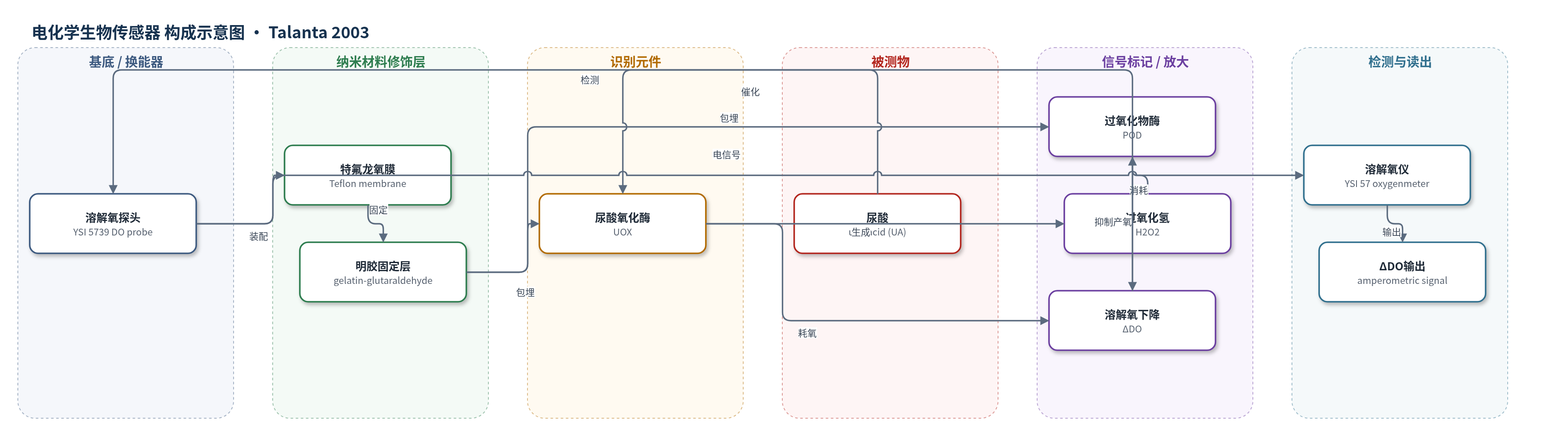
点击图片查看大图 · 依据论文自动绘制
传感器类型
电化学生物传感器
检测对象
尿酸(uric acid, UA);样品基质:尿液(urine,7500倍稀释)
检测原理
尿酸氧化酶特异性催化尿酸与O2、H2O反应生成尿囊素、CO2和H2O2,同时消耗溶解氧;生成的H2O2可非酶分解产生O2,抵消部分耗氧信号。过氧化物酶偶联消耗H2O2,消除该干扰,使界面溶解氧下降更真实。DO探头通过特氟龙氧选择性膜感知生物活性层与膜界面处溶解氧浓度变化,将ΔDO转换为安培/电学信号,由YSI 57溶解氧仪读出。尿酸浓度越高,UOX催化耗氧越多,ΔDO越大,在0.1–0.5 mM线性。
检测灵敏度
LOD: 0.1 mM;线性范围: 0.1–0.5 mM
效应效果
传感器对L-天冬氨酸、柠檬酸、L-谷氨酸、乙醇酸、草酸和葡萄糖无响应,选择性良好;0.3 mM尿酸重现性n=10,均值0.296 mM,S.D. 0.009 mM,C.V. 2.96%;4°C储存1个月后活性保持>83%。尿液7500倍稀释后,标准法测得生物传感器2180、试剂盒1978(原文单位mM l^-1),加标4182后总浓度4162和3960,回收率99.5%和94.7%。作者称其LOD 0.1 mM低于多种方法,可完成>50次测定,适合常规尿液尿酸分析。
传感器的构成
- 换能器电极:YSI 5739溶解氧探头(DO probe),用于检测溶解氧(DO)浓度变化。
- 氧选择性隔膜:特氟龙膜(Teflon membrane, 0.0005 in),以O-ring固定并经0.5% SDS预处理,允许氧透过并降低表面张力。
- 固定化基质:明胶(gelatin, calf skin gelatin 225 bloom),承载并固定尿酸氧化酶与过氧化物酶。
- 识别元件:尿酸氧化酶(UOX, E.C 1.7.3.3),特异性催化尿酸氧化并生成H2O2。
- 偶联信号酶:过氧化物酶(POD, E.C 1.11.1.7),消耗H2O2,减少其非酶分解产氧对信号的干扰。
- 交联剂:戊二醛(glutaraldehyde, 2.5%),交联明胶-酶体系形成稳定生物活性层。
- 工作缓冲液:磷酸盐缓冲液(phosphate buffer, PB, 50 mM, pH 7.5),氧饱和并在35 °C下维持酶活。
中文摘要
开发了一种基于尿酸氧化酶/过氧化物酶偶联酶系统的新安培生物传感器,用于尿液中尿酸的特异性、选择性测定。商品化尿酸氧化酶和过氧化物酶以明胶为基质、戊二醛交联固定于预处理特氟龙膜上。方法基于尿酸氧化酶催化尿液尿酸生成过氧化氢,过氧化物酶消耗过氧化氢,随后生物传感器测量溶解氧浓度下降。传感器响应在尿酸浓度0.1–0.5 mM间线性。优化研究得到最佳工作条件为磷酸盐缓冲液(pH 7.5,50 mM)和35 °C。最适酶活分别为尿酸氧化酶64.9×10^-3 U cm^-2、过氧化物酶512.7 U cm^-2。还进行了重现性、底物特异性和储存稳定性等特性研究。
英文摘要
A new amperometric biosensor based on urate oxidase-peroxidase coupled enzyme system for the specific and selective determination of uric acid in urine was developed. Commercially available urate oxidase and peroxidase were immobilized with gelatin by using glutaraldehyde and fixed on a pretreated teflon membrane. The method is based on generation of H(2)O(2) from urine uric acid by urate oxidase and its consuming by peroxidase and then measurement of the decreasing of dissolved oxygen concentration by the biosensor. The biosensor response depends linearly on uric acid concentration between 0.1 and 0.5 muM. In the optimization studies of the biosensor, phosphate buffer (pH 7.5; 50 mM) and 35 degrees C were obtained as the optimum working conditions. In addition, the most suitable enzyme activities were found as 64.9x10(-3) U cm(-2) for urate oxidase and 512.7 U cm(-2) for peroxidase. And also some characteristic studies of the biosensor such as reproducibility, substrate specificity and storage stability were carried out.