组成图示
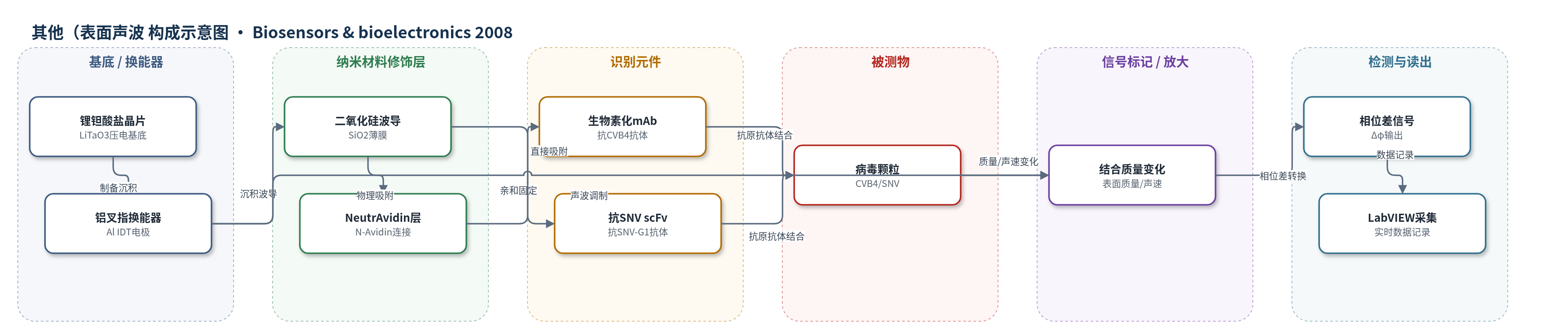
点击图片查看大图 · 依据论文自动绘制
传感器类型
其他(表面声波(SAW)生物传感器)
检测对象
柯萨奇病毒B4(Coxsackie virus B4, CVB4)、辛诺布雷病毒(Sin Nombre virus, SNV,汉坦病毒);样品基质为PBS、蒸馏水、污水排放水、Rio Grande河水等复杂水样(文中亦提及可适用于血液、痰液等体液)
检测原理
该传感器以36° y切锂钽酸盐(LiTaO3)为压电基底,铝叉指换能器(IDT)施加325 MHz交流电压,在基底表面产生水平极化表面剪切波(HPSSW/SH-SAW),并经二氧化硅(SiO2)波导传播。测试延迟线表面固定识别抗体:CVB4通道用NeutrAvidin(N-Avidin)固定生物素化抗CVB4单克隆抗体,SNV通道直接吸附抗SNV-G1 scFv。当病毒颗粒与抗体特异性结合时,传感器表面质量增加并改变界面粘弹性和局部声速,使测试线相对参考线的相位差(Δφ)发生可测变化。LabVIEW程序采集IDT输出电压并转换为相位差,实时扣除参考线背景。信号随病毒浓度增加而线性增大,无需标记,可在数秒内响应。
检测灵敏度
线性范围: CVB4 9×10^5–3.6×10^6 viruses/μl(Δφ 0.95±0.54–6.99±0.96,R^2=0.99);SNV 1.8×10^1–1.8×10^4 viral particles/μl(Δφ 0.63±0.49–4.85±0.77,R^2=0.95);CVB4+HSV-1 R^2=0.98;SNV+HSV-1 R^2=0.97;SNV检测灵敏度约为CVB4的5×10^5倍。
效应效果
该传感器对目标病毒选择性高,HSV-1等量干扰不降低CVB4或SNV检测线性(R^2分别为0.98和0.97);HSV-1单独存在时信号低(CVB4实验3.6×10^6/μl时Δφ=0.64±0.33)。SNV加标至1.8×10^4颗粒/μl时,在蒸馏水、PBS、河水和污水中Δφ分别为8.21±0.11、4.85±0.77、5.36±0.93、4.22±0.84,较背景高约82、48、54、42倍,p<0.05。传感器经有机溶剂、超声和UV-ozone再生后可重复使用,多次抗体再包被后目标信号在均值±约13%标准误差内。相比需前处理的RT-PCR(约5000拷贝/ml)、ELISA和SPR,SAW无需前处理,可检测至少7000 SNV颗粒,适合现场便携检测。
传感器的构成
- 基底/换能器:36° y切、x传播锂钽酸盐(LiTaO3)压电晶片,510 μm厚,产生水平极化表面剪切波(HPSSW)
- 换能器电极:铝(Al)叉指换能器(IDT)及接地、总线、接触焊盘,施加325 MHz交流电压激发并接收表面声波
- 波导层:二氧化硅(SiO2)薄膜,约5000 Å,PECVD沉积并经HMDS处理,承载识别元件并影响声波相位/声速
- 连接层:NeutrAvidin生物素结合蛋白(N-Avidin),0.25 mg/mL PBS物理吸附于测试延迟线,用于固定生物素化抗体(CVB4通道)
- 识别元件:生物素化抗CVB4单克隆抗体(204-4 mAb,IgG2a)或抗SNV-G1单链可变区抗体(scFv),特异性捕获病毒颗粒
- 样品环境:静态流体池,0.4 mL PBS或复杂水样,注入0.1 mL含病毒样品,实现液相检测
- 读出系统:325 MHz电源、LabVIEW程序与笔记本电脑,采集电压并转换为相位差质量位移(Δφ)
中文摘要
病毒在医学和生物防御中备受关注,在远低于致病阈值浓度下实现高灵敏、高特异、高选择性检测仍是挑战。理想的病毒检测应无需样品前处理,可直接用于血液、痰液等体液以及泳池、河流等自然或人工水体。本文报道一种稳健的表面声波(SAW)生物传感器,将325 MHz表面声波的灵敏度与抗体的特异性相结合,用于检测病毒生物制剂。该传感器采用锂钽酸盐(LiTaO3)SAW换能器和二氧化硅(SiO2)波导平台,包含三条测试延迟线和一条参考延迟线,并分别固定抗柯萨奇病毒B4(Coxsackie virus B4)或A类生物制剂辛诺布雷病毒(Sin Nombre virus, SNV,汉坦病毒)的抗体。传感器可在数秒内快速检测递增浓度的病毒颗粒,两种病毒的响应均在一个数量级范围内呈线性,其中SNV检测灵敏度约为CVB4的5×10^5倍。在单纯疱疹病毒1型(HSV-1)干扰下,传感器对目标病毒的选择性未受影响。该传感器可检测低于汉坦病毒心肺综合征(HCPS)患者常见病毒载量的SNV,并能在河水、污水等复杂水样中无需前处理选择性检测SNV。这是首个报道基于抗体的SAW生物传感器检测病毒生物制剂,具有发展为手持、自包含现场快速病毒检测设备的应用潜力。
英文摘要
Viruses are of high medical and biodefense concern and their detection at concentrations well below the threshold necessary to cause health hazards continues to be a challenge with respect to sensitivity, specificity, and selectivity. Ideally, assays for accurate and real time detection of viral agents would not necessitate any pre-processing of the analyte, which would make them applicable for example to bodily fluids (blood, sputum) and man-made as well as naturally occurring bodies of water (pools, rivers). We describe herein a robust biosensor that combines the sensitivity of surface acoustic waves (SAW) generated at a frequency of 325MHz with the specificity provided by antibodies for the detection of viral agents. A lithium tantalate-based SAW transducer with silicon dioxide waveguide sensor platform featuring three test and one reference delay lines was used to adsorb antibodies directed against either Coxsackie virus B4 or the category A bioagent Sin Nombre virus (SNV), a member of the genus Hantavirus, family Bunyaviridae, negative-stranded RNA viruses. Rapid detection (within seconds) of increasing concentrations of viral particles was linear over a range of order of magnitude for both viruses, although the sensor was approximately 5 x 10(5)-fold more sensitive for the detection of SNV. For both pathogens, the sensor's selectivity for its target was not compromised by the presence of confounding Herpes Simplex virus type 1. The biosensor was able to detect SNV at doses lower than the load of virus typically found in a human patient suffering from hantavirus cardiopulmonary syndrome (HCPS). Further, in a proof-of-principle real world application, the SAW biosensor was capable to selectively detect SNV agents in complex solutions, such as naturally occurring bodies of water (river, sewage effluent) without analyte pre-processing. This is the first study that reports on the detection of viral agents using an antibody-based SAW biosensor that has the potential to be used as a hand-held and self-contained device for rapid viral detection in the field.