组成图示
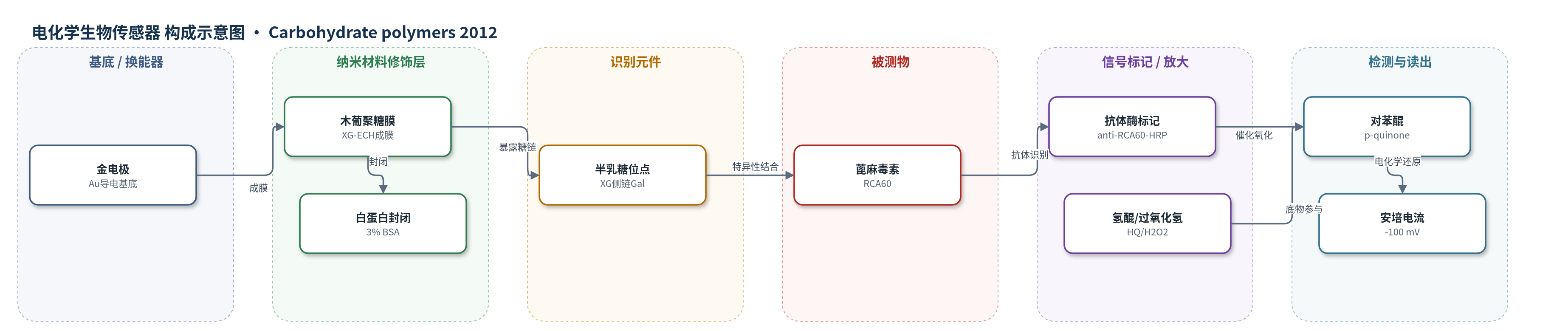
点击图片查看大图 · 依据论文自动绘制
传感器类型
电化学生物传感器
检测对象
蓖麻毒素(ricin, RCA60);样品基质:蓖麻籽粕(castor seed meal)稀释于 0.15 M NaCl,标准品/缓冲液为磷酸盐缓冲液(PB, pH 6.5)
检测原理
该传感器利用 RCA60 B 链对半乳糖/半乳糖胺残基的特异性结合。金电极表面交联 XG 膜暴露半乳糖位点,天然 RCA60 与 XG 结合后,界面形成 RCA60-XG 复合物;变性 RCA60 因失去糖结合能力而不结合。随后加入 anti-RCA60-HRP,抗体识别 RCA60 并将 HRP 定位在电极附近。在 H2O2 和 HQ 存在下,HRP 催化 HQ 氧化为对苯醌,对苯醌在 Au 电极表面被电化学还原,产生阴极电流。RCA60 浓度越高,结合的 HRP 越多,催化生成的对苯醌越多,电流响应越大,从而实现定量与毒性评估。
检测灵敏度
LOD: 2.1 μg mL−1(天然 RCA60);线性范围: 7.0–500 μg mL−1;r = 0.996 (n = 7)
效应效果
该传感器可区分天然与变性 RCA60,无 RCA60 时抗体-HRP 电流与空白相近,特异性来自 XG-RCA60 结合。3% BSA 封闭抑制非特异性吸附。XG 膜 25 次连续伏安循环变化系数 1.4%;三个独立电极对 0.5 mg/mL RCA60 的 RSD 为 6.5%。经 0.1 M glycine-HCl(pH 2.6)5 min 再生后,可连续使用至少 5 次,初始安培响应损失约 5%,7 天内稳定。实际蓖麻籽粕在 1:16 稀释(约 2.2 μg/mL RCA60)下可区分未脱毒与脱毒样品,与 SDS-PAGE 一致。作者认为方法简单、便携,适用于饲料毒性评估。
传感器的构成
- 基底/换能器电极:金电极(Au),经氧化铝抛光、超声、piranha 溶液和电化学清洗,提供导电基底与电流换能
- 修饰层:木葡聚糖薄膜(XG),从 Hymenaea courbaril L. 提取,含半乳糖单元,作为 RCA60 的识别基质;用环氧氯丙烷(ECH)和 NaOH 交联成膜
- 封闭剂:3% 牛血清白蛋白(BSA),封闭非特异性结合位点
- 识别元件:XG 侧链半乳糖残基(Gal),与 RCA60 B 链特异性结合
- 信号标记物:抗 RCA60 多克隆抗体偶联辣根过氧化物酶(anti-RCA60-HRP),识别已结合 RCA60 并催化信号反应
- 底物/电子供体:过氧化氢(H2O2)与氢醌(HQ),在 HRP 催化下生成可电化学还原的对苯醌
- 电化学系统:Ag/AgCl 参比电极、铂丝对电极和磷酸盐缓冲液(PB, pH 6.5),用于三电极安培/伏安检测
中文摘要
蓖麻籽及其粕中含有强细胞毒素蓖麻毒素(RCA60),使其不能直接用作动物饲料。为评估蓖麻籽粕脱毒效果,本文提出一种基于凝集素–碳水化合物相互作用的生物传感器。以金电极为基底,在其表面构建由 Hymenaea courbaril L. 提取的木葡聚糖(XG)薄膜,并用环氧氯丙烷交联以提高稳定性;随后用 3% 牛血清白蛋白(BSA)封闭非特异性位点。检测时,样品中的天然 RCA60 通过 B 链与 XG 上的半乳糖残基结合,再加入辣根过氧化物酶(HRP)标记的抗 RCA60 多克隆抗体。在 H2O2 和氢醌存在下,HRP 催化氢醌氧化生成对苯醌,对苯醌在金电极表面发生电化学还原,产生与 RCA60 浓度相关的电流信号。伏安法表明 XG 膜牢固结合于金电极,该传感器可区分天然与变性 RCA60,对天然 RCA60 的检出限为 2.1 μg mL−1,为蓖麻籽粕毒性评估提供了一种简单、准确的策略。
英文摘要
Oil from the seed of the castor plant (Ricinus communis L.) is an important commodity for a number of industries, ranging from pharmaceuticals to renewable energy resources. However, the seed and subsequent seed meal contain ricin (RCA60), a potent cytotoxin, making it an unusable product for animal feed. In order to investigate the efficiency of reducing the toxicity of the seed meal, a biosensor is proposed by exploring the lectin-carbohydrate binding. A gold electrode was assembled with a film of Xyloglucan (XG) extracted from Hymenaea courbaril L. The analytical response to RCA60 was obtained using a polyclonal antibody against RCA60 conjugated to peroxidase. The current responses were generated by reaction with H2O2 and amplified with hydroquinone as chemical mediator. Voltammetric studies showed that the XG film was tightly bound to the gold electrode. This biosensor allows discriminate lectins in native and denatured forms. The limit of detection of native RCA60 was 2.1 μg mL(-1). This proposed biosensor showed to be a potential and accurate method for toxicity assessment of the ricin in castor seed meal by simple polysaccharide film-electrode strategy.