组成图示
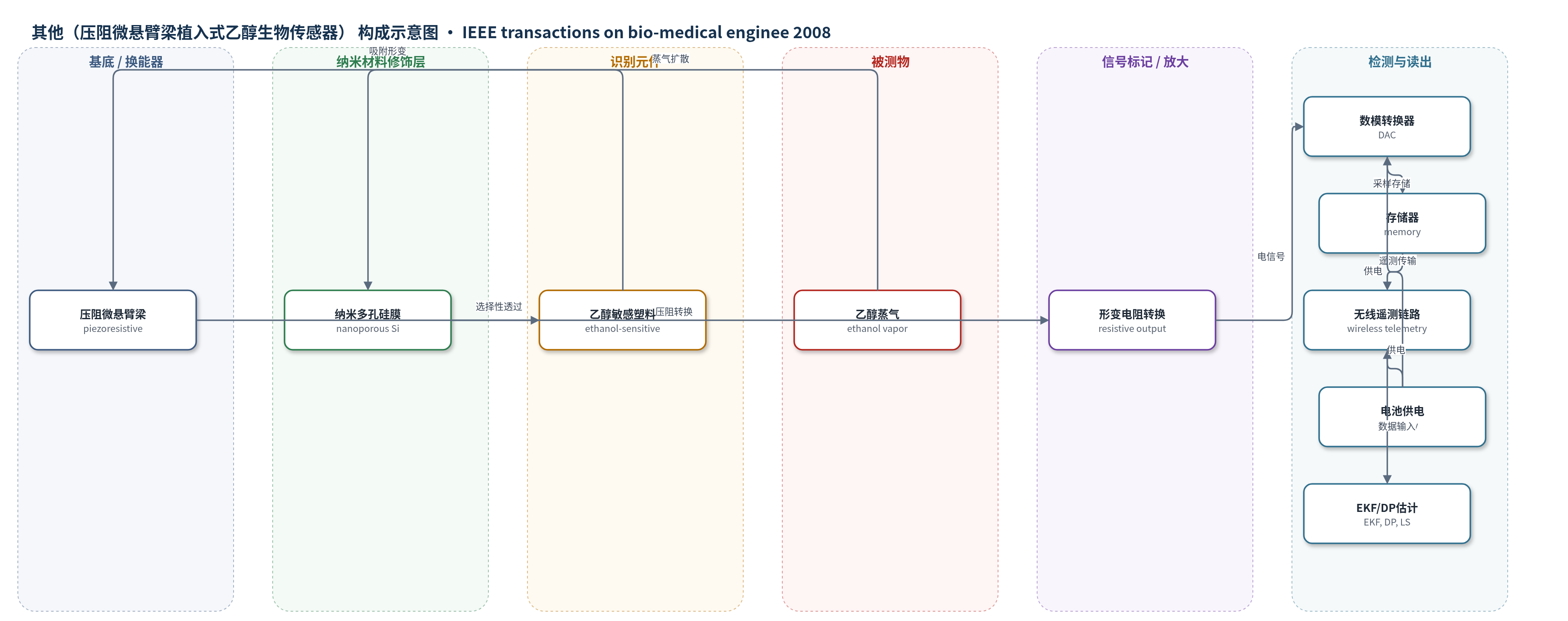
点击图片查看大图 · 依据论文自动绘制
传感器类型
其他(压阻微悬臂梁植入式乙醇生物传感器)
检测对象
乙醇(ethanol, EtOH);样品基质:皮下植入后外周组织/组织间液(peripheral tissue/interstitial fluid)
检测原理
乙醇蒸气从组织间液扩散进入传感器气相腔,先通过纳米多孔硅膜(nanoporous silicon membrane)过滤,阻挡大于乙醇的分子。乙醇被涂覆在压阻微悬臂梁一侧的乙醇敏感塑料(ethanol-sensitive plastic)选择性吸附,使微悬臂梁发生机械形变。压阻微悬臂梁(piezoresistive microcantilever)将形变转换为电阻或电压变化,形成随乙醇浓度变化的电信号。该信号经数模转换器(DAC)采样、存储器暂存,并通过无线遥测链路传输。由于传感器只测外周组织浓度,系统进一步结合乙醇摄入(EC)模型、胃肠道吸收(Gut)模型和药代动力学(PBPK)模型,用扩展卡尔曼滤波(EKF)、动态规划(DP)和最小二乘反演血液、肝脏、外周组织浓度及口服摄入轨迹。方法不依赖化学放大,而依赖MEMS机械换能与统计模型反演。
检测灵敏度
原文未报告LOD、线性范围、灵敏度斜率或相关系数。
效应效果
论文以模拟和典型临床饮酒轨迹评估系统。传感器初步测试噪声标准差小于峰值5%,标称噪声信噪比(NSR)为5%。三阶段算法使口服摄入均方误差(MSE)逐阶段改善;乙醇守恒(AREA)误差从第一阶段较差降至第三阶段约5%;饮酒开始/停止时刻误差在NSR 5%时小于10分钟。系统对胃肠道模型参数30%偏差和恒定变异系数(CCV)传感器模型仍保持稳健。纳米多孔硅膜可阻挡大于乙醇的分子,提供一定选择性。作者认为该方法可满足酒精研究对长期、无创、社区环境饮酒监测的需求,但传感器尚未获得体内实验数据,后续将在动物模型中验证。
传感器的构成
- 换能器:压阻微悬臂梁(piezoresistive microcantilevers),将乙醇敏感层吸附乙醇后的机械形变转换为电阻变化。
- 识别元件:乙醇敏感塑料(ethanol-sensitive plastic),涂覆于微悬臂梁一侧,选择性响应乙醇蒸气。
- 保护过滤层:纳米多孔硅膜(nanoporous silicon membrane),维持气相传感并阻挡大于乙醇的分子。
- 信号处理与遥测模块:数模转换器(DAC)、存储器(memory)、短程无线遥测链路(wireless telemetry link)和天线(antenna),用于离散采样、存储和传输。
- 封装与供电:电池(battery)和皮下植入胶囊(subcutaneous capsule),提供长期植入工作电源与生物相容封装。
中文摘要
为克服酒精研究中难以在社区环境中无创、连续测量数周至数月乙醇摄入的问题,作者提出一种基于微机电系统(MEMS)的皮下植入式乙醇生物传感器及其统计信号处理方法。该传感器植入皮下后测量外周组织乙醇浓度,而非直接测量血液或肝脏浓度。由于口服乙醇需经胃肠道吸收、分布和消除,外周组织浓度与真实摄入之间存在强烈低通滤波和非线性药代动力学关系。为此,论文构建了乙醇摄入(EC)模型、胃肠道吸收(Gut)模型和基于生理学的药代动力学(PBPK)模型,形成乙醇浓度生成模型,并将传感器噪声与漂移作为测量模型。系统采用扩展卡尔曼滤波(EKF)估计状态变量,再结合动态规划(DP)和最小二乘估计口服摄入轨迹与分段恒定饮酒速率,从而从外周组织乙醇浓度时间序列反演血液、肝脏和外周组织乙醇浓度及乙醇摄入时间序列,为饮酒模式识别提供基础。
英文摘要
The understanding of drinking patterns leading to alcoholism has been hindered by an inability to unobtrusively measure ethanol consumption over periods of weeks to months in the community environment. An implantable ethanol sensor is under development using microelectromechanical systems technology. For safety and user acceptability issues, the sensor will be implanted subcutaneously and, therefore, measure peripheral-tissue ethanol concentration. Determining ethanol consumption and kinetics in other compartments from the time course of peripheral-tissue ethanol concentration requires sophisticated signal processing based on detailed descriptions of the relevant physiology. A statistical signal processing system based on detailed models of the physiology and using extended Kalman filtering and dynamic programming tools is described which can estimate the time series of ethanol concentration in blood, liver, and peripheral tissue and the time series of ethanol consumption based on peripheral-tissue ethanol concentration measurements.