组成图示
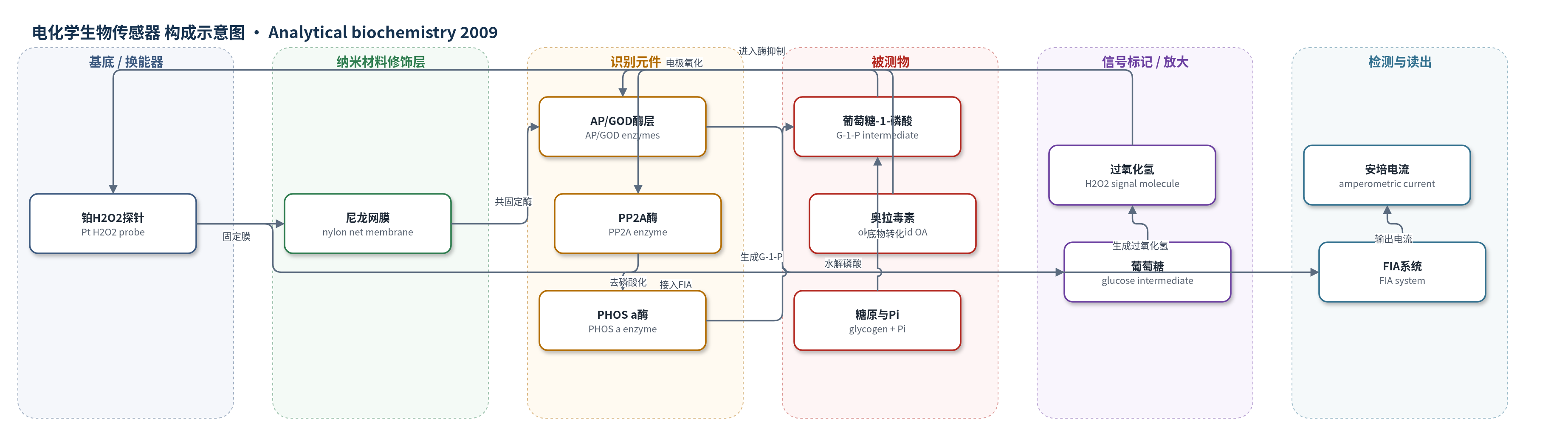
点击图片查看大图 · 依据论文自动绘制
传感器类型
电化学生物传感器
检测对象
奥拉毒素(okadaic acid, OA);样品基质:乙醇-缓冲液标准溶液,目标应用基质为贻贝/贝类组织
检测原理
OA 作为 PP2A 抑制剂,与 PP2A 结合后降低其去磷酸化活性。未受抑制时,PP2A 将活性糖原磷酸化酶α(PHOS a)转化为非活性 PHOS b,使糖原和无机磷酸(Pi)生成葡萄糖-1-磷酸(G-1-P)减少;OA 浓度越高,PP2A 抑制越强,PHOS a 残余活性越高,G-1-P 生成越多。G-1-P 进入双酶探针后,被 AP 水解为葡萄糖,GOD 催化葡萄糖氧化生成 H2O2。H2O2 透过醋酸纤维素膜到达 Pt 电极,在固定电位下发生电化学氧化,产生与 H2O2 浓度成正比的安培电流。该酶级联将 OA 的抑制事件放大为可测电流,电流随 OA 浓度升高而增大。
检测灵敏度
OA 工作范围: 30–250 pg ml⁻¹;OA 信号中点: 70 pg ml⁻¹;G-1-P 线性范围: 10⁻⁵–10⁻² M;G-1-P LOD: 5×10⁻⁶ M
效应效果
该方法通过空白扣除消除乙醇对电极的直接氧化干扰;1% 乙醇、10 min 孵育不抑制 PP2A,2% 和 5% 乙醇则显著抑制 PP2A。双酶 GOD–AP 探针经 2 个月常规使用后活性基本不变,H2O2 传感性能稳定;PHOS a 在 -20°C 保存 1、2、3 周残余活性分别为 70%、60%、50%,建议保存不超过 1 周。OA 校准 n=3 的残余活性为 23±3%(0 pg/mL)、34±4%(30 pg/mL)和 84±1%(250 pg/mL)。作者认为该 FIA 电化学方法简单、可半自动,适合作为贝类组织 OA 筛查工具,但未报告实际样品回收率或与 HPLC/LC-MS 的直接对比。
传感器的构成
- 换能器电极:铂(Pt)H2O2 探针,催化 H2O2 氧化并产生安培电流
- 内充电解质:0.1 M 氯化钾(KCl),填充电极夹套,提供离子导电通路
- 酶固定基底:尼龙网膜(nylon net membrane),经二氯甲烷(CH2Cl2)、三乙氧基氧鎓四氟硼酸盐(TOTFB)、聚乙烯亚胺(PEI)和戊二醛活化,用于共固定酶
- 识别/信号转换酶层:碱性磷酸酶(AP)与葡萄糖氧化酶(GOD)共固定,AP 水解 G-1-P 生成葡萄糖,GOD 氧化葡萄糖生成 H2O2
- 分子筛膜:醋酸纤维素膜(cellulose acetate membrane,MWCO ≈100 Da),阻挡大分子和细菌,允许 H2O2 等小分子透过
- 外保护膜:聚碳酸酯膜(polycarbonate membrane,12 μm 孔径),机械保护酶膜并防止污染
- 密封结构:O 形圈(O-ring),固定各膜并密封电极夹套
中文摘要
本文报道了一种用于流动注射分析(FIA)检测奥拉毒素(okadaic acid, OA)的双酶电化学探针及其优化研究。该探针利用蛋白磷酸酶-2A(PP2A)被 OA 抑制的特性,以及 PP2A 对糖原磷酸化酶α(PHOS a)的调控作用。在无 OA 时,PP2A 将活性 PHOS a 去磷酸化为非活性 PHOS b,使糖原转化为葡萄糖-1-磷酸(G-1-P)减少;OA 存在时 PP2A 被抑制,PHOS a 残余活性增加,G-1-P 生成增多。随后 G-1-P 在碱性磷酸酶(AP)作用下生成葡萄糖,葡萄糖氧化酶(GOD)将葡萄糖氧化生成 H2O2,H2O2 在铂电极上发生电化学氧化产生电流。AP 与 GOD 共固定于尼龙网膜并覆盖于 H2O2 铂探针上,组成双酶电化学探针,接入 FIA 系统。研究优化了缓冲液、酶量、孵育时间等参数,结果表明 OA 在 30–250 pg/mL 范围内呈剂量依赖性抑制 PP2A,总分析时间约 54 min(离线孵育 50 min 加传感器响应 4 min)。
英文摘要
A bienzyme electrochemical probe has been assembled and used to monitor the inhibition of the enzyme protein phosphatase-2A (PP2A) by okadaic acid (OA), taking advantage of the particular characteristics of a biochemical pathway in which PP2A is involved. This enzyme has significant activity toward glycogen phosphorylase a (PHOS a), which in turn catalyzes the conversion of glycogen to glucose-1-phosphate (G-1-P). In addition, PP2A is strongly inhibited by OA and its derivatives. Due to this combination of properties, PP2A was employed to develop an assay system involving a preliminary phase of off-line enzymatic incubations (OA/PP2A, PP2A/PHOS a, PHOS a/glycogen+phosphate). This off-line step was followed by the electrochemical detection of H2O2, which is the final product of two sequential enzymatic reactions: G-1-P with alkaline phosphatase (AP) producing glucose, then glucose with glucose oxidase (GOD) producing hydrogen peroxide. These two enzymes were coimmobilized on a nylon net membrane that was placed over an H2O2 platinum probe inserted into a flow injection analysis (FIA) system. During a first phase of the study, all analytical parameters were optimized. During a subsequent phase, the inhibition of PP2A enzyme by OA was evaluated. The calibration of the system shows a working range for detection of OA between 30 and 250 pg ml(-1). The total analysis time is the sum of 50 min for the off-line enzymatic incubations and 4 min for the biosensor response.