组成图示
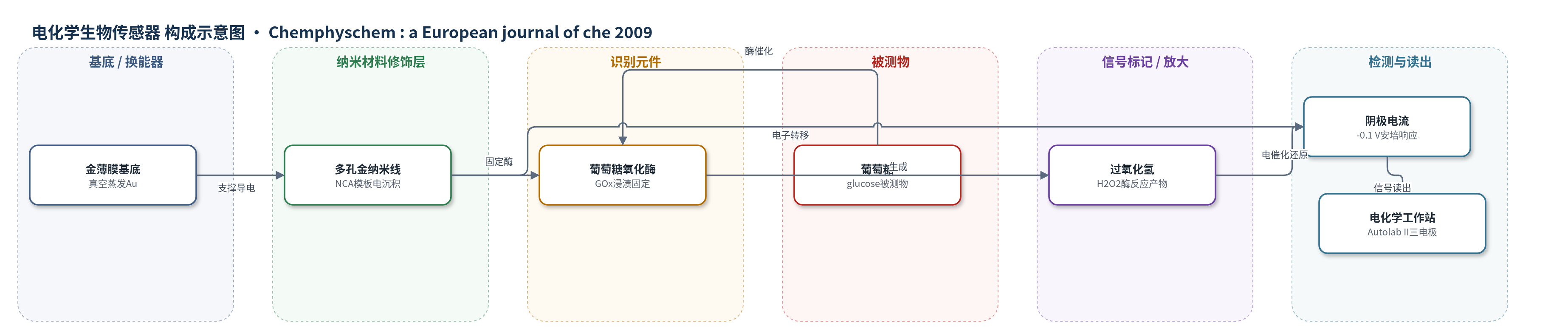
点击图片查看大图 · 依据论文自动绘制
传感器类型
电化学生物传感器
检测对象
葡萄糖(glucose);样品基质:0.1 M磷酸盐缓冲液(PBS, pH 7.0)
检测原理
葡萄糖氧化酶(GOx)固定于多孔金纳米线阵列表面,形成酶-纳米电极界面。当葡萄糖扩散至电极表面时,GOx催化葡萄糖与氧气反应生成葡萄糖酸和过氧化氢(H2O2)。生成的H2O2在多孔金纳米线电极表面发生电催化还原,在-0.1 V下产生阴极电流。多孔金纳米线由纳米颗粒松散堆积形成,具有高比表面积和丰富孔隙,可负载更多GOx并维持其活性;同时其快速界面电子转移降低H2O2还原过电位,使电流响应更快、更强。随着葡萄糖浓度增加,酶反应生成H2O2速率增加,阴极电流线性增大,从而实现葡萄糖定量检测。
检测灵敏度
LOD: 4.6×10⁻⁵ M;线性范围: 5×10⁻⁵ M–2×10⁻³ M;灵敏度: 15.6 mA cm−2 mM−1;斜率: 1.95848 mA/mM(I(mA)=0.03235+1.95848C(mm));R^2 = 0.99906
效应效果
该多孔金纳米线-葡萄糖氧化酶电极对葡萄糖响应迅速,响应时间约5 s,快于实心金纳米线电极的约7 s。其灵敏度约为15.6 mA cm−2 mM−1,高于文献中5.11 mA cm−2 mM−1的GOx金电极,并与15.1 mA cm−2 mM−1的层层共价结合GOx金电极相当;实心金纳米线电极灵敏度约为8.76 mA cm−2 mM−1。在-0.1 V下,0.5 mM抗坏血酸未产生可观察干扰,表明对常见干扰物具有一定抗干扰能力。连续7 d对5 mM葡萄糖的稳定性测试中,多孔电极响应保持约85%,非多孔电极保持约74%。作者认为该方法快速、低成本,可扩展到其他氧化酶型电化学生物传感器。
传感器的构成
- 换能器电极:多孔金纳米线阵列(porous Au nanowire arrays, Au NWs),由纳米通道氧化铝(NCA)模板内一步电沉积Au形成,提供高比表面积与快速电子转移
- 基底电极:真空蒸发金薄膜(Au film),沉积于NCA模板背面,作为初始导电基底
- 模板结构层:纳米通道氧化铝(NCA, nanochannel alumina),孔径约65 nm,限定金纳米线形貌,后续用5 wt%磷酸刻蚀去除
- 识别元件:葡萄糖氧化酶(GOx, glucose oxidase),浸渍固定于多孔金纳米线阵列,催化葡萄糖氧化
- 信号标记物:过氧化氢(H2O2),酶反应产物,在电极表面电催化还原产生阴极电流
- 电解液与测量电极:0.1 M磷酸盐缓冲液(PBS, pH 7.0)、饱和KCl Ag/AgCl参比电极和Pt箔对电极,用于三电极电化学测量
中文摘要
本文报道利用纳米通道氧化铝(NCA)模板通过一步电沉积法制备多孔金纳米线阵列。金纳米线的微观结构强烈依赖于电沉积电流密度,低电流密度下由于成核速率低、分散结晶而形成由纳米颗粒松散堆积构成的多孔结构。采用电化学阻抗谱研究多孔金纳米线阵列的界面电子传输特性,结果表明其具有快速界面电子转移和典型多孔电极阻抗特征。循环伏安测试显示该多孔金纳米线电极在低电位下对过氧化氢具有明显的电催化还原和氧化响应。将葡萄糖氧化酶(GOx)固定于多孔金纳米线阵列电极上,构建了葡萄糖电化学生物传感器。与实心金纳米线阵列电极相比,多孔电极具有更大的有效比表面积,可负载更多GOx并维持其生物活性,同时改善质量传输和电子传输。该传感器对葡萄糖具有快速、灵敏的电化学响应,可用于葡萄糖检测。
英文摘要
Nanochannel alumina templates are used as templates for fabrication of porous gold nanowire arrays by a direct electrodeposition method. After modification with glucose oxidase, a porous gold nanowire-array electrode is shown to be an excellent electrochemical biosensor for the detection of glucose. The picture shows an SEM image of a nanowire array after removal of the alumina template by acid dissolution. We report the fabrication of porous gold nanowire arrays by means of a one-step electrodeposition method utilizing nanochannel alumina templates. The microstructure of gold nanowires depends strongly on the current density. The formation of porous gold nanowires is attributed to disperse crystallization under conditions of low nucleation rate. Interfacial electron transport through the porous gold nanowires is studied by electrochemical impedance spectroscopy. Cyclic voltammetric studies on the porous gold nanowire arrays reveal a low-potential electrocatalytic response towards hydrogen peroxide. The properties of the glucose oxidase modified porous gold nanowire array electrode are elucidated and compared with those of nonporous enzyme electrodes. The glucose oxidase modified porous gold nanowire-array electrode is shown to be an excellent electrochemical biosensor for the detection of glucose.