组成图示
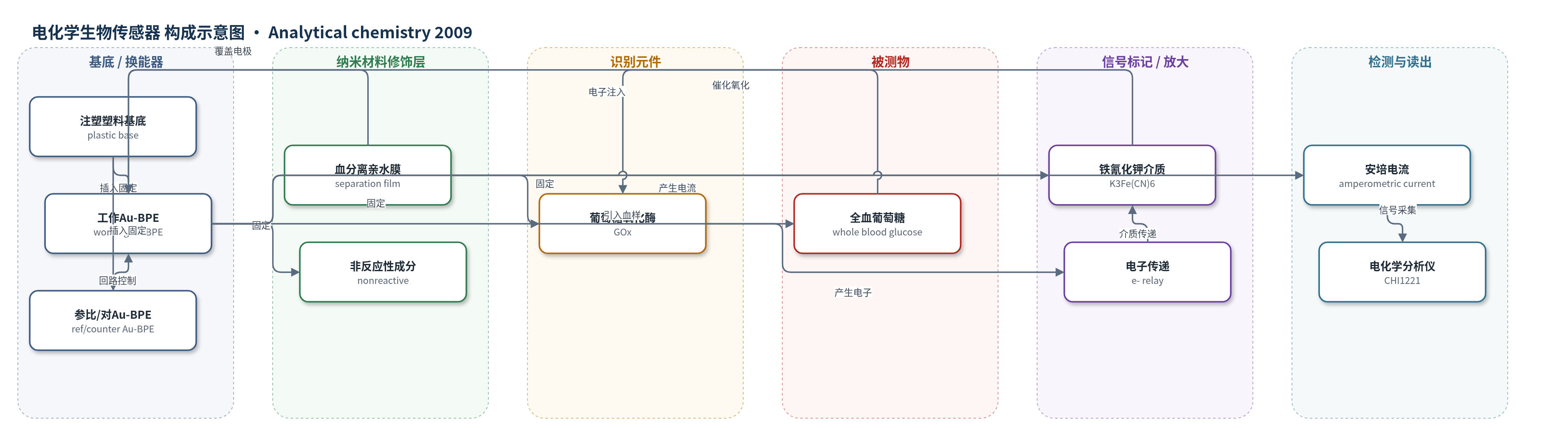
点击图片查看大图 · 依据论文自动绘制
传感器类型
电化学生物传感器
检测对象
葡萄糖(glucose);样品基质:全血/毛细血管血(whole blood/capillary blood),另在 pH 7.4 PBS 中校准
检测原理
传感器采用两电极安培检测。全血样品经试纸条侧边 U 形缺口毛细作用进入反应区,血分离/亲水膜引导血浆接触电极。葡萄糖氧化酶(GOx)特异性识别并催化葡萄糖氧化,产生还原态酶/电子;铁氰化钾(K3Fe(CN)6)作为可溶性电子介质接受电子并在 Au-BPE 表面被氧化,将电子传递至工作电极。在 +0.2 V 固定电位下,介质氧化产生稳态阳极电流,电流大小与葡萄糖浓度成正比。低工作电位降低抗坏血酸、尿酸等电活性物质干扰,两电极配置简化电路并提高批量一致性。
检测灵敏度
线性范围: linear up to 800 mg/dL (i.e., 44.5 mM, r2 > 0.99) in pH 7.4 PBS;灵敏度: 0.71 µA/mM
效应效果
传感器在 pH 7.4 PBS 中对葡萄糖线性至 800 mg/dL(44.5 mM),灵敏度 0.71 µA/mM,r2 > 0.99,低电位工作可抑制电活性干扰。传感器间 CV 为 0.8–1.4%(56.5–561.0 mg/dL),优于商业传感器(CV 3–6%)。176 份 30–572 mg/dL 毛细血管血与 YSI 2300 参考值比较,Clarke 误差网格 100% 位于 A 区(96.6%)和 B 区(3.4%),r2 = 0.982。25、40、50 °C 干燥储存 90 天,5 mM 葡萄糖响应偏差 <5%。作者认为该技术可避免丝网印刷活性面积不一致,适合大规模制备一次性安培试纸条,并可推广至胆固醇、尿素、尿酸和 HbA1c 检测。
传感器的构成
- 基底/换能器电极:注塑塑料基底(injection molding plastic base)与两根桶镀金电极(Au-BPE),分别作工作电极和参比/对电极,提供导电与安培换能。
- 电极固定结构:塑料基底中空孔以物理过盈方式插入 Au-BPE,无粘合剂,保证批量制造一致性。
- 识别元件层:葡萄糖氧化酶(GOx,48.5%)固定于 Au-BPE 表面,特异性催化葡萄糖氧化。
- 电子介质层:铁氰化钾(K3Fe(CN)6,8.5%)作为电子传递介质,将 GOx 催化产生的电子传递至电极并降低工作电位。
- 辅助试剂层:非反应性成分(nonreactive ingredients,43%)作为载体/稳定成分,与 GOx 和铁氰化钾共同构成生物试剂层。
- 样品导入/分离膜层:3M 亲水膜(hydrophilic film)围绕集成试剂/血分离膜区域,利用毛细作用引入血样并辅助血细胞分离。
- 样品入口结构:试纸条侧边 U 形缺口(U-shaped notch)控制血样体积进入反应区。
中文摘要
本文报道利用桶镀金电极制备一次性安培葡萄糖生物传感器的应用。该传感器通过将两根桶镀金电极插入注塑塑料基底,并在电极表面固定生物试剂层和膜制成。桶镀的主要功能是为制造零件提供经济电镀方式;其制造流程简单,可提高自动化批量生产的制造精度。在两电极体系中,葡萄糖检测在 pH 7.4 PBS 中线性范围达 800 mg/dL(即 44.5 mM,r2 > 0.99),灵敏度为 0.71 µA/mM。传感器间重现性优异,检测 56.5–561.0 mg/dL 葡萄糖时变异系数仅为 0.8–1.4%。实验室试验采用 176 份葡萄糖浓度为 30–572 mg/dL 的毛细血管血样品评价临床应用,所提生物传感器测量值与实验室参考值呈良好线性相关。误差网格分析表明该技术有望大规模制备生物传感器试纸条。以全血葡萄糖为模型分析物成功验证后,该制备技术可推广至其他桶镀贵金属电极用于多种应用。
英文摘要
We demonstrate here the application of barrel plating gold electrodes for fabricating a new type of disposable amperometric glucose biosensor. It is prepared by inserting two barrel plating gold electrodes onto an injection molding plastic base followed by immobilizing with a bioreagent layer and membrane on the electrode surface. The primary function of barrel plating is to provide an economical way to electroplate manufactured parts. The manufacture procedure is simple and can increase the fabrication precision for automation in mass production. At the two-electrode system, the detection of glucose is linear up to 800 mg/dL (i.e., 44.5 mM, r(2) > 0.99) in pH 7.4 PBS with a sensitivity of 0.71 microA/mM. Excellent sensor-to-sensor reproducibility shows coefficients of variation of only 0.8-1.4% for the detection of 56.5-561.0 mg/dL glucose. In laboratory trials 176 capillary blood samples with a range of 30-572 mg/dL glucose are used to evaluate the clinical application of the biosensor. A good linear correlation is observed between the measured values of the proposed biosensor and laboratory reference. Error grid analysis verifies that the proposed technique is promising in fabricating biosensor strips on a mass scale. As successfully demonstrated by using whole blood glucose as a model analyte, the fabrication technique can extend into other barrel plating noble metal electrodes for various applications.