组成图示
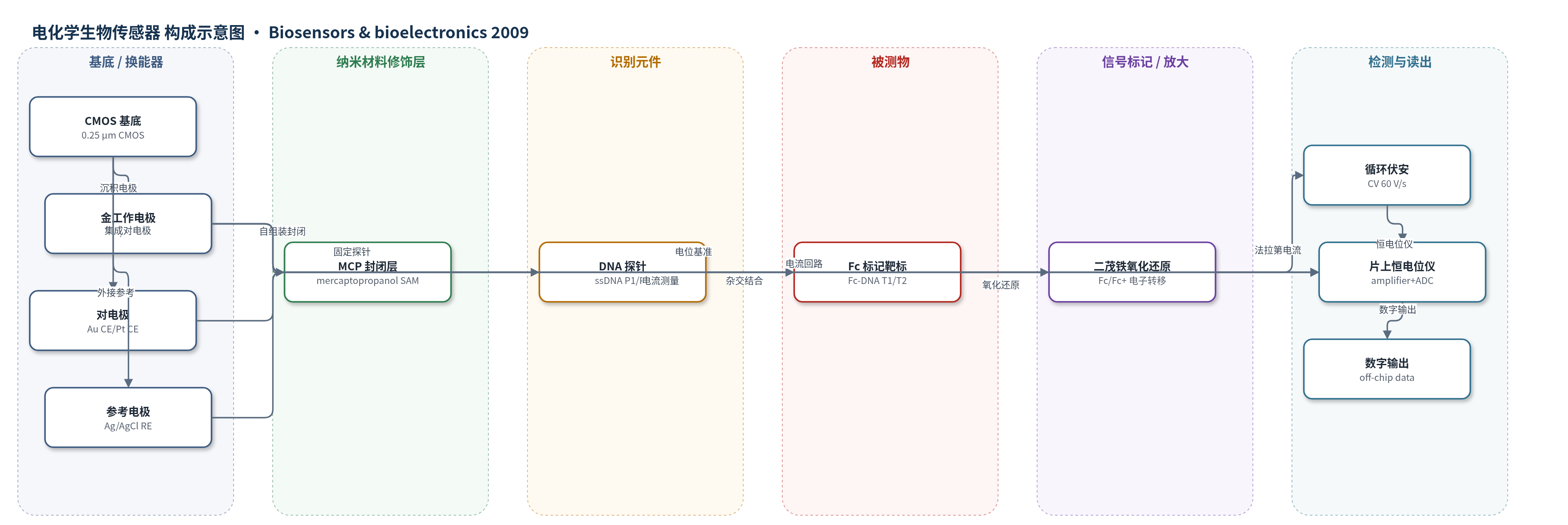
点击图片查看大图 · 依据论文自动绘制
传感器类型
电化学生物传感器
检测对象
DNA 靶标(DNA targets T1/T2),样品基质为磷酸盐缓冲液(PPB, pH 7.4)
检测原理
硫醇化 ssDNA 探针经 Au–S 键固定于 Au 工作电极,MCP 自组装单分子层封闭非特异结合位点。二茂铁 (Fc) 标记的靶标 DNA 与互补探针杂交后,Fc 位于电极表面附近,在循环伏安扫描中发生 Fc ↔ Fc+ + e− 的表面氧化还原反应,产生法拉第电流;未杂交靶标在溶液中不能有效电子转移,因此无需洗涤即可实时监测。峰电流与扫描速率和电极面积成正比,扣除双电层充电电流后积分法拉第面积,再除以电子电荷和电极面积,可得到表面杂交覆盖度。覆盖度随靶标浓度按 Langmuir 等温线增加,从而可定量分析杂交程度与动力学。
检测灵敏度
LOD: 50 pM 靶标浓度(≈4 × 10^10 cm^-2);最小可测电流: 550 pA(S/N=3)
效应效果
该平台在 4×4 CMOS 阵列上实现多路、特异性 DNA 杂交检测:P1 位点仅响应 T1,P2 位点仅响应 T2,非互补靶标无信号。60 nM T1 实时杂交最大覆盖度约 6.8×10^12 cm^-2,时间常数 τ≈590 s,kf≈2.4×10^4 M^-1 s^-1,kr≈2.4×10^-4 s^-1;多路位点 τ 分别约 540 s 和 740 s。浓度系列 Langmuir 拟合 Ka≈1×10^8 M^-1,最低测量覆盖度约 1×10^12 cm^-2(4 nM,x=0.1)。硬件检测限为 550 pA(S/N=3),对应约 50 pM 靶标浓度或 4×10^10 cm^-2。当前阵列密度约 250 cm^-2,优化后可达 >6000 cm^-2。作者认为其可发展便携、低成本、高通量 DNA 诊断平台,并克服荧光微阵列无法实时监测的局限。
传感器的构成
- CMOS 基底:0.25 μm CMOS 芯片,集成控制放大器、10-bit ADC 与数字电路,提供主动读出与电极互连
- 工作电极:Au/Ti 修饰顶层金属,Au 厚 200 nm、Ti 厚 20 nm,作为 DNA 探针固定与氧化还原反应界面
- 对电极:片上 Au CE 或片外 Pt-wire CE,与参考电极构成三电极体系,提供电流源/汇
- 参考电极:Ag/AgCl/3 M NaCl RE,维持缓冲液稳定电位
- 识别元件:3′-硫醇化 20-mer ssDNA 探针 P1/P2,经 Au–S 键自组装固定于 Au 工作电极
- 封闭层:1 mM mercaptopropanol (MCP) 自组装单分子层,钝化 Au 表面并降低非特异结合
- 信号标记物:靶标 DNA 5′ 端连接 N-(2-ferrocene-ethyl) maleimide 二茂铁 (Fc) 氧化还原标签,杂交后产生法拉第电流
中文摘要
基于荧光检测的光学生物传感已成为定量表面固定探针与荧光标记靶标之间 DNA 杂交程度的标准方法,但其光学仪器体积庞大,难以用于即时检测。电化学检测技术有望消除对笨重光学部件的依赖,实现便携式设备;与荧光检测不同,多路电化学检测需要电子活性基底,并受益于集成电子仪器,以减小平台尺寸并避免未放大信号引出芯片带来的电磁干扰。本文报道了一种采用标准互补金属氧化物半导体(CMOS)工艺构建的主动电化学生物传感器阵列,用于在芯片上对偶联二茂铁氧化还原标签的靶标 DNA 进行定量杂交检测。该 5 mm×3 mm 芯片包含 4×4 金工作电极阵列和集成恒电位仪电子,包括控制放大器与电流输入模数转换器,通过循环伏安驱动氧化还原反应、感知 DNA 结合并将数字数据传输出芯片。研究展示了 DNA 靶标的多路、特异性检测以及杂交过程的实时监测,这是传统荧光微阵列难以实现的任务。
英文摘要
Optical biosensing based on fluorescence detection has arguably become the standard technique for quantifying extents of hybridization between surface-immobilized probes and fluorophore-labeled analyte targets in DNA microarrays. However, electrochemical detection techniques are emerging which could eliminate the need for physically bulky optical instrumentation, enabling the design of portable devices for point-of-care applications. Unlike fluorescence detection, which can function well using a passive substrate (one without integrated electronics), multiplexed electrochemical detection requires an electronically active substrate to analyze each array site and benefits from the addition of integrated electronic instrumentation to further reduce platform size and eliminate the electromagnetic interference that can result from bringing non-amplified signals off chip. We report on an active electrochemical biosensor array, constructed with a standard complementary metal-oxide-semiconductor (CMOS) technology, to perform quantitative DNA hybridization detection on chip using targets conjugated with ferrocene redox labels. A 4 x 4 array of gold working electrodes and integrated potentiostat electronics, consisting of control amplifiers and current-input analog-to-digital converters, on a custom-designed 5 mm x 3 mm CMOS chip drive redox reactions using cyclic voltammetry, sense DNA binding, and transmit digital data off chip for analysis. We demonstrate multiplexed and specific detection of DNA targets as well as real-time monitoring of hybridization, a task that is difficult, if not impossible, with traditional fluorescence-based microarrays.