组成图示
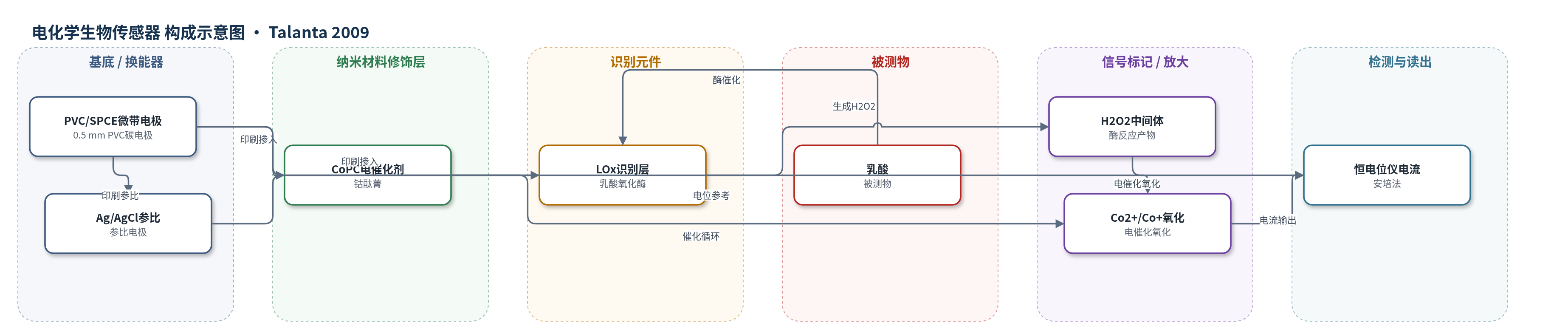
点击图片查看大图 · 依据论文自动绘制
传感器类型
电化学生物传感器
检测对象
乳酸(lactate)、过氧化氢(H2O2);样品基质:0.25 M pH 7.3 磷酸盐缓冲液(含 0.1 M NaCl),拟用于细胞培养液。
检测原理
乳酸氧化酶(LOx)催化乳酸氧化为丙酮酸并生成过氧化氢(H2O2)。H2O2扩散至钴酞菁(CoPC)修饰的微带碳电极表面,在+400 mV恒电位下发生电催化氧化:2Co2+PC + H2O2 → 2Co+PC + 2H+ + O2,随后2Co+PC → 2Co2+PC + 2e−,电子转移产生电流。微带电极边缘形成径向扩散,使电流达到稳态并与被测物浓度成正比。选择+400 mV而非最大电流电位,可降低干扰并避免CoPC在+0.5–0.6 V发生不可逆失活。该体系无额外信号放大,主要依靠微带电极增强传质和电流密度。
检测灵敏度
乳酸:LOD: 289 μM;线性范围: 1–6 mM(动态范围 1–10 mM);灵敏度: 3.63 nA mM−1;R^2 = 0.98。H2O2:LOD: 15 μM;线性范围: 0.07–7 mM;灵敏度: 59 nA mM−1。
效应效果
该传感器在静置与搅拌条件下响应相近,表明微带电极以径向扩散为主,信噪比提高。选择+400 mV可降低干扰并避免CoPC在+0.5–0.6 V的不可逆失活。乳酸校准内电极变异系数约9%(n=6),H2O2校准CV为9–18.5%;传感器稳定至少两周。未报告实际样品加标回收率。与文献中基于乳酸氧化酶的宏尺寸传感器检出限4.4 μM、10 μM和300 μM相比,本文289 μM具有竞争力。作者认为该微带乳酸生物传感器可用于体外细胞培养液中乳酸的长期电化学监测,以评估细胞代谢。
传感器的构成
- 基底与换能器:0.5 mm PVC基底上的丝网印刷碳电极(SPCE),剪切形成微带工作电极,提供电子传导与稳态电流。
- 电催化剂修饰层:水基碳墨中掺入钴酞菁(CoPC),电催化氧化H2O2并维持Co2+/Co+循环。
- 识别元件:乳酸氧化酶(LOx)掺入水基碳墨,催化乳酸氧化为丙酮酸并生成H2O2。
- 参比电极:印刷Ag/AgCl参比电极,提供稳定电位参考。
- 绝缘与微带成型层:绝缘层与介电胶带定义9 mm2区域,剪切暴露电极边缘形成微带,降低欧姆降并增强径向扩散。
- 信号转换介质:酶反应生成的H2O2作为电活性中间体,在+400 mV下被CoPC电催化氧化,电流与乳酸浓度相关。
中文摘要
本研究首次证明,由水基碳墨制备的丝网印刷碳微带电极可直接检测过氧化氢,并在同一墨中加入乳酸氧化酶后可构建用于乳酸测定的微带生物传感器。这些微带器件通过剪切常规尺寸丝网印刷碳电极(SPCE)制成,其中含有电催化剂钴酞菁(CoPC)。采用多种电化学方法对过氧化氢响应进行表征:循环伏安曲线呈S形,电流密度达4.2 mA cm−2;扫描速率研究表明传质为径向与平面扩散混合,但静置与流体力学条件下的安培研究进一步表明径向扩散占主导。计时安培研究显示,不同过氧化氢浓度下均可获得稳态电流,且电流与浓度成正比。随后将乳酸氧化酶掺入水基配方中印刷并剪切,制成乳酸微带生物传感器。伏安图表明乳酸氧化酶未损害电极对过氧化氢的检测完整性。选择+400 mV进行校准,乳酸可在1–10 mM范围内测定,至6 mM呈线性,计算检出限为289 μM。该研究为通过微带生物传感器电化学监测体外细胞代谢提供了平台。
英文摘要
The present study demonstrated for the first time that screen-printed carbon microband electrodes fabricated from water-based ink can readily detect H(2)O(2) and that the same ink, with the addition of lactate oxidase, can be used to construct microband biosensors to measure lactate. These microband devices were fabricated by a simple cutting procedure using conventional sized screen-printed carbon electrodes (SPCEs) containing the electrocatalyst cobalt phthalocyanine (CoPC). These devices were characterised with H(2)O(2) using several electrochemical techniques. Cyclic voltammograms were found to be sigmoidal; a current density value of 4.2 mA cm(-2) was obtained. A scan rate study revealed that the mass transport mechanism was a mixture of radial and planar diffusion. However, a further amperometric study under quiescent and hydrodynamic conditions indicated that radial diffusion predominated. A chronoamperometric study indicated that steady-state currents were obtained with these devices for a variety of H(2)O(2) concentrations and that the currents were proportional to the analyte concentration. Lactate microband biosensors were then fabricated by incorporating lactate oxidase into the water-based formulation prior to printing and then cutting as described. Voltammograms demonstrated that lactate oxidase did not compromise the integrity of the electrode for H(2)O(2) detection. A potential of +400 mV was selected for a calibration study, which showed that lactate could be measured over a dynamic range of 1-10mM which was linear up to 6mM; a calculated lower limit of detection of 289 microM was ascertained. This study provides a platform for monitoring cell metabolism in-vitro by measuring lactate electrochemically via a microband biosensor.