组成图示
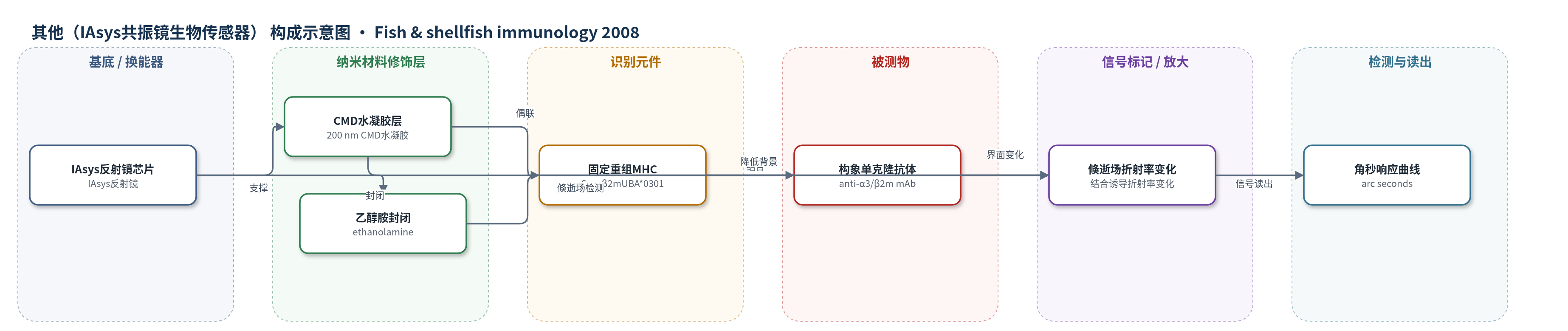
点击图片查看大图 · 依据论文自动绘制
传感器类型
其他(IAsys共振镜生物传感器)
检测对象
鲑MHC I/β2-微球蛋白单链复合物(Sasaβ2mUBA*0301,recombinant single-chain salmon MHC class I/β2m),样品基质为重组蛋白溶液(复性后,固定于CMD表面)
检测原理
该检测采用IAsys共振镜生物传感器。重组单链鲑MHC I/β2m复合物先偶联到羧甲基葡聚糖(CMD)水凝胶表面,未结合位点用乙醇胺封闭。当流动相中的构象特异性单克隆抗体(anti-α3或anti-β2m)与固定MHC结合时,传感表面质量与局部折射率发生变化。IAsys通过倏逝场监测表面折射率变化,引起反射镜共振条件改变,实时输出角秒(arc seconds)响应。抗体浓度或结合量越高,响应越大;未结合或阴性对照响应低。该过程无酶促或核酸放大,信号直接来自抗原-抗体结合引起的界面折射率变化。
检测灵敏度
原文未报告 LOD、线性范围、灵敏度斜率或相关系数。
效应效果
论文未报告RSD、实际样品加标回收率或LOD。重组蛋白以包涵体形式表达,产量达10 mg/L,优化后获得5 mg/L;Ni-NTA纯化后经抗体亲和层析得到53 kDa条带,Bradford法测得最终浓度200 mg/mL。IAsys生物传感器对重组MHC与三种构象抗体的结合产生150–230角秒响应,阴性对照无相应结合。作者指出与ELISA相比,生物传感器可实时监测结合/解离、使用小体积样品、通过调节流速和搅拌降低传质限制,且传感表面可再生。该体系可生产足量鲑MHC I蛋白,用于研究肽结合特异性并设计针对ISAV的肽疫苗。
传感器的构成
- 换能器基底:IAsys resonant mirror biosensor 反射镜芯片,检测倏逝场折射率变化
- 传感表面:200 nm 厚羧甲基葡聚糖(CMD)水凝胶层,提供活化结合位点
- 识别元件:重组单链鲑 MHC I/β2m(Sasaβ2mUBA*0301),固定于 CMD 表面
- 封闭剂:乙醇胺(ethanolamine),封闭未结合活化 CMD 位点
- 信号分子:构象特异性单克隆抗体(anti-α3 clone 7、anti-β2m clone 45/15),结合后改变界面
- 读出介质:蒸馏水(distilled water),流动相并搅拌
中文摘要
二聚体I类主要组织相容性复合体(MHC)分子由约45 kDa重链和12 kDa β2-微球蛋白(β2m)轻链组成。过去十年对大西洋鲑MHC基因的认识使作者能够制备具有生物活性的可溶性、稳定MHC I分子。本文报道利用细菌表达系统生产基于Sasa-UBA*0301等位基因的重组单链MHC分子;选择该等位基因是因为既往研究提示其与传染性鲑贫血病毒抗性相关。所设计的单链鲑MHC I分子中,β2m羧基端通过15或20个氨基酸柔性肽连接子与重链氨基端相连(Sasaβ2mUBA*0301)。作者成功制备针对MHC I重链和β2m的单克隆抗体,并显示其结合重组分子。重组复合物经表达、分离,并通过优化条件放大生产;随后用抗β2m和α3的单克隆抗体亲和层析纯化,Western blot分析洗脱液,并通过去除变性剂复性。利用生物传感器分析其识别天然MHC构象的单克隆抗体结合能力,确认正确折叠。该体系可生产足量MHC I蛋白,有助于研究MHC I肽结合特异性并设计针对病毒病原的肽疫苗。
英文摘要
Heterodimeric class I major histocompatibility complex (MHC) molecules consist of a putative 45-kDa heavy chain and a 12-kDa beta2-microglobulin (beta2m) light chain. The knowledge about MHC genes in Atlantic salmon accumulated during the last decade has allowed us to generate soluble and stable MHC class I molecules with biological activity. We report here the use of a bacterial expression system to produce the recombinant single-chain MHC molecules based on a specific allele Sasa-UBA*0301. This particular allele was selected because previous work has shown its association with the resistance to infectious salmon anaemia virus. The single-chain salmon MHC class I molecule has been designed and generated, in which the carboxyl terminus of beta2m is joined together with a flexible 15 or 20 amino acid peptide linker to the amino terminus of the heavy chain (Sasabeta2mUBA*0301). Monoclonal antibodies were successfully produced against both the MHC class I heavy chain and beta(2)m, and showed binding to the recombinant molecule. The recombinant complex Sasabeta2mUBA*0301 was expressed and isolated; the production was scaled up by adjusting to its optimal conditions. Subsequently, the recombinant proteins were purified by affinity chromatography using mAb against beta2m and alpha3. Eluates were analyzed by Western blot and refolded by the removal of denaturant. The correct folding was confirmed by measuring its binding capacity against mAb produced to recognize the native form of MHC molecules by biosensor analysis. This production of sufficient amounts of class I MHC proteins may represent a useful tool to study the peptide-binding specificity of MHC class I molecules, in order to design a peptide vaccine against viral pathogens.