组成图示
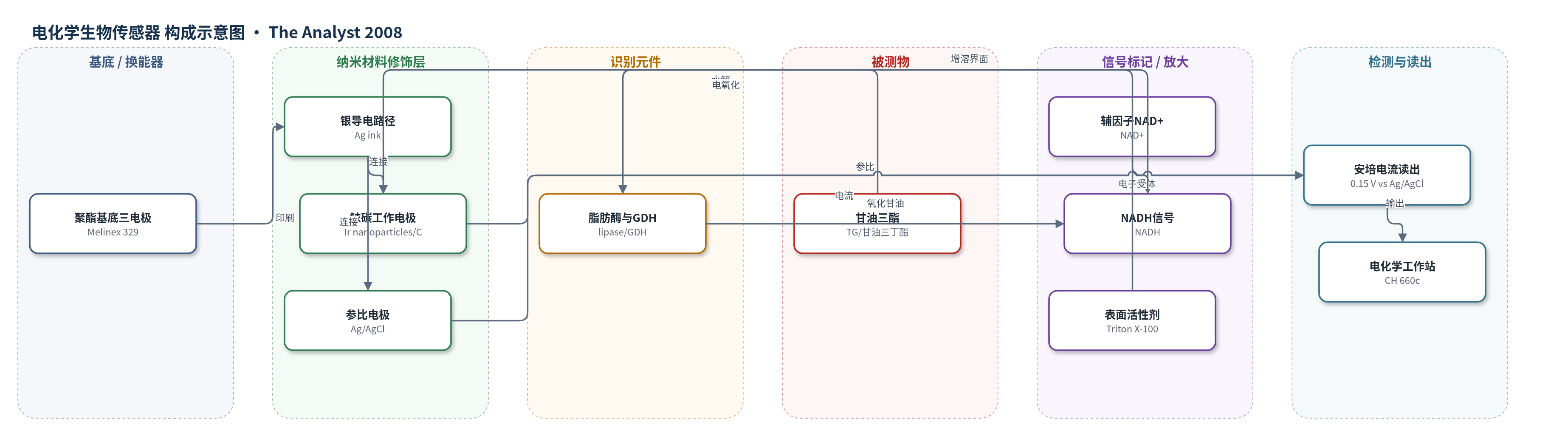
点击图片查看大图 · 依据论文自动绘制
传感器类型
电化学生物传感器
检测对象
甘油三酯(triglyceride, TG);样品基质:牛血清、人血清;模型底物:甘油三丁酯(glyceryl tributyrate)、葵花籽油(sunflower seed oil)模拟血液TG。
检测原理
TG在脂肪酶(lipase)催化下水解为甘油和脂肪酸;甘油在NAD+存在下被甘油脱氢酶(GDH)氧化为二羟基丙酮,同时生成NADH。NADH扩散至铱纳米颗粒修饰的碳工作电极,在+0.15 V(vs Ag/AgCl)发生电催化氧化,产生与NADH浓度成正比的安培电流。TG浓度越高,酶促生成的NADH越多,电流越大。Ir纳米颗粒降低NADH氧化过电位并抑制尿酸、抗坏血酸等干扰。加入Triton X-100形成胶束,增加TG水相界面面积,提高脂肪酶水解效率;升高孵育温度可加快酶反应,从而增强信号。
检测灵敏度
线性范围: 0–10 mM(glyceryl tributyrate,牛血清);灵敏度: 7.5 nA mM-1;线性范围: 0–10 mM(glyceryl tributyrate,人血清);灵敏度: 7.0 nA mM-1;线性范围: 0–150 mg dL-1(sunflower seed oil模拟TG,牛血清);灵敏度: 0.191 nA dL mg-1(=16.9 nA mM-1);线性范围: 0–150 mg dL-1(sunflower seed oil模拟TG,人血清);灵敏度: 0.188 nA dL mg-1(=16.63 nA mM-1)
效应效果
在牛血清和人血清中,尿酸(UA,416 μmol L-1)和抗坏血酸(AA,86 μmol L-1)会提高背景电流,但扣除背景后TG检测电流变化很小,AA几乎无干扰,UA仅有轻微干扰。含UA和AA的人血清中甘油三丁酯灵敏度为9.2 nA mM-1,与牛血清结果相近。加入0.25%(v/v)Triton X-100可优化TG水解界面;37–57 °C范围内电流差随温度以3.93 nA/单位温度增加,优化孵育温度为52 °C。传感器为一次性丝网印刷电极,可低成本批量制备,适用于家庭或即时检测场景。
传感器的构成
- 基底/换能器:聚酯薄膜(Melinex 329)与丝网印刷三电极,提供一次性可印刷载体。
- 导电路径:银导电油墨(Ag ink),连接工作、对、参比电极。
- 工作电极/对电极:铱纳米颗粒掺杂碳墨(Ir nanoparticles doped carbon ink,5% Ir;含聚乙烯亚胺PEI和羟乙基纤维素HEC),催化NADH氧化并降低过电位。
- 参比电极:Ag/AgCl油墨,提供稳定参比电位。
- 绝缘层:绝缘油墨(insulator ink),覆盖非电极区域防止短路。
- 识别元件:脂肪酶(lipase,EC 3.1.1.3,Candida rugosa)与甘油脱氢酶(GDH,EC 1.1.1.6,Cellulomonas),在样品溶液中水解TG并氧化甘油。
- 辅因子/反应物:β-烟酰胺腺嘌呤二核苷酸(NAD+),作为GDH电子受体生成NADH。
- 信号标记/放大:酶促生成的NADH,在Ir修饰电极上电氧化产生电流;Triton X-100表面活性剂增加TG界面面积。
中文摘要
本研究报道了一种基于铱纳米颗粒修饰碳基电极的安培型生物传感器,用于血清中甘油三酯(TG)的检测与定量。检测基于对酶促反应生成的NADH进行电化学检测:TG在脂肪酶作用下水解生成甘油,甘油在NAD+存在下被甘油脱氢酶(GDH)催化氧化,生成NADH。研究选用短链甘油三酯甘油三丁酯作为模型底物,在牛血清和人血清中评估传感器性能。实验观察到甘油三丁酯在0–10 mM范围内呈线性响应,牛血清中灵敏度为7.5 nA mM-1,人血清中为7.0 nA mM-1。同时评估了尿酸(UA)和抗坏血酸(AA)的潜在干扰。加入适量表面活性剂并提高孵育温度可提升传感器性能。作者以葵花籽油模拟血液TG,优化了牛血清中TG检测条件。结果表明,该铱纳米颗粒修饰工作电极生物传感器为血清TG的准确测定提供了简便手段。
英文摘要
The detection and quantification of triglyceride (TG) using an iridium nano-particle modified carbon based biosensor was successfully carried out in this study. The detection procedures were based on the electrochemical detection of enzymatically produced NADH. TG was hydrolyzed by lipase and the glycerol produced was catalytically oxidized by NAD-dependent glycerol dehydrogenase producing NADH in a solution containing NAD(+). Glyceryl tributyrate, a short chain triglyceride, was chosen as the substrate for the evaluation of this TG biosensor in bovine serum and human serum. A linear response to glyceryl tributyrate in the concentration range of 0 to 10 mM and a sensitivity of 7.5 nA mM(-1) in bovine serum and 7.0 nA mM(-1) in human serum were observed experimentally. The potential interference of species such as uric acid (UA) and ascorbic acid (AA) was assessed. The incorporation of a selected surfactant and an increase in the incubation temperature appeared to enhance the performance of this biosensor. The conditions for the determination of TG levels in bovine serum using this biosensor were optimized, with sunflower seed oil being used as an analyte to simulate the detection of TG in blood. The experimental results demonstrated that this iridium nano-particle modified working electrode based biosensor provided a relatively simple means for the accurate determination of TG in serum.