组成图示
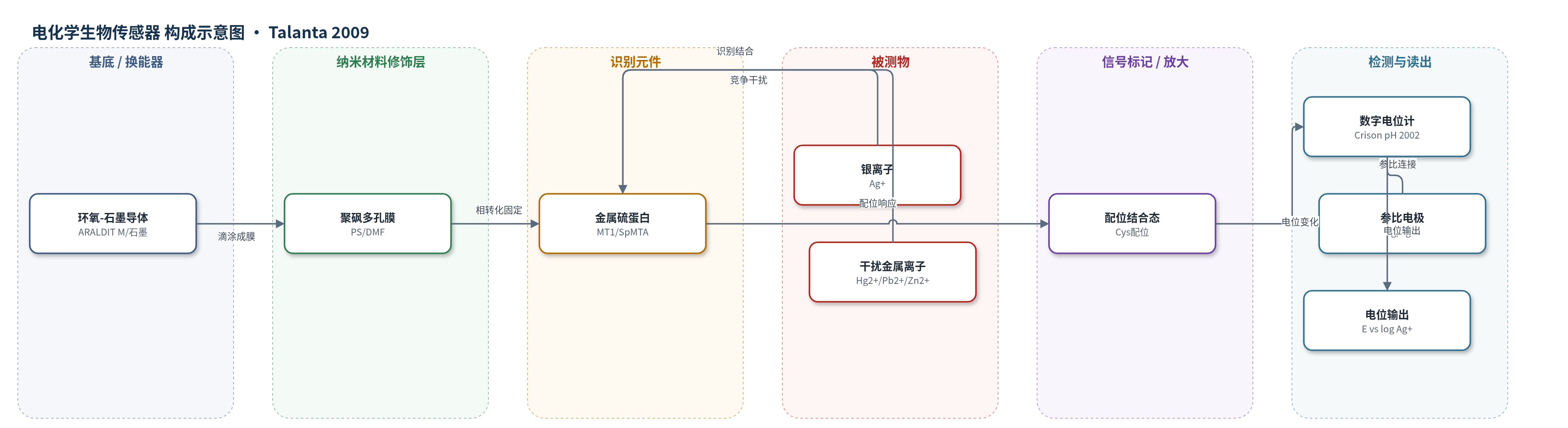
点击图片查看大图 · 依据论文自动绘制
传感器类型
电化学生物传感器
检测对象
银离子(silver ion, Ag+);样品基质为水溶液/标准溶液(含NaNO3或硝酸盐背景)
检测原理
全固态指示电极由环氧-石墨内部导体和聚砜(PS)膜组成,金属硫蛋白(MT)以锌配合物形式经相转化嵌入PS膜,并在0.1 M Ag+中预处理2 h,使结合位点发生Zn(II)/Ag(I)置换。当溶液Ag+浓度变化时,Ag+与膜内MT的半胱氨酸硫醇配位,改变膜/溶液界面离子复合平衡和电荷分布,产生与Ag+活度相关的膜电位。该电位通过数字电位计相对Ag/AgCl参比电极读出,在10^-5–10^-2 M范围内呈Nernst线性,斜率约61 mV/十倍浓度。不同MT因氨基酸组成和金属结合亲和力不同,对Pb2+、Zn2+等干扰响应不同。该传感器无酶催化或核酸放大,选择性主要来自蛋白配位识别。
检测灵敏度
LOD: about 10−5 M;线性范围: 10−5 to 10−2 M;灵敏度: ca. 61 mV per decade;P1-ISE LOD: 3.1 × 10⁻⁵ M (S.D. = 1 × 10⁻⁶), 60 mV/dec (S.D. = 4);P2-ISE LOD: 2.5 × 10⁻⁵ M (S.D. = 8 × 10⁻⁶), 62 mV/dec (S.D. = 3)
效应效果
干存优于湿存:湿存4、6、10 d后灵敏度分别下降30%、60%、100%;干存4–5 ℃保存3个月无显著变化。连续10 d校准重现性良好,P1-ISE LOD 3.1×10⁻⁵ M(S.D.=1×10⁻⁶)、斜率60 mV/dec(S.D.=4),P2-ISE LOD 2.5×10⁻⁵ M(S.D.=8×10⁻⁶)、斜率62 mV/dec(S.D.=3)。功能pH约3.0–7.5,pH>8因Ag2O生成使电位下降。选择性上,Hg2+干扰最强;P1-ISE对Pb2+、Zn2+、Cd2+、Cu2+干扰低,P2-ISE受Pb2+、Zn2+弱干扰,与SpMTA亲和力更高一致。作者认为其选择性优于需孵育/再生的MT电容传感器,展示蛋白离子载体电位传感器新方向。
传感器的构成
- 内部导体:环氧树脂ARALDIT M与固化剂HY 5162(1:0.4 w/w)及石墨粉(1:1 w/w)制成环氧-石墨浆料,固化后作为全固态内部接触与导电基底
- 膜基质:聚砜(polysulfone, PS)溶于N,N-二甲基甲酰胺(DMF,100 mg/mL),滴涂后相转化形成100–200 μm多孔膜,提供蛋白固定微环境
- 识别/离子载体:重组金属硫蛋白小鼠MT1(P1)或海胆SpMTA(P2),以锌配合物形式嵌入PS膜,通过半胱氨酸配位结合Ag+
- 活化层:0.1 M Ag+溶液浸泡2 h,使蛋白结合位点发生Zn(II)/Ag(I)置换,形成Ag+响应态
- 参比电极:双盐桥Ag/AgCl参比电极(Orion 90-02-00),提供稳定电位参考
- 信号读出:数字电位计Crison pH 2002(±0.1 mV)与计算机控制软件,测量指示电极与参比电极间电位差
中文摘要
本文报道利用固定化金属结合生物分子构建新型电位型传感器用于金属分析。以银离子选择性电极(Ag+-ISE)为模型,采用聚砜(PS)多孔聚合物基质嵌入金属硫蛋白(MT)作为离子载体,包括小鼠MT1(P1)和海胆SpMTA(P2)。聚砜此前未用于电位型生物传感器,其优点是与生物材料相容;相转化法使蛋白始终处于水相,减少结构改变。制备所需蛋白量少,可干燥保存且寿命长。电极在10^-5至10^-2 M Ag+范围内呈线性响应,斜率约61 mV/十倍浓度,检出限约10^-5 M,工作pH 2-8。除Hg2+外,Pb2+、Zn2+、Cd2+、Cu2+对Ag+测定无明显干扰。值得注意的是,Pb2+和Zn2+对P1-ISE与P2-ISE的亲和力不同,与这些阳离子对SpMTA高于MT1的亲和力一致。因此,不同MT的金属结合特征得以保留,并决定其生物传感器的差异性能。这些结果为将蛋白用作离子载体、开发新型电位型生物传感器提供了广泛可能。
英文摘要
We show here the use of immobilized metal-binding biomolecules for metal analysis by using novel potentiometric sensors. To this end and as a model, Ag(+)-ISEs were developed using polysulfone matrix embedding metallothioneins as ionophores (mouse MT1 (P1) or sea urchin SpMTA (P2)). Polysulfone, a porous polymer that was not used until the present in potentiometric biosensors, has the advantage of being compatible with biological materials. Also, the phase inversion procedure allows protein incorporation into the membrane with minima alterations, since it always remains in the aqueous phase. Construction of these biosensors required small amounts of protein; they can be dry-stored and have long lifetimes. They exhibited linear responses with slopes of ca. 61mV per decade within the 10(-5) to 10(-2)M Ag(+) concentration range, detection limits of about 10(-5)M, and worked in the 2-to-8 pH range. Except for Hg(2+), the Pb(2+), Zn(2+), Cd(2+), Cu(2+) cations do not interfere with Ag(+) determination. Significantly, different affinities of Pb(2+) and Zn(2+) towards P1- and P2-ISE were found, in good correlation with the higher affinity of these cations towards SpMTA than to MT1. Consequently, the distinct metal-binding features of each MT are conserved and determine the differential properties of their biosensors. These results open a broad range of possibilities for the use of proteins as ionophores in what could be considered a new type of potentiometric biosensor if their response mechanism is taken into account.