组成图示
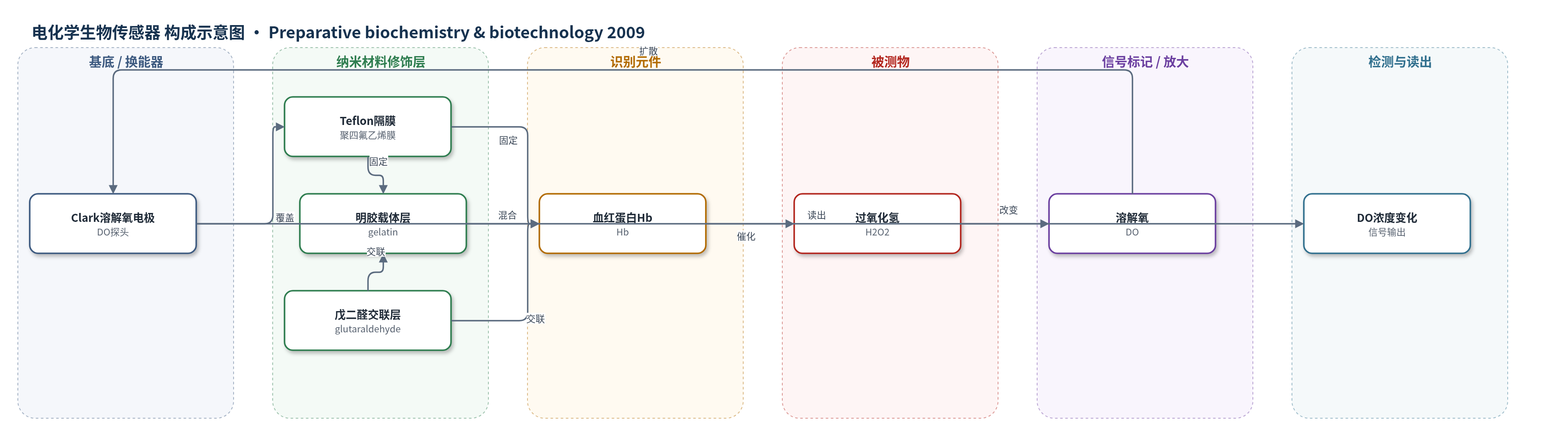
点击图片查看大图 · 依据论文自动绘制
传感器类型
电化学生物传感器
检测对象
过氧化氢(H2O2);样品基质:牛奶(milk)及磷酸盐缓冲液标准
检测原理
本传感器以血红蛋白(Hb)作为识别/催化元件。Hb 分子含有四个电活性血红素铁中心,具有类似过氧化物酶的电催化活性,可催化过氧化氢(H2O2)还原。Hb 与明胶混合后以戊二醛交联固定于预处理 Teflon 膜上,形成生物活性层。待测 H2O2 从样品中扩散穿过 Teflon 膜进入生物活性层,与固定化 Hb 的血红素中心发生催化反应。该反应引起反应体系中溶解氧(DO)浓度下降,DO 变化通过 Clark 溶解氧电极进行电化学检测。随着 H2O2 浓度增加,DO 下降幅度增大,从而获得与 H2O2 浓度相关的信号。该过程无需外加酶或纳米放大材料,主要依赖 Hb 自身血红素催化活性。
检测灵敏度
线性范围: 100–1000 mM H2O2;R^2 = 0.9923
效应效果
在优化条件下,传感器对 H2O2 的线性范围为 100–1000 mM,相关系数 R^2=0.9923。重复性实验以 600 mM H2O2 为标准(n=10),平均响应为 590 mM,标准偏差 16.2 mM,变异系数 2.7%,表明信号重现性良好。实际样品分析中,未预处理牛奶样品加标 600 mM H2O2,三个样品测得 611、611、592 mM,回收率分别为 +1.8%、+1.8%、−1.3%,与加标量吻合较好。作者认为该传感器制备简单、材料廉价,可用于牛奶等实际样品中 H2O2 的检测。文中未报告选择性、抗干扰、长期稳定性及与 ELISA/HPLC 等方法的对比。
传感器的构成
- 换能器电极:Clark 溶解氧电极(YSI 5700 系列 DO 探头),用于检测溶解氧浓度变化
- 隔膜层:高灵敏度 Teflon(聚四氟乙烯)膜,覆盖于探头表面并允许物质扩散
- 载体层:明胶(gelatin/gelatine),与血红蛋白混合形成生物活性膜
- 识别/催化元件:血红蛋白(Hb),提供血红素电催化活性以催化 H2O2 还原
- 交联固定层:戊二醛(glutaraldehyde,2.5%),交联 Hb-明胶并固定于 Teflon 膜
- 信号介质:溶解氧(DO),H2O2 加入后 DO 浓度下降作为检测信号
中文摘要
过氧化氢(H2O2)的检测在工业、环境保护和临床监测等领域具有重要意义;H2O2 若被摄入、吸入或接触皮肤和眼睛可能具有毒性。血红蛋白(Hb)含有四个电活性血红素铁中心,可作为研究血红素蛋白电子转移反应的模型分子,也可用于生物传感和电催化。本研究将血红蛋白固定于 Clark 电极表面,开发了一种用于检测 H2O2 的新型电化学生物传感器。测量原理基于固定化血红蛋白对 H2O2 还原的电催化活性。血红蛋白与明胶经戊二醛交联后固定于预处理 Teflon 膜上。研究确定了生物传感器的最佳条件,包括最适宜的血红蛋白和明胶用量以及戊二醛比例,并开展了最佳 pH 和最佳温度等表征。重复性实验计算了平均值、标准差和变异系数。优化和表征后,该传感器被应用于实际样品中 H2O2 的测定。
英文摘要
The detection of hydrogen peroxide, H2O2, plays an important role in many fields including industry, environmental protection, and clinical control. Hydrogen peroxide can be toxic if ingested, inhaled, or by contact with the skin or eyes. Hemoglobin is a molecule with four electroactive iron hemes which can be used as an ideal model molecule for the study of electron transfer reactions of heme proteins and also for biosensing and electrocatalysis. The present study describes the immobilization of hemoglobin on a Clark electrode surface to develop a novel electrochemical biosensor for the detection of hydrogen peroxide. The principle of the measurements was based on the electrocatalytic activity of the immobilized hemoglobin to the reduction of hydrogen peroxide. Hemoglobin was crosslinked with gelatine using glutaraldehyde and fixed on a pretreated teflon membrane. The optimum conditions for the biosensor were established. The most suitable hemoglobin and gelatin amounts and glutaraldehyde ratio were determined. Characterization studies of the biosensor, such as optimum pH and optimum temperature, were carried out. The repeatability experiments were done and the average value (x), standard deviation (S.D.), and variation coefficient (C.V.) were calculated. After the optimization and characterization studies the proposed biosensor was applied to determination of H2O2 in real samples.