组成图示
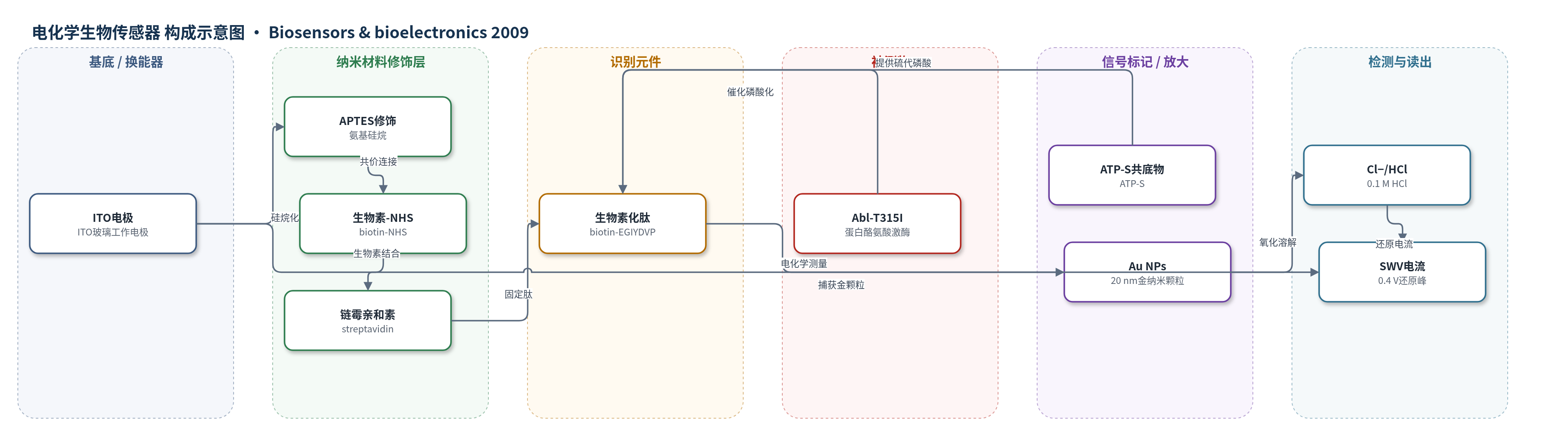
点击图片查看大图 · 依据论文自动绘制
传感器类型
电化学生物传感器
检测对象
Abl-T315I蛋白酪氨酸激酶活性(Abl1-T315I kinase activity);样品基质为体外HEPES磷酸化反应缓冲液(60 mM HEPES,pH 7.5,含MgCl2、MnCl2、Na3VO4、ATP-S);同时可监测小分子抑制剂staurosporine的抑制作用。
检测原理
生物素化底物肽biotin-EGIYDVP经生物素–链霉亲和素作用固定在APTES/生物素-NHS修饰的ITO电极上。加入Abl-T315I和ATP-S后,激酶将ATP-S的γ-硫代磷酸基团转移到肽的酪氨酸残基,生成硫代磷酸化肽。硫代磷酸化肽与Au NPs结合,使金颗粒在电极表面富集。随后在0.1 M HCl中,Au NPs于1.20 V被氧化为[AuCl4]−,表面生物分子变性,[AuCl4]−在约0.4 V被还原,SWV还原峰电流与Au NPs数量成正比,从而反映激酶活性。加入staurosporine抑制硫代磷酸化时,Au NPs减少,电流下降。
检测灵敏度
LOD: 10 ng/mL(Abl-T315I活性);Abl-T315I信号在>100 ng/mL饱和;线性范围: 10–500 μM(biotin-EGIYDVP底物肽浓度)。
效应效果
传感器对Abl-T315I选择性良好:非特异性PKC底物肽biotin-SIYRRGSRRWRKL响应可忽略,目标/非目标肽t检验P<0.005。250 μM目标肽四次测量χ²=1.388、P=0.71,t检验P=0.14–0.23,重复性良好;各条件n=3。反应2 h后信号饱和。Lineweaver–Burk得Km=0.672 mM、Vmax=6.73 pmol min−1 μg−1,与放射性标记文献一致。500 nM staurosporine使电流下降50%,>1 μM信号可忽略,与文献Ki=620 nM相符。作者认为可用于体外激酶谱分析和小分子抑制剂高通量筛选。
传感器的构成
- 基底/换能器电极:ITO玻璃工作电极(indium tin oxide, ITO,电阻率8–12 Ω),提供电化学测量界面。
- 氨基硅烷修饰层:APTES((3-aminopropyl)triethoxysilane)10% v/v水溶液浸渍并120 °C烘烤,在ITO表面引入氨基。
- 生物素化层:biotin-NHS(biotinamidohexanoic acid N-hydroxysuccinimide ester)10 μM,与APTES氨基共价连接,提供生物素结合位点。
- 链霉亲和素固定层:streptavidin 10 μM,结合生物素并固定生物素化底物肽;Tween-20(1.0% w/v)封闭游离位点。
- 识别/底物层:biotin-EGIYDVP(生物素化Abl-T315I特异性底物肽),作为PTK催化硫代磷酸化的底物。
- 酶促反应层:Abl-T315I(蛋白酪氨酸激酶)与ATP-S(adenosine 5′-[γ-thio] triphosphate)共底物,催化肽的硫代磷酸化。
- 纳米信号标记层:Au NPs(20 nm胶体金纳米颗粒,A525=0.5),通过硫代磷酸化肽在表面富集,作为电化学信号放大元件。
- 电化学读出介质:0.1 M HCl(pH 2)提供Cl−,Ag/AgCl参比电极与Pt对电极;Au NPs在1.20 V氧化为[AuCl4]−并在约0.4 V还原产生电流。
中文摘要
本文报道了一种基于金纳米颗粒(Au NPs)的电化学生物传感器,用于监测蛋白酪氨酸激酶(PTK)催化的肽磷酸化反应。在肽修饰的氧化铟锡(ITO)电极上,以腺苷5′-[γ-硫]三磷酸(ATP-S)作为共底物进行硫代磷酸化。肽被硫代磷酸化后,Au NPs在电极表面富集,并通过监测Au NP表面的Cl−氧化/还原进行电化学检测。作者以与慢性髓系白血病(CML)治疗相关的临床重要激酶Abl-T315I为模型,结合其高特异性底物肽EGIYDVP测定激酶活性,电化学检测Abl-T315I活性的检出限为10 ng/mL。通过优化传感器性能,并利用非特异性肽修饰电极进行对照实验,证实了方法的选择性。基于Cl−氧化化学获得的电化学电流响应还可用于监测小分子抑制剂staurosporine对硫代磷酸化反应的抑制。
英文摘要
Protein tyrosine kinase (PTK)-catalysed phosphorylation reactions of peptides are monitored electrochemically in the presence of Au nanoparticles (NPs) on peptide modified indium tin-oxide (ITO) electrodes. The method is based on the thiophosphorylation using adenosine 5'-[gamma-thio] triphosphate (ATP-S) as the co-substrate. Upon thiophosphorylation of the peptides, the Au NPs accumulate on the surface and can be detected electrochemically by monitoring Cl(-) oxidation at the Au NP surface. The activity of a clinically important PTK, Abl-T315I, which is implicated in the therapy of chronic myelogenous leukaemia (CML), is determined. Abl-T315I was assayed in combination with its highly specific substrate peptide EGIYDVP. The detection limit for the electrochemical detection of Abl-T315I activity was 10ng/mL. The performance of the biosensor was optimized and control experiment using non-specific peptide-modified electrodes were carried out. The electrochemical current response obtained from the Cl(-) oxidation chemistry enabled monitoring the inhibition of the thiophosphorylation reactions using staurosporine, a small molecule inhibitor.