组成图示
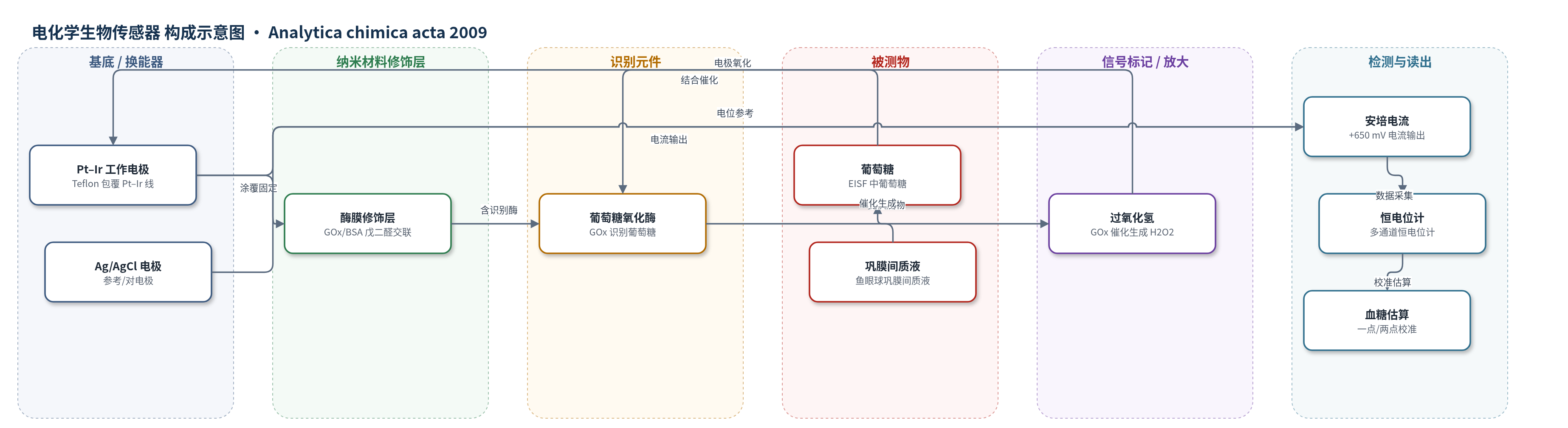
点击图片查看大图 · 依据论文自动绘制
传感器类型
电化学生物传感器
检测对象
葡萄糖(glucose, Glc);样品基质:尼罗罗非鱼眼球巩膜间质液(EISF),用于间接估算全血葡萄糖(whole blood glucose)
检测原理
葡萄糖从鱼眼球巩膜间质液(EISF)扩散进入针式传感腔,被固定在 Pt–Ir 工作电极表面的葡萄糖氧化酶(GOx)识别并催化氧化,生成葡萄糖酸内酯和过氧化氢(H2O2)。在 Ag/AgCl 参考/对电极构成的两电极体系中,对 Pt–Ir 工作电极施加 +650 mV 电位,H2O2 在电极表面发生电氧化,产生与葡萄糖浓度成正比的安培电流。传感器输出电流经数据采集后,采用一点或两点校准法换算为 EISF 葡萄糖浓度;再依据 EISF 葡萄糖与全血葡萄糖的相关关系估算血糖。该过程无额外信号放大,主要依赖酶催化与安培换能。
检测灵敏度
校准线性范围: 51.02–459.60 mg dL−1;相关系数: 0.995;体内血糖监测范围: 70–420 mg dL−1;相关系数: 0.958
效应效果
传感器在 EISF 中响应迅速、线性良好、重现性较好,校准线性范围 51.02–459.60 mg dL−1,相关系数 0.995。EISF 葡萄糖与全血葡萄糖高度相关(R=0.960,n=112),84% 的 EISF 值在血糖 30% 以内,EISF 约为血糖 94%。pH 5.0–6.5 与 10–36 °C 内响应上升,超出后下降。体内连续监测 160 min,两点校准更准确,血糖范围 70–420 mg dL−1,传感器估算值与全血葡萄糖相关(y=0.4401+0.8656x,R=0.958)。作者认为可用于鱼类健康连续监测,未来需开发遥测系统。
传感器的构成
- 基底/换能器电极:Teflon 包覆 Pt–Ir 线,剥离端暴露 1.0 mm Pt–Ir 作为工作电极/传感腔
- 连接导线:铜线缠绕 Teflon 包覆表面,用于连接恒电位计
- 参考/对电极:Ag/AgCl 糊涂覆于铜线周围,作为参考电极/对电极
- 识别/催化层:葡萄糖氧化酶(GOx,2 mg,352 U/mL)与牛血清白蛋白(BSA,10 mg)溶于 0.1 M PBS,涂覆于传感腔形成酶膜
- 交联固定层:50% 戊二醛(glutaraldehyde)交联 GOx 与 BSA,稳定酶膜
- 封装/保护端:环氧树脂(epoxy resin)封端导线尖端,保留 0.7 mm 传感腔
- 植入固定组件:22G 导管(外层 Teflon、内层穿刺针)与生物医用胶(Aronalpha-A,主要成分 ethylcyanoacrylate)用于植入和固定
中文摘要
本研究开发了一种用于连续估算鱼类血糖的生物传感器系统。由于血液凝固和蛋白在传感器表面聚集会降低输出信号,直接实时测量血液成分困难,因此选择眼球巩膜间质液(EISF)作为传感器植入位点。对尼罗罗非鱼 EISF 与血糖浓度的关系评估显示,两者高度相关(y=2.2996+0.9438x,R=0.960,n=112)。基于该相关性,作者制备了采用柔性导线电极的针式酶传感器,并将其植入鱼巩膜。该传感器响应迅速、线性良好且重现性较好,可实现连续葡萄糖监测。结果表明,葡萄糖浓度随传感器输出电流随时间增加,血糖变化可连续反映在 EISF 中。采用一点或两点校准法估算葡萄糖浓度,其中两点校准法在 160 min 内对 70–420 mg dL−1 血糖范围监测最准确,传感器估算值与全血葡萄糖高度相关(y=0.4401+0.8656x,R=0.958)。
英文摘要
A biosensor system was developed for continuous estimation of blood glucose in fish. Because it is difficult to measure blood components in real-time due to decreased sensor output resulting from blood coagulation and coalescing blood proteins at the sensor placement site, we used the eyeball scleral interstitial fluid (EISF) as the site of sensor implantation. Evaluation of the relationship between EISF and blood glucose concentrations revealed that the blood glucose concentration correlated closely with the EISF glucose concentration (y=2.2996+0.9438x, R=0.960, n=112). To take advantage of the close correlation between blood and EISF glucose, we prepared a needle-type enzyme sensor for implantation in the fish sclera using a flexible wire electrode. The sensor provided a rapid response, good linearity, and reproducibility. Continuous glucose monitoring could be carried out by implanting this needle-type glucose sensor onto the eye. The findings indicated that the glucose concentration increased with sensor output current over time, and that changes in the blood glucose were continuously reflected in the EISF. The glucose concentration was estimated based on the one-point or two-point calibration methods. The two-point calibration method yielded the most accurate glucose monitoring (blood glucose range of 70-420 mg dL(-1)) over 160 min. Sensor-estimated glucose and whole blood glucose values were highly correlated (y=0.4401+0.8656x, R=0.958).