组成图示
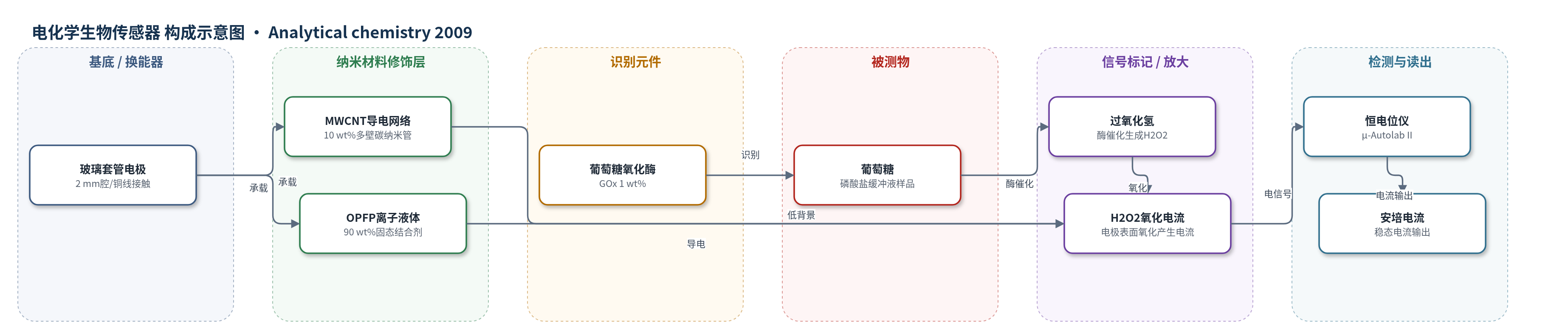
点击图片查看大图 · 依据论文自动绘制
传感器类型
电化学生物传感器
检测对象
葡萄糖(glucose,生物传感器主检测物)、过氧化氢(H2O2)、NADH;样品基质:0.05 M 磷酸盐缓冲液(pH 7.5)
检测原理
该传感器以 MWCNT/OPFP 复合糊状电极为工作电极,GOx 直接掺入复合基质中。葡萄糖进入电极界面后,被 GOx 催化氧化并生成 H2O2;MWCNT 提供高导电通道和电催化活性位点,OPFP 固态离子液体降低双电层电容与背景电流,使 H2O2 在较低电位发生氧化。恒电位仪在固定电位(如 +0.9 V 或 +0.3 V)下记录稳态安培电流,电流随葡萄糖浓度增加而增大。该体系没有外加化学放大,主要依靠酶催化产生 H2O2 和复合电极的低过电位电子转移提高信噪比;Nafion 涂层可进一步阻挡干扰物。
检测灵敏度
灵敏度: 5.0 µA/mM(+0.9 V);线性范围: 至 8 mM(+0.9 V);灵敏度: 2 µA/mM(+0.3 V);线性范围: 至 6 mM(+0.3 V);Nafion 涂层后线性范围: 至 12 mM
效应效果
该复合电极对 H2O2 和 NADH 的稳态响应在 4–6 s 内达到。葡萄糖生物传感器在 +0.9 V 下灵敏度为 5.0 µA/mM,显著高于 MWCNT/矿物油/GOx 的 3.0 nA/mM,而石墨/OPFP/GOx 无响应;在 +0.3 V 下灵敏度为 2 µA/mM,可降低抗坏血酸和尿酸干扰。涂覆 1% Nafion 后线性范围扩展至 12 mM 并提高选择性。10 次葡萄糖测量变异系数不超过 4.0%。对 5 mM NADH 连续 60 min 测试,MWCNT/OPFP 电流仅下降 15%,裸玻璃碳下降 50%,显示良好抗污性。作者认为该电极适合构建稳健的电化学传感器和生物传感器。
传感器的构成
- 基底/换能器电极:玻璃套管电极腔(2 mm 直径、3 mm 深)与铜线,提供机械支撑和电接触
- 导电纳米材料层:多壁碳纳米管(MWCNT,10 wt%),形成导电网络并促进电子转移
- 离子液体结合剂层:1-正辛基吡啶鎓六氟磷酸盐(OPFP,90 wt%),固态结合剂,降低背景电流并增强机械稳定性
- 识别元件:葡萄糖氧化酶(GOx,1 wt%,1 mg/100 mg 复合料),催化葡萄糖氧化生成 H2O2
- 信号分子/电子供体:过氧化氢(H2O2),由 GOx 催化产生并在电极表面氧化产生电流
- 可选抗干扰层:Nafion 聚合物(1%),阻挡抗坏血酸/尿酸等干扰并扩展线性范围
中文摘要
本文报道了一种由多壁碳纳米管(MWCNT)与离子液体1-正辛基吡啶鎓六氟磷酸盐(OPFP)组成的新型复合电极。与石墨/矿物油等传统电极相比,该电极具有更低的背景电流和双电层电容,同时表现出更高的灵敏度和稳定性。基于循环伏安响应和背景电流稳定性,10%(w/w)MWCNT 被确定为最佳负载量。该复合电极对过氧化氢和 NADH 均显示良好电催化活性,可通过将葡萄糖氧化酶或醇脱氢酶直接掺入复合基质,分别构建葡萄糖和酒精生物传感器。与裸玻璃碳电极相比,其对 NADH 氧化的抗污性和稳定性显著提高。2% MWCNT 负载量初始电化学性能较差,但经 70 °C 温和加热后响应接近 10% 最佳组成。该电极制备简便、背景低、灵敏度高、机械稳定性好,为开发多种稳健的电化学传感器和生物传感器提供了新途径。
英文摘要
A new composite electrode has been fabricated using multiwall carbon nanotubes (MWCNT) and the ionic liquid n-octylpyridinum hexafluorophosphate (OPFP). This electrode shows very attractive electrochemical performances compared to other conventional electrodes using graphite and mineral oil, notably improved sensitivity and stability. One major advantage of this electrode compared to other electrodes using carbon nanotubes and other ionic liquids is its extremely low capacitance and background currents. A 10% (w/w) loading of MWCNT was selected as the optimal composition based on voltammetric results, as well as the stability of the background response in solution. The new composite electrode showed good activity toward hydrogen peroxide and NADH, with the possibility of fabricating a sensitive biosensor for glucose and alcohol using glucose oxidase and alcohol dehydrogenase, respectively, by simply incorporating the specific enzyme within the composite matrix. The marked electrode stability and antifouling features toward NADH oxidation was much higher for this composite compared to a bare glassy carbon electrode. While a loading of 2% MWCNT showed very poor electrochemical behavior, a large enhancement was observed upon gentle heating to 70 degrees C, which gave a response similar to the optimum composition of 10%. The ease of preparation, low background current, high sensitivity, stability, and small loading of nanotubes using this composite can create new novel avenues and applications for fabricating robust sensors and biosensors for many important species.