组成图示
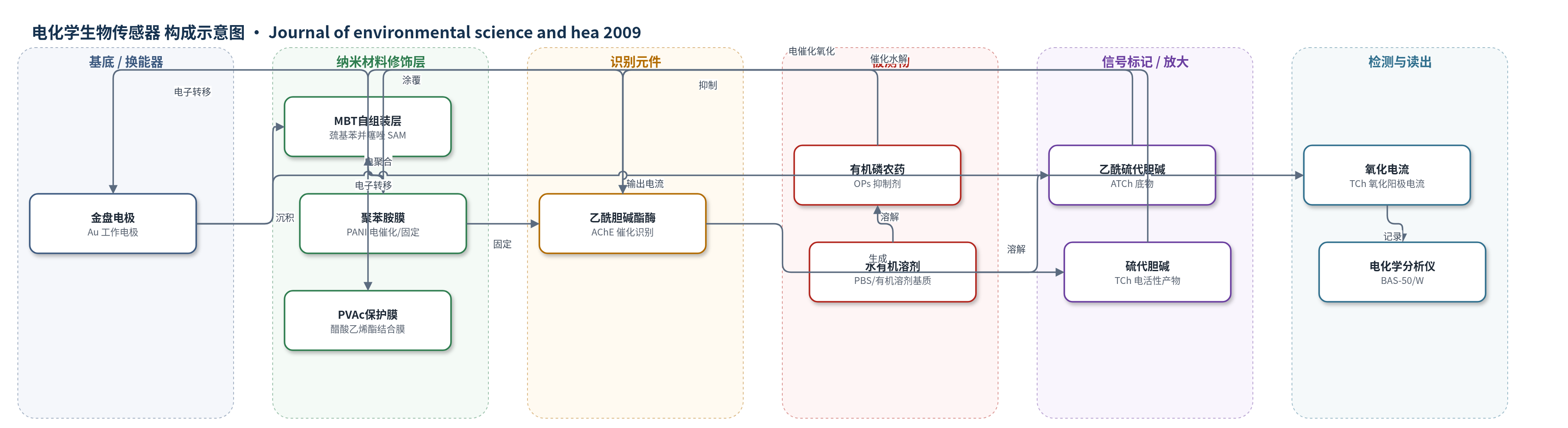
点击图片查看大图 · 依据论文自动绘制
传感器类型
电化学生物传感器
检测对象
对硫磷-甲基(parathion-methyl)、马拉硫磷(malathion)、毒死蜱(chlorpyrifos);样品基质:水-有机溶剂标准溶液(0.1 M 磷酸缓冲 KCl,pH 7.2,含丙酮/乙醇/乙腈等)
检测原理
该传感器基于乙酰胆碱酯酶(AChE)对有机磷农药(OPs)的抑制响应。AChE 催化电活性底物乙酰硫代胆碱(ATCh)水解,生成硫代胆碱(TCh)和乙酸;TCh 在聚苯胺(PANI)修饰电极上发生电催化氧化,PANI 作为电子媒介将电子经巯基苯并噻唑(MBT)自组装层传递至金电极,形成阳极电流。当样品中存在 OPs 时,农药不可逆抑制 AChE 活性丝氨酸,使 TCh 生成减少,氧化电流下降。实验在厌氧条件下进行,以 0.1 M 磷酸缓冲 KCl(pH 7.2)和水-有机溶剂为介质,按 I%=(I1-I2)/I1×100 计算抑制率,抑制率随农药浓度升高而增大,从而实现定量检测。
检测灵敏度
LOD: 0.388 ppb (388.0 ppt, 1.332 nM) (parathion-methyl);LOD: 0.0623 ppb (62.3 ppt, 0.189 nM) (malathion);LOD: 0.0127 ppb (12.7 ppt, 0.018 nM) (chlorpyrifos);灵敏度: -53.66 % I/decade (parathion-methyl)、-35.24 % I/decade (malathion)、-26.68 % I/decade (chlorpyrifos);R^2 = 0.9766 (parathion-methyl)、0.9679 (malathion)、0.9875 (chlorpyrifos)
效应效果
该传感器在 0.1 M 磷酸缓冲 KCl(pH 7.2)中,60 µL AChE 负载时 ATCh 响应最大,80 µL 相近,40 µL 明显偏低;最佳 pH 为 7.2,7.5 接近。4 ℃ 保存 28 d 后最大电流由 -6.234×10^-6 A 降至 -4.957×10^-6 A,损失约 20%,日内波动较小。25 ℃ 酶活性最高。极性溶剂中,90% 水-丙酮抑制仅 10%,纯乙腈、丙酮、乙醇分别抑制 93%、96%、77%。对三种有机磷农药,抑制率随浓度升高而增大;对硫磷-甲基灵敏度最高(-53.66 % I/decade),高于文献碳纳米管丝网印刷传感器 48%。未报告选择性、实际样品回收率与 RSD。
传感器的构成
- 工作电极基底:金盘电极(Au),直径 1.6 mm,经氧化铝抛光、Piranha 溶液蚀刻和电化学清洗,提供导电基底与电子转移界面
- 自组装单层:巯基苯并噻唑(MBT)SAM,10 mM 乙醇溶液浸渍 2 h 形成 Au/MBT,作为界面修饰层
- 导电聚合物层:聚苯胺(PANI),在 0.2 M 苯胺/1 M HCl 中电聚合 10 个循环,作为 AChE 固定基质和 TCh 电催化介质
- 识别元件:乙酰胆碱酯酶(AChE),60 µL 酶液在 +400 mV 下通过 PANI 氧化固定,催化 ATCh 水解
- 保护结合膜:醋酸乙烯酯(PVAc),0.3 M 丙酮溶液 2 µL 涂覆干燥,防止厚膜在有机溶剂中崩解
- 电活性底物:乙酰硫代胆碱(ATCh),加入样品中被 AChE 水解为 TCh,提供可氧化电活性信号
中文摘要
本文报道了一种金/巯基苯并噻唑/聚苯胺/乙酰胆碱酯酶/醋酸乙烯酯(Au/MBT/PANI/AChE/PVAc)厚膜生物传感器,用于在选定的水-有机溶剂体系中测定有机磷农药。该器件通过将乙酰胆碱酯酶(AChE)包埋于聚苯胺(PANI)复合膜中构建,再在表面涂覆醋酸乙烯酯(PVAc),以防止生物膜在有机溶剂中崩解。传感器采用电活性底物乙酰硫代胆碱(ATCh)实现安培检测:AChE 催化 ATCh 水解生成硫代胆碱(TCh),TCh 在 PANI 修饰电极上发生电催化氧化并产生阳极电流。在厌氧 0.1 M 磷酸缓冲 KCl(pH 7.2)及水-有机溶剂中,随 ATCh 连续加入,电流峰向更阳极方向移动且峰高增加。作者系统考察了酶负载量、pH、长期稳定性、温度稳定性以及极性和非极性有机溶剂对安培行为的影响,并用于检测对硫磷-甲基、马拉硫磷和毒死蜱。结果显示三种农药的检出限分别为 1.332 nM、0.189 nM 和 0.018 nM。
英文摘要
This paper reports the construction of the gold/mercaptobenzothiazole/polyaniline/acetylcholinesterase/polyvinylacetate (Au/ MBT/PANI/AChE/PVAc) thick-film biosensor for the determination of certain organophosphate pesticide solutions in selected aqueous organic solvent solutions. The Au/MBT/PANI/AChE/PVAc electrocatalytic biosensor device was constructed by encapsulating acetylcholinesterase (AChE) enzyme in the PANI polymer composite, followed by the coating of poly(vinyl acetate) (PVAc) on top to secure the biosensor film from disintegration in the organic solvents evaluated. The electroactive substrate called acetylthiocholine (ATCh) was employed to provide the movement of electrons in the amperometric biosensor. The voltammetric results have shown that the current shifts more anodically as the Au/MBT/PANI/AChE/PVAc biosensor responded to successive acetylthiocholine (ATCh) substrate addition under anaerobic conditions in 0.1 M phosphate buffer, KCl (pH 7.2) solution and aqueous organic solvent solutions. For the Au/MBT/PANI/AChE/PVAc biosensor, various performance and stability parameters were evaluated. These factors include the optimal enzyme loading, effect of pH, long-term stability of the biosensor, temperature stability of the biosensor, the effect of polar organic solvents, and the effect of non-polar organic solvents on the amperometric behavior of the biosensor. The biosensor was then applied to detect a series of 5 organophosphorous pesticides in aqueous organic solvents and the pesticides studied were parathion-methyl, malathion and chlorpyrifos. The results obtained have shown that the detection limit values for the individual pesticides were 1.332 nM (parathion-methyl), 0.189 nM (malathion), 0.018 nM (chlorpyrifos).