组成图示
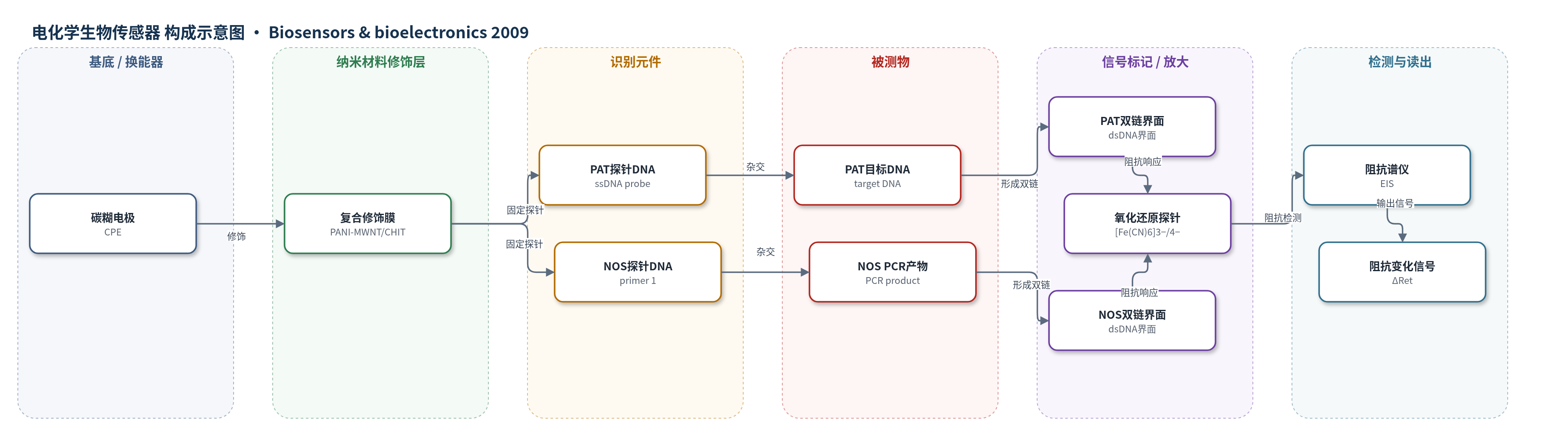
点击图片查看大图 · 依据论文自动绘制
传感器类型
电化学生物传感器
检测对象
PAT基因特异性DNA序列(phosphinothricin acetyltransferase gene, PAT)、NOS基因终止子PCR产物(terminator of nopaline synthase gene, NOS);样品基质:转基因大豆DNA提取液/PCR扩增产物溶液(2× SSC杂交液)
检测原理
传感器以PANI-MWNT/CHIT复合膜修饰CPE,PANI与MWNT协同提高导电性、电子转移和比表面积,使探针DNA大量吸附。目标DNA与探针杂交后形成双链DNA,使电极表面负电荷密度增加且DNA层变厚,阻碍溶液中[Fe(CN)6]3−/4−在电极表面的电子转移,电子转移阻抗Ret增大。以杂交前后Ret差值ΔRet作为无标记信号,ΔRet随目标DNA浓度对数增加,在1.0 × 10−13–1.0 × 10⁻⁷ mol/L线性。对转基因大豆NOS基因样品先经PCR扩增,再变性为单链与探针杂交,实现定性检测。
检测灵敏度
LOD: 2.7 × 10⁻¹⁴ mol/L;线性范围: 1.0 × 10⁻¹³–1.0 × 10⁻⁷ mol/L;线性方程: ΔRet (Ω) = 434.50 log C + 5907.86;RSD = 0.996
效应效果
该传感器对完全互补DNA响应最强,单碱基错配、双碱基错配和非互补DNA响应分别为互补信号的77.8%、25.9%和3.7%,显示较高序列选择性。传感器可经10 mmol/L NaOH变性再生,重复使用8次而不明显损失灵敏度;4 ℃保存24 h阻抗无明显变化,10 d后仍保留92%初始灵敏度。对转基因大豆NOS基因PCR产物可成功定性检测,杂交后Ret明显增大。作者认为PANI-MWNT/CHIT复合膜通过协同效应显著提高DNA负载和电子转移,使无标记EIS检测灵敏度增强、检出限降低、线性范围宽,适用于转基因植物中PAT和NOS等基因的筛查。
传感器的构成
- 基底/换能器电极:碳糊电极(CPE,直径4 mm),提供导电基底并作为电化学换能器。
- 纳米复合材料修饰层:聚苯胺纳米纤维(PANI)与多壁碳纳米管(MWNT)复合分散于壳聚糖(CHIT)膜(PANI-MWNT/CHIT),增强导电性、电子转移和生物相容性,提高DNA负载。
- 识别元件:PAT基因探针单链DNA(ssDNA,5′-GCC ACA AAC ACC ACA AGA GT-3′)或NOS基因探针(primer 1)吸附固定,用于特异性杂交。
- 杂交缓冲介质:2× SSC(0.30 mol/L NaCl、30.0 mmol/L柠檬酸钠),维持DNA杂交反应环境。
- 氧化还原探针:1.0 mmol/L K3[Fe(CN)6]/K4[Fe(CN)6](1:1)含0.1 mol/L KCl,用于EIS无标记阻抗检测。
中文摘要
本文报道了一种基于聚苯胺纳米纤维(PANI)、多壁碳纳米管(MWNT)和壳聚糖(CHIT)修饰碳糊电极(CPE)的高灵敏电化学生物传感器。利用PANI与MWNT纳米颗粒在壳聚糖膜中的协同效应,构建了具有优异电子导电性和生物相容性的纳米结构膜,并通过扫描电镜、循环伏安法和电化学阻抗谱进行表征。PANI-MWNT复合膜显著提高了探针DNA在电极表面的固定量。DNA杂交事件采用无标记电化学阻抗谱(EIS)策略监测。在优化条件下,该DNA电化学生物传感器对草铵膦乙酰转移酶基因(PAT,转基因植物重要筛选检测基因)特异性DNA序列的动态检测范围为1.0 × 10⁻¹³至1.0 × 10⁻⁷ mol/L,检出限为2.7 × 10−14 mol/L。同时,对一种转基因大豆样品中胭脂碱合成酶基因(NOS)终止子的PCR扩增产物也进行了成功检测。
英文摘要
A sensitive electrochemical DNA biosensor was successfully realized on polyaniline nanofibers (PANI), multi-walled carbon nanotubes (MWNT) and chitosan (CHIT) modified carbon paste electrode (CPE) based on the synergistic effect between PANI and MWNT nanoparticles in chitosan film. PANI and MWNT nanocomposites resulted in highly enhanced electron conductive and biocompatible nanostructured film, which was examined by scanning electron microscopy (SEM), cyclic voltammetry (CV) and electrochemical impedance spectroscopy (EIS). The immobilization of the probe DNA on the surface of electrode was largely improved due to the unique synergistic effect of PANI and MWNT. The DNA hybridization events were monitored with an EIS label-free detection strategy. Under the optimal conditions, the dynamic detection range of this DNA electrochemical biosensor was from 1.0 x 10(-13) to 1.0 x 10(-7)mol/L and a detection limit of 2.7 x 10(-14)mol/L for the detection of DNA specific sequence of the phosphinothricin acetyltransferase gene (PAT, one of the important screening detection genes for the transgenic plants). Simultaneously, the polymerase chain reaction (PCR) amplification of the terminator of nopaline synthase gene (NOS) from the sample of one kind of genetically modified soybean was also detected satisfactorily.