组成图示
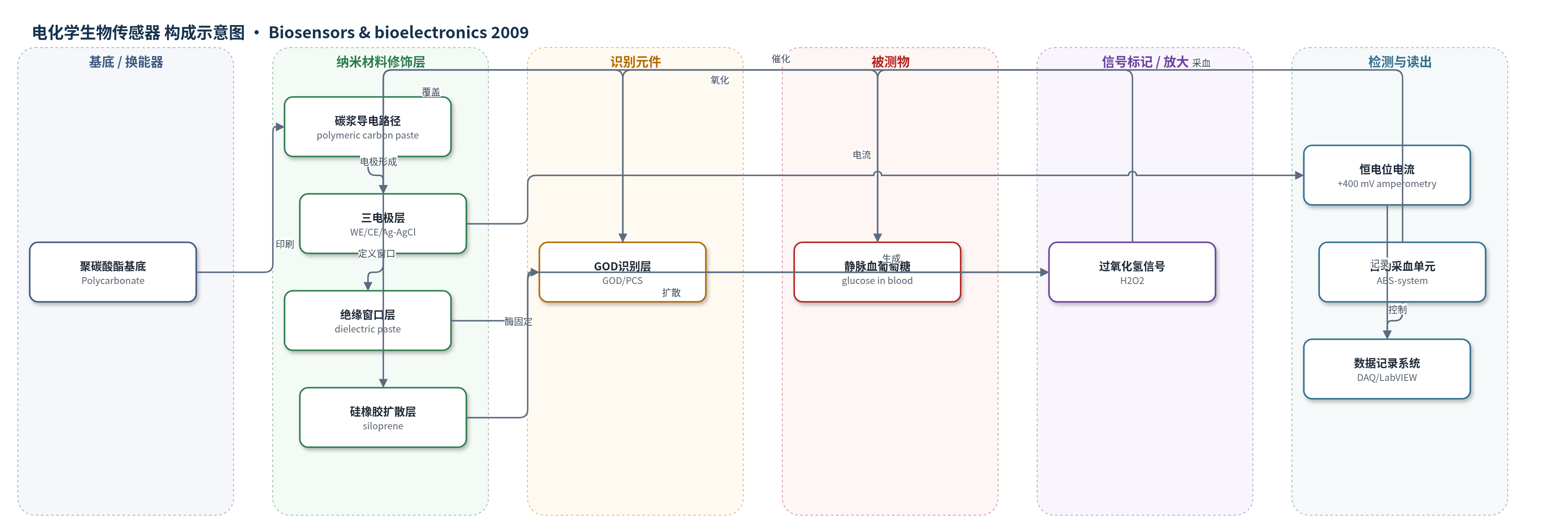
点击图片查看大图 · 依据论文自动绘制
传感器类型
电化学生物传感器
检测对象
葡萄糖(glucose),样品基质为外周静脉血(peripheral venous blood,体外 ex vivo)
检测原理
自动采血单元从外周静脉抽取约1.69 mL血液,肝素化后进入微结构平面流通池。血液中的葡萄糖在固定于工作电极的葡萄糖氧化酶(GOD)催化下与氧气反应,生成葡萄糖-1,5-内酯和过氧化氢(H2O2)。H2O2穿过硅橡胶(siloprene)扩散/保护层到达铂化碳工作电极;在相对于Ag/AgCl参比电极+400 mV的恒电位下,H2O2在工作电极发生阳极氧化,释放电子形成电流。由于酶反应速率受葡萄糖浓度控制,且扩散层使反应处于扩散控制状态,电流随葡萄糖浓度增加而线性增大,线性范围可达20 mmol/L。系统每10 s记录电流,经标准葡萄糖溶液校准后转换为血糖浓度。
检测灵敏度
线性范围: up to 20 mmol l−1;灵敏度: 1.8 nA mmol−1 glucose;校准方程: y = 1.64x + 6.3, R = 0.9984;95% response time: <2 min
效应效果
预实验中,10 mmol/L稀释牛血清下准确度5.0%、精密度5.1%、长期稳定性−0.02 mmol/L/h。临床验证中,单独采血单元与手动参考采血Pearson相关中位数0.982(0.928–0.997),系统误差−1.66±9.01%;完整系统相关中位数0.950(0.936–0.963),系统误差−1.00±6.61%。Clark误差网格96.93%在A区、3.07%在B区;胰岛素滴定误差网格99.56%可接受。2 mL/h“保持静脉通畅”生理盐水使导管阻塞采血失败率从13.33%降至3.33%。每次采血1.69±0.09 mL,冲洗液8.83±0.28 mL,总冲洗液<270 mL;APTT无显著升高(p=0.05),无不良事件。作者认为可用于重症监护替代频繁手动采血,组装<5 min。
传感器的构成
- 基底支撑:聚碳酸酯(Polycarbonate)塑料片,承载印刷电极并构成传感器本体
- 导电路径:聚合物碳浆(polymeric carbon paste)印刷三条导电路径,连接工作、对、参比电极
- 工作电极:铂化碳浆(platinised carbon paste)覆盖导电路径,作为阳极氧化H2O2的换能电极
- 对电极:铂化碳浆(platinised carbon paste)覆盖导电路径,完成三电极恒电位测量回路
- 参比电极:银/氯化银浆(Ag/AgCl paste)覆盖第三条导电路径,提供稳定参比电位
- 绝缘层:绝缘浆(dielectric paste)印刷定义指示窗口,隔离非敏感区
- 识别/催化层:葡萄糖氧化酶(GOD)以聚羧酰胺磺酸盐(PCS)为包埋基质固定于工作电极表面,催化葡萄糖氧化生成H2O2
- 扩散/保护层:硅橡胶(siloprene)覆盖GOD-PCS层,限制扩散并保护酶层
- 流通池:微结构平面流通池(micro-structured planar flow-through cell)引导血液流经指示窗口并收集微气泡
中文摘要
强化胰岛素治疗可降低危重患者的死亡率和并发症,但要求医护人员频繁采血测定血糖,造成较大工作负担。本研究评估一种由自动采血单元与葡萄糖生物传感器组成的自动化间断静脉血监测系统,用于人体体外血糖测定。研究在12小时内比较单独采血单元及完整系统相对于手动参考采血的线性相关性和系统误差。受试者留置两根静脉导管,分别连接自动系统与参考系统,按15和30分钟间隔采血。结果显示,手动与自动采血样本的Pearson相关系数中位数在单独采血单元为0.982,在完整系统为0.950。葡萄糖生物传感器线性范围可达20 mmol/L,95%响应时间小于2分钟。Clark误差网格分析显示96.93%的数据对位于A区,3.07%位于B区;胰岛素滴定误差网格分析显示99.56%为可接受处理。在自动采血系统中加入“保持静脉通畅”生理盐水输注后,因导管阻塞导致的采血失败率降低四倍。结果表明,外周静脉自动采血结合自动葡萄糖测定是频繁手动采血的一种有前景替代方案。
英文摘要
Intensive insulin therapy reduces mortality and morbidity in critically ill patients but imposes great demands on medical staff who must take frequent blood samples for the determination of glucose levels. A solution to this resourcing problem would be provided by an automated blood monitoring system. The aim of the present clinical study was to evaluate such a system comprising an automatic blood sampling unit linked to a glucose biosensor. Our approach was to determine the correlation and system error of the sampling unit alone and of the combined system with respect to reference levels over 12h in humans. Two venous cannulae were inserted to connect the automatic and reference systems to the subjects. Blood samples were taken at 15 and 30 min intervals. The median Pearson coefficient of correlation between manually and automatically withdrawn blood samples was 0.982 for the sampling unit alone and 0.950 for the complete system. The biosensor had a linear range up to 20 mmoll(-1) and a 95% response time of <2 min. Clark Error Grid analysis showed that 96.93% of the data (228 data pairs) was in zone A and 3.07% in zone B. Insulin Titration Error Grid analysis suggested an acceptable treatment in 99.56% of cases. Implementation of a "Keep Vein Open" saline infusion into the automated blood sampling system reduced blood withdrawal failures through occluded catheters fourfold. In summary, automated blood sampling from a peripheral vein coupled with automatic glucose determination is a promising alternative to frequent manual blood sampling.