组成图示
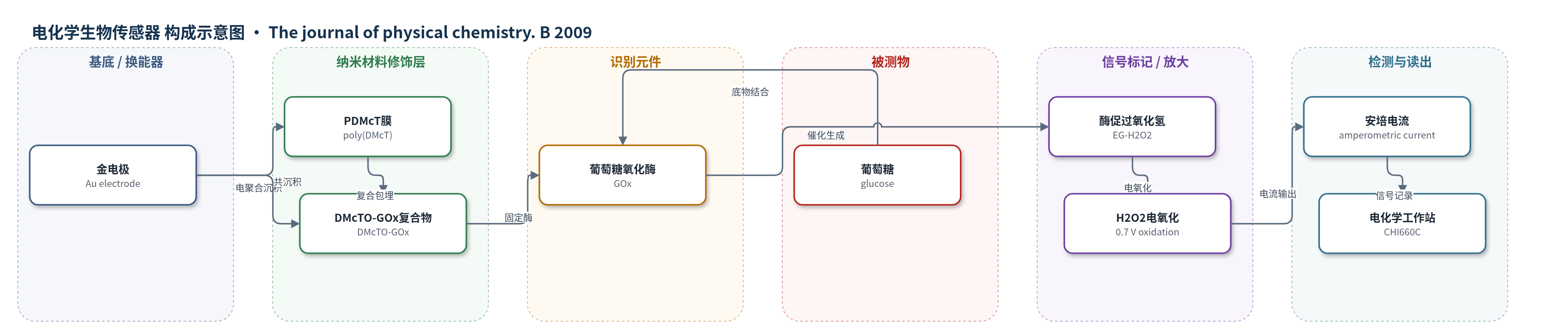
点击图片查看大图 · 依据论文自动绘制
传感器类型
电化学生物传感器
检测对象
葡萄糖(glucose);样品基质为pH 7.0磷酸盐缓冲液(PBS),文中未报告血清、食品或环境水样等实际基质检测。
检测原理
该传感器为第一代安培型葡萄糖生物传感器。葡萄糖扩散进入PDMcT/DMcTO-GOx多孔膜后,被固定其中的GOx催化氧化,同时消耗O2并生成H2O2。生成的H2O2在0.7 V(vs SCE)工作电极表面发生电化学氧化,产生与葡萄糖浓度成正比的阳极电流。PDMcT为非导电多孔聚合物,DMcTO-GOx复合物通过酶促H2O2预氧化DMcT形成,使GOx高负载包埋于膜中,提高酶量与传质。信号放大主要来自高酶负载、多孔结构及H2O2电氧化,而非HCR/RCA等核酸放大。
检测灵敏度
BPEM: LOD: 0.2 µM;线性范围: 2.0 µM–1.6 mM;灵敏度: 51 µA cm-2 mM-1;r2 = 0.9989。CPEM: LOD: 0.4 µM;线性范围: 5.0 µM–1.5 mM;灵敏度: 38 µA cm-2 mM-1;r2 = 0.9965。CEP: LOD: 10 µM;线性范围: 10 µM–4.8 mM;灵敏度: 0.43 µA cm-2 mM-1;r2 = 0.9991。BPEM/CPEM灵敏度较CEP提高119/88倍,LOD降低约2个数量级。
效应效果
在优化条件下,BPEM电极灵敏度为51 µA cm-2 mM-1,CPEM为38 µA cm-2 mM-1,CEP为0.43 µA cm-2 mM-1;BPEM/CPEM较CEP提高119/88倍,LOD分别降至0.2/0.4 µM,约低2个数量级。响应时间小于10 s,对0.10 mM抗坏血酸和尿酸无明显干扰。4 ℃ PBS保存15 d后仍保持初始灵敏度的80%。BPEM比CPEM高1.3倍,归因于酶周围预氧化更近、酶负载更高。与多数第一代葡萄糖传感器(通常<20 µA cm-2 mM-1,多数<10)相比性能更优。EQCM显示膜刚性好,PDMcT可阴极脱附,利于电极再生。
传感器的构成
- 基底/换能器电极:金电极(Au electrode,6.0 mm,面积约0.29 cm²;EQCM中位于9 MHz AT切石英晶体一侧),提供导电基底与电化学换能。
- 聚合物修饰层:聚(2,5-二巯基-1,3,4-噻二唑)(PDMcT),由DMcT在1.3 V恒电位电聚合形成,非导电多孔膜,固定酶并抗污。
- 预氧化复合层:DMcT寡聚/聚合物-葡萄糖氧化酶复合物(DMcTO-GOx),由酶促生成H2O2(EG-H2O2)预氧化DMcT形成,高负载包埋GOx。
- 识别元件:葡萄糖氧化酶(GOx),催化葡萄糖氧化并生成H2O2。
- 信号放大/标记物:酶促生成过氧化氢(EG-H2O2),在0.7 V被电化学氧化产生安培电流。
- 读出层:恒电位安培检测(0.7 V vs SCE,pH 7.0 PBS),电流随葡萄糖浓度变化。
中文摘要
基于单锅生物化学预氧化与单体电聚合(BPEM)构建新型高性能生物传感平台,实现酶高负载高活性固定。以2,5-二巯基-1,3,4-噻二唑(DMcT)为单体,葡萄糖氧化酶(GOx)为模型酶,葡萄糖存在下酶促生成的H2O2(EG-H2O2)为预氧化剂。将葡萄糖加入含超声分散DMcT和GOx的pH7.0磷酸盐缓冲液悬浮液中,酶促生成H2O2,将DMcT预氧化为DMcT寡聚/聚合物(DMcTO),形成大量包埋GOx的DMcTO-GOx复合物;随后与聚(DMcT)共电沉积于金电极。对比无预氧化常规电聚合(CEP)和外加H2O2化学预氧化电聚合(CPEM)。BPEM和CPEM葡萄糖传感器灵敏度分别提高119和88倍,检出限降低约2个数量级。BPEM更高灵敏度可能源于酶分子周围生物化学预氧化邻近性改善及更大酶负载。电化学石英晶体微天平研究修饰过程,发现PDMcT可阴极脱附,有利于电极再生。BPEM策略推荐用于多种聚合物/酶的生物传感与生物催化。
英文摘要
A novel and high-performance biosensing platform was prepared on the basis of one-pot biochemical preoxidation and electropolymerization of monomer (BPEM) for high-load and high-activity immobilization of enzymes. As representative materials here, 2,5-dimercapto-1,3,4-thiadiazole (DMcT) was used as the monomer, glucose oxidase (GOx) was used as the model enzyme, and enzymatically generated H2O2 (EG-H2O2) in the presence of glucose was used as the preoxidant. In the BPEM protocol, glucose was added to a pH 7.0 phosphate buffer suspension containing ultrasonically dispersed DMcT and GOx, in order to enzymatically generate H2O2, which preoxidized DMcT to DMcT oligomers/polymer (DMcTO) and thus led to the formation of DMcTO-GOx composites with a great deal of GOx entrapped; the composites were then co-electrodeposited with poly(DMcT) on a Au electrode. For comparison, the enzyme immobilization was also conducted by a preoxidation-free conventional electropolymerization protocol (CEP), as well as a chemical preoxidation and electropolymerization of monomer (CPEM) protocol with externally added H2O2 (EA-H2O2) as the preoxidant. The glucose biosensors constructed by the BPEM and CPEM protocols exhibited detection sensitivities enhanced by 119 and 88 times, respectively, compared to that constructed by the CEP protocol, as well as limits of detection lowered by ca. 2 orders of magnitude. The higher sensitivity of the enzyme electrode prepared by the BPEM protocol compared to that prepared by the CPEM protocol is probably due to the improved proximity of biochemical preoxidation around the enzyme molecules and thus a larger enzyme load. The electrochemical quartz crystal microbalance technique was used to investigate various electrode modification processes, which also revealed that poly(DMcT) could be cathodically detached from the electrode surface, favorably enabling the electrochemical regeneration of the electrode substrate. The proposed BPEM strategy is recommended for wide biosensing and biocatalysis applications based on many other polymers/enzymes.