组成图示
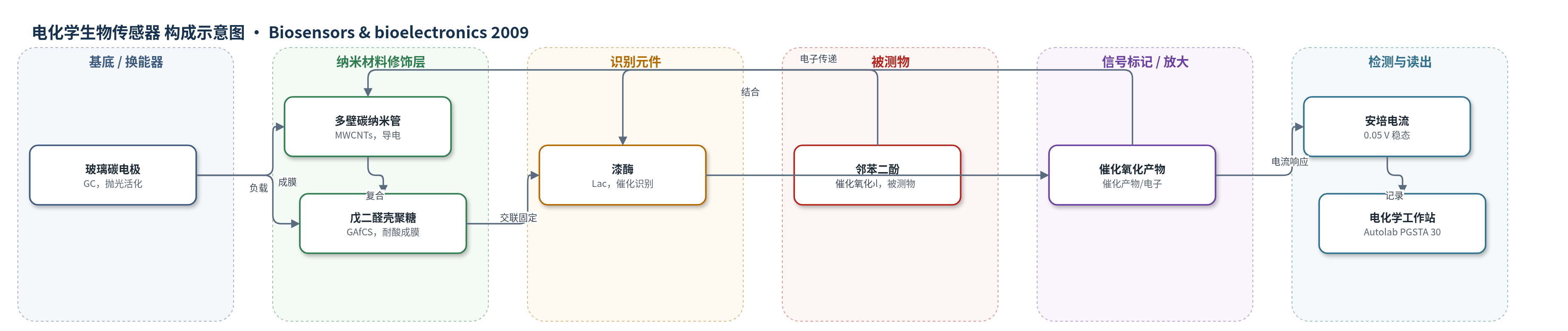
点击图片查看大图 · 依据论文自动绘制
传感器类型
电化学生物传感器
检测对象
邻苯二酚(catechol),样品基质为 Britton–Robinson 缓冲液(pH 3.0)
检测原理
邻苯二酚扩散进入 GAfCS–MWCNTs 膜,与固定漆酶(Lac)活性位点结合并被催化氧化;该氧化与 O2 还原偶联,Lac 完成氧化还原循环。MWCNTs 作为导电网络促进 Lac、底物/产物与 GC 之间的电子转移,并增大有效电化学面积。电极在 0.05 V 下记录稳态电流,随邻苯二酚浓度增加,催化循环引起的界面电子转移变化使电流呈负向线性变化。两步交联使 Lac 在 pH 3.0 保持高活性,提高灵敏度。
检测灵敏度
LOD: 20 nM (S/N = 3);线性范围: 0.1–50 μM;LRE: ΔI (μA) = −0.040 −101.9c (mM);R^2 = 0.9996
效应效果
文中未报告选择性/抗干扰与实际样品回收率。该电极在 pH 3.0 对邻苯二酚检测线性好,LOD 20 nM,低于文献 2 μM 和 0.66 μM;表观 Michaelis 常数 60 μM,优于一步 GA 交联的 95、170 μM 及文献 70、610 μM。连续 20 次 10 μM 检测 RSD 3.03%,1 周保留 92%,1 个月保留 85%。QCM 显示膜在 pH 3.0 稳定。葡萄糖/空气生物燃料电池最大功率密度 9.6 μW/cm2,开路电压 0.19 V,短路电流密度 114 μA/cm2,15000 s 放电后电压/电流保持 93%。
传感器的构成
- 基底电极:玻璃碳电极(GC),经抛光与电位循环活化,作为电子转导基底。
- 纳米导电修饰层:多壁碳纳米管(MWCNTs),分散于 GAfCS 中,提高膜导电性与电化学活性面积。
- 交联成膜基质:戊二醛功能化壳聚糖(GAfCS),由壳聚糖(CS)与戊二醛(GA)反应形成,提供耐酸网络膜并固定酶。
- 识别元件:漆酶(Lac,Trametes versicolor),催化邻苯二酚氧化及氧还原。
- 工作介质:Britton–Robinson 缓冲液(B–R,pH 3.0),提供酸性检测环境。
中文摘要
为固定 Trametes versicolor 漆酶(Lac)并在酸性水溶液中保持高活性,作者用戊二醛(GA)化学修饰壳聚糖(CS)制备 GA 功能化壳聚糖(GAfCS),再与 Lac 反应形成 Lac–GAfCS 复合膜,两步法使膜在弱酸性溶液中稳定,并经石英晶体微天平(QCM)和耐久性测试证实。Lac–GAfCS–多壁碳纳米管(MWCNTs)/玻璃碳(GC)电极在 ABTS 存在下对 O2 还原表现出良好催化活性,并考察了 pH 依赖的酶活性。以该电极为生物阴极、GOx–GAfCS–MWCNTs/GC 电极为生物阳极,在 Nafion 膜分隔的醋酸缓冲液(pH 5.0)中构建葡萄糖/空气生物燃料电池,最大输出功率密度 9.6 μW/cm2,开路电压 0.19 V,短路电流密度 114 μA/cm2。该电极还用于 Britton–Robinson 缓冲液(pH 3.0)中邻苯二酚检测,线性范围 0.1–50 μM,检出限 20 nM。与直接 GA 一步交联相比,GAfCS 两步交联对酶活性损伤更小,适用于高活性固定。
英文摘要
To immobilize laccase (Lac) from Trametes versicolor that shows its maximum enzymatic activity in acidic aqueous solutions, the biopolymer chitosan (CS) was chemically modified with glutaraldehyde (GA) to form GA functionalized CS (GAfCS), which was then allowed to react with Lac to form a Lac-GAfCS composite that is robust in weakly acidic solutions (two-step protocol), as confirmed by quartz crystal microbalance and durability tests. The Lac-GAfCS-multiwalled carbon nanotubes (MWCNTs)/glassy carbon (GC) electrode exhibited good catalytic activity towards O(2) reduction in the presence of 2,2'-azinobis (3-ethylbenzothiazoline-6-sulfonate) diammonium salt (ABTS), and the pH-dependent enzymatic activity of the immobilized Lac towards O(2) reduction was examined. A glucose/air biofuel cell was fabricated, with the Lac-GAfCS-MWCNTs/GC electrode as the biocathode and a glucose oxidase (GOx)-GAfCS-MWCNTs/GC electrode as the bioanode in a Nafion membrane-separated acetate buffer solution (pH 5.0). The biofuel cell output a maximum power density of 9.6 microW/cm(2), an open-circuit cell voltage of 0.19V, and a short-circuit current density of 114 microA/cm(2), respectively, as measured with an electrochemical noise (ECN) apparatus. Furthermore, the Lac-GAfCS-MWCNTs/GC electrode was applied to determine catechol in Britton-Robinson buffer solution (pH 3.0), with a linear range of 0.1-50 microM and a limit of detection of 20 nM. In comparison with the direct use of GA for one-pot Lac-GA-CS or Lac-GA crosslinking to immobilize Lac, the use of macromolecular GAfCS in the proposed two-step protocol was proven to be less harmful to the enzymatic activity and thus more suitable for immobilizing the enzyme to construct the biofuel cell and biosensor. This work may be helpful for exploiting the popular biocompatible CS as an acid-resistant film matrix for many other biotechnology applications, and the proposed two-step crosslinking protocol is recommended for high-activity immobilization of other biomolecules.