组成图示
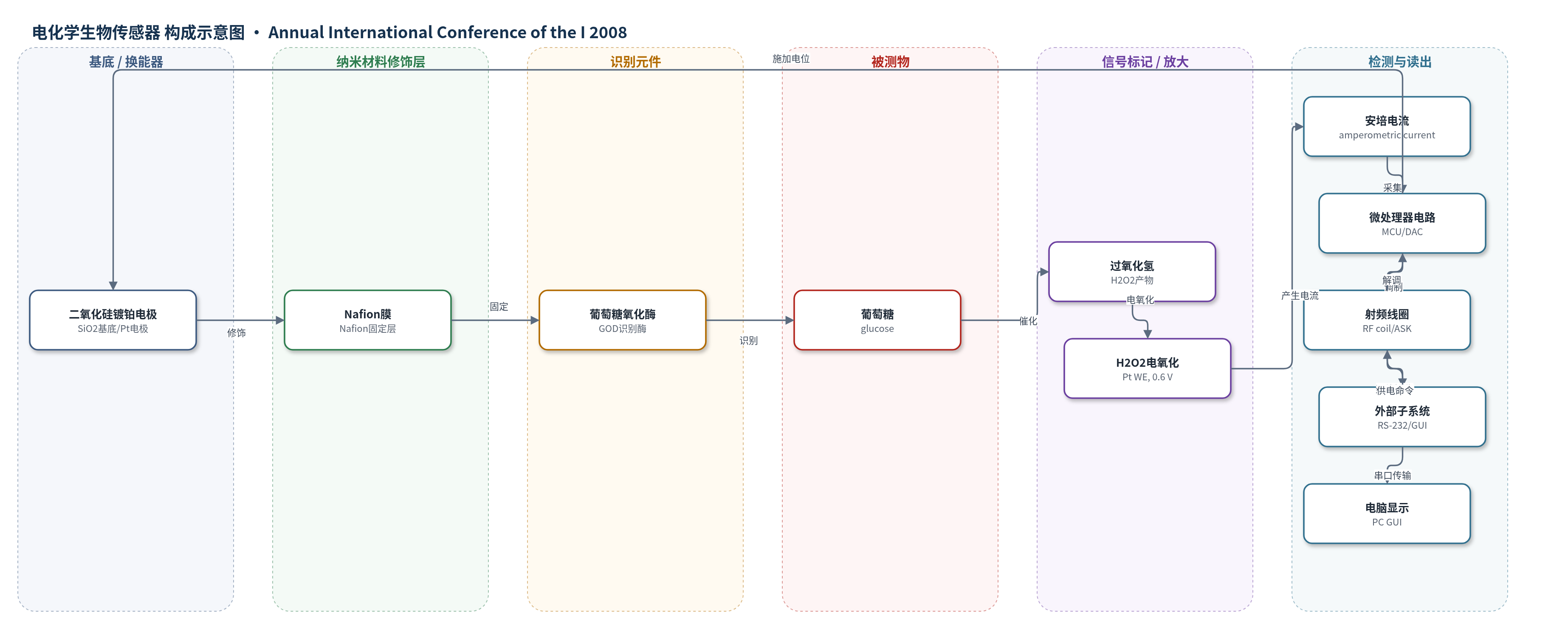
点击图片查看大图 · 依据论文自动绘制
传感器类型
电化学生物传感器
检测对象
葡萄糖(glucose);样品基质:磷酸盐缓冲液(PBS,体外)、糖尿病大鼠组织间液(interstitial tissue fluid,体内)
检测原理
葡萄糖氧化酶(GOD)固定于Nafion修饰的铂工作电极表面,作为识别元件催化葡萄糖氧化并生成过氧化氢(H2O2)。在外部子系统通过射频线圈无线供电并发送命令后,植入子系统微处理器经DAC在工作电极施加0.6 V电位,H2O2在铂电极表面发生电氧化,产生与葡萄糖浓度相关的安培电流。该电流经电化学安培电路采集、数字化,并以ASK调制通过射频线圈回传;外部子系统解调后经RS-232传输至计算机显示。信号随葡萄糖浓度升高而增大,体外线性范围达0–15 mM。
检测灵敏度
线性范围: 0 to 15 mM;R = 0.998
效应效果
体外PBS中葡萄糖0–15 mM呈线性,R=0.998;过氧化氢功能验证在0.002–0.01 mM范围内R=0.999。植入Alloxan诱导糖尿病大鼠皮下后,禁食24 h时组织间液葡萄糖低于5 mM并可降至基线0 mM,进食后升至约10 mM,表明可区分禁食与非禁食状态。体内信号波动较大,作者归因于大鼠活动。装置尺寸22×8 mm,通过RF无线供电与ASK数据传输,具备植入式连续葡萄糖监测潜力;未报告RSD、回收率或与ELISA等方法的对比。
传感器的构成
- 基底/换能器电极:二氧化硅基底镀铂(silicon oxide coated with platinum, SiO2/Pt),微加工制备工作电极与参比电极,承担电化学换能。
- 修饰/固定层:Nafion®膜(Nafion membrane)修饰工作电极,用于固定葡萄糖氧化酶并稳定酶界面。
- 识别元件:葡萄糖氧化酶(glucose oxidase, GOD)固定于工作电极表面,特异性催化葡萄糖氧化。
- 封装层:聚二甲基硅氧烷(polydimethylsiloxane, PDMS)密封微处理器、电路和接收线圈,仅暴露电极组。
- 植入电路:微处理器、电源调节、命令解调、葡萄糖传感触发、信号读出电路和数模转换器(DAC),实现0.6 V安培测量与数字化。
- 无线换能:接收线圈(coil 2)与外部线圈(coil 1)通过射频(RF,800 kHz)耦合,完成无线供电、命令接收和ASK信号回传。
- 外部读出:外部子系统含LCD、命令按钮、RS-232接口和计算机GUI,接收并显示葡萄糖浓度曲线。
中文摘要
本文报道了一种用于体外和体内研究的微型无线葡萄糖生物传感器。该传感器由外部控制子系统和植入式传感子系统组成。植入子系统包含微处理器,用于协调射频、电源调节、命令解调、葡萄糖传感触发和信号读出电路;除传感电极外,微处理器、电路和接收线圈均用聚二甲基硅氧烷(PDMS)密封。电极组为二氧化硅基底镀铂,包括工作电极和参比电极,葡萄糖氧化酶(GOD)固定在工作电极表面。植入子系统通过射频技术与外部子系统双向通信;外部子系统无线供电、发送命令、接收葡萄糖响应,并通过RS-232连接传输至计算机。体外和体内研究用于评估该传感器。体外线性响应可达15 mM葡萄糖;体内结果显示糖尿病大鼠组织间液在禁食和非禁食期间出现显著葡萄糖变化。
英文摘要
A miniaturized wireless glucose biosensor has been developed to perform in vitro and in vivo studies. It consists of an external control subsystem and an implant sensing subsystem. The implant subsystem consists of a micro-processor, which coordinates circuitries of radio frequency, power regulator, command demodulator, glucose sensing trigger and signal read-out. Except for a set of sensing electrodes, the micro-processor, the circuitries and a receiving coil were hermetically sealed with polydimethylsiloxane. The electrode set is a substrate of silicon oxide coated with platinum, which includes a working electrode and a reference electrode. Glucose oxidase was immobilized on the surface of the working electrode. The implant subsystem bi-directionally communicates with the external subsystem via radio frequency technologies. The external subsystem wirelessly supplies electricity to power the implant, issues commands to the implant to perform tasks, receives the glucose responses detected by the electrode, and relays the response signals to a computer through a RS-232 connection. Studies of in vitro and in vivo were performed to evaluate the biosensor. The linear response of the biosensor is up to 15 mM of glucose in vitro. The results of in vivo study show significant glucose variations measured from the interstitial tissue fluid of a diabetes rat in fasting and non-fasting periods.