组成图示
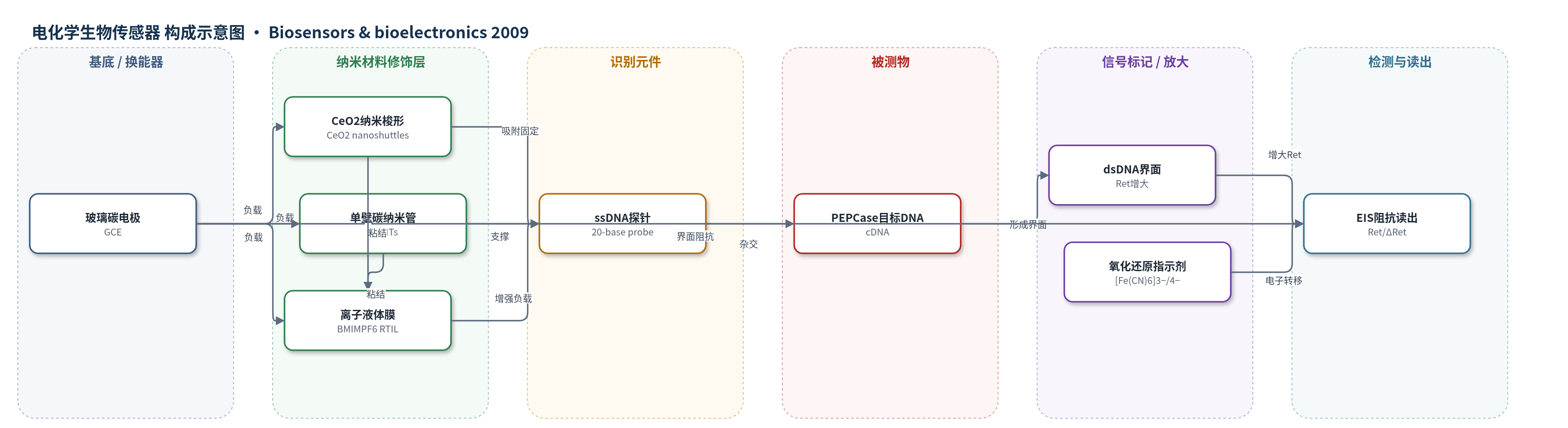
点击图片查看大图 · 依据论文自动绘制
传感器类型
电化学生物传感器
检测对象
PEPCase基因序列特异性DNA(phosphoenolpyruvate carboxylase gene sequence-specific DNA / cDNA,20-base oligonucleotide);样品基质:2× SSC杂交缓冲液(pH 7.5,模拟/缓冲样品)
检测原理
该传感器采用无标记阻抗检测原理。CeO2纳米梭形表面带正电荷,可吸附固定带负电的ssDNA探针;SWNTs提供电子传导通道,BMIMPF6离子液体提高离子导电性并增强膜均匀性,三者协同提高探针负载量。当目标PEPCase基因DNA与探针杂交形成dsDNA后,电极界面负电荷密度增加、DNA膜变厚,阻碍[Fe(CN)6]3−/4−向电极表面扩散和电子转移,使EIS Nyquist图高频半圆直径即电子转移电阻Ret增大。以杂交前后Ret差值ΔRet作为测量信号,ΔRet与目标DNA浓度对数呈线性关系,从而实现目标DNA的定量检测。
检测灵敏度
LOD: 2.3 × 10⁻¹³ mol/L;线性范围(对数浓度): 1.0 × 10⁻¹²–1.0 × 10⁻⁷ mol/L;回归方程: ΔRet (Ω) = 5.285 lg C + 27.632;R = 0.9952
效应效果
该传感器对完全互补目标DNA响应显著,非互补DNA几乎无响应,单碱基和双碱基错配序列的Ret增幅明显小于互补序列,选择性良好。探针在B-R(pH 6.0)、Tris–HCl(pH 7.0)和2× SSC(pH 7.5)中30 ℃孵育10 h后EIS信号几乎不变,孵育液260 nm无DNA吸收。6个平行传感器检测1.0×10⁻¹⁰ mol/L目标DNA的RSD为3.75%。杂交电极沸水10 min变性、冰盐浴冷却后可再生,连续使用3次灵敏度基本不变。与MWNTs/ZrO2、SiO2/PATP/Au和CeO2/CHIT等纳米氧化物DNA传感器相比,本文方法检出限更低、检测范围更宽,适用于转基因油菜PEPCase基因检测。
传感器的构成
- 基底/工作电极:玻璃碳电极(GCE),经0.3 μm和0.05 μm α-Al2O3抛光、超声清洗,提供导电基底与电子转移动态界面。
- 纳米材料修饰层:纳米梭形氧化铈(CeO2 nanoshuttles),高比表面积、高等电点正电荷表面,用于吸附固定带负电的ssDNA探针。
- 纳米材料修饰层:单壁碳纳米管(SWNTs),提供大比表面积和高电子传导通道,增强界面电子转移。
- 纳米材料修饰层:室温离子液体1-丁基-3-甲基咪唑六氟磷酸酯(BMIMPF6),高离子导电性并作为粘结剂,使CeO2与SWNTs分散均匀、降低界面阻抗。
- 识别元件:20碱基单链DNA探针(ssDNA,5′-CAG CAC CTA GGC ATA GGT TC-3′),通过磷酸骨架负电荷与CeO2正表面吸附固定,与目标DNA杂交。
- 信号指示剂:[Fe(CN)6]3−/4−氧化还原电对,用于EIS监测电极界面电子转移电阻变化。
- 清洗/去除非特异结合:0.5% SDS溶液及超纯水,用于去除未固定或未杂交DNA。
- 杂交介质:2× SSC缓冲液(pH 7.5),提供DNA杂交所需离子环境。
中文摘要
本文在玻璃碳电极(GCE)表面构建了一种由纳米梭形氧化铈(CeO2)、单壁碳纳米管(SWNTs)和疏水性室温离子液体1-丁基-3-甲基咪唑六氟磷酸酯(BMIMPF6)组成的纳米复合膜,用于DNA固定与杂交的电化学传感。以[Fe(CN)6]3−/4−为氧化还原指示剂,通过循环伏安法和电化学阻抗谱(EIS)研究该复合膜的界面性质及DNA固定、杂交行为。CeO2、SWNTs和离子液体的协同作用可显著提高DNA杂交识别灵敏度。探针单链DNA固定后,电极表面电子转移电阻(Ret)增大;与互补目标DNA杂交后,Ret进一步增大。利用固定探针电极与杂交电极之间Ret的显著差异,可实现目标DNA的无标记EIS检测。该传感器成功检测了转基因油菜中磷酸烯醇式丙酮酸羧化酶(PEPCase)基因的序列特异性DNA。在最佳条件下,PEPCase基因目标序列的动态范围为1.0×10−12–1.0×10−7 mol/L,检出限为2.3×10−13 mol/L,表明该纳米复合膜在灵敏电化学生物传感器中具有良好应用前景。
英文摘要
A novel nanocomposite membrane, comprising of nanosized shuttle-shaped cerium oxide (CeO(2)), single-walled carbon nanotubes (SWNTs) and hydrophobic room temperature ionic liquid (RTIL) 1-butyl-3-methylimidazolium hexafluorophosphate (BMIMPF(6)), was developed on the glassy carbon electrode (GCE) for electrochemical sensing of the immobilization and hybridization of DNA. The properties of the CeO(2)-SWNTs-BMIMPF(6)/GCE, the characteristics of the immobilization and hybridization of DNA were studied by cyclic voltammetry and electrochemical impedance spectroscopy (EIS) using [Fe(CN)(6)](3-/4-) as the redox indicator. The synergistic effect of nano-CeO(2), SWNTs and RTIL could dramatically enhance the sensitivity of DNA hybridization recognition. The electron transfer resistance (R(et)) of the electrode surface increased after the immobilization of probe ssDNA on the CeO(2)-SWNTs-BMIMPF(6) membrane and rose further after the hybridization of the probe ssDNA with its complementary sequence. The remarkable difference between the R(et) value at the probe DNA-immobilized electrode and that at the hybridized electrode could be used for label-free EIS detection of the target DNA. The sequence-specific DNA of phosphoenolpyruvate carboxylase (PEPCase) gene from transgenically modified rape was detected by this DNA electrochemical biosensor. Under optimal conditions, the dynamic range for detecting the sequence-specific DNA of the PEPCase gene was from 1.0x10(-12) mol/L to 1.0x10(-7) mol/L, and the detection limit was 2.3x10(-13) mol/L, suggesting that the CeO(2)-SWNTs-BMIMPF(6) nanocomposite hold great promises for the applications in sensitive electrochemical biosensor.