组成图示
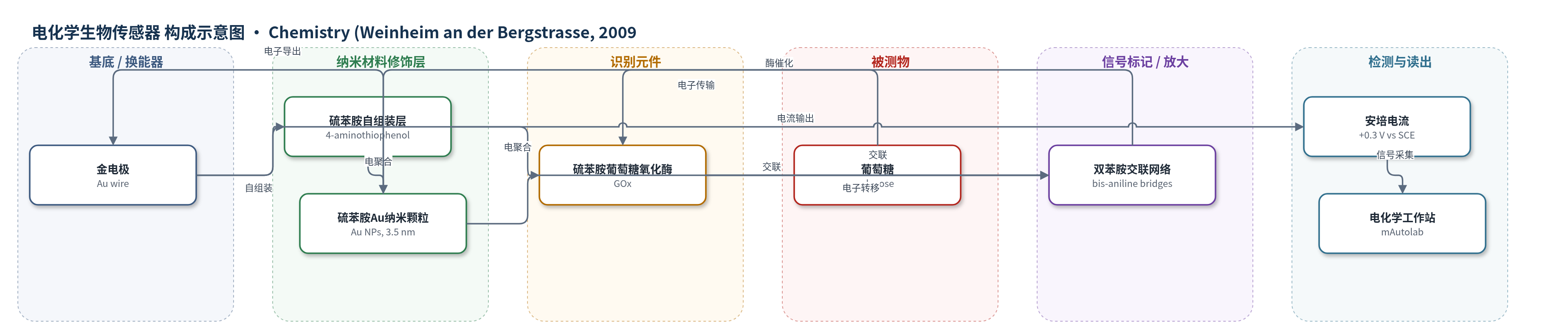
点击图片查看大图 · 依据论文自动绘制
传感器类型
电化学生物传感器
检测对象
葡萄糖(glucose);样品基质:磷酸盐缓冲液(pH 7.4),文中面向糖尿病血糖/皮下液应用
检测原理
葡萄糖扩散进入由双苯胺桥联单元交联的Au NPs/GOx三维纳米多孔复合膜后,被共价固定的葡萄糖氧化酶(GOx)催化氧化。GOx活性中心的氧化还原变化通过硫苯胺/双苯胺桥联单元进行介导电子转移,电子再经Au NPs形成的三维导电网络传输至金电极。在+0.3 V vs SCE下,电化学工作站记录到随葡萄糖浓度升高而增大的阳极电流;有效电接触使酶-电极电子周转速率约500 s^-1,从而降低干扰物氧化竞争并允许有氧条件下检测。粗糙化金表面可增大电极表面积约50倍,使安培响应提高约20倍。
检测灵敏度
未报告LOD、线性范围、灵敏度斜率或相关系数。
效应效果
该电极对葡萄糖氧化具有良好选择性:在0.1 mM抗坏血酸存在下,0至+0.1 V区间电流干扰小于3–8%;有氧条件下电流仅轻微下降,表明有效电接触可抑制氧竞争。通过汞齐化后硝酸处理粗糙化金表面,电极表面积增大约50倍,葡萄糖安培响应提高约20倍。稳定性方面,室温连续运行后活性下降约20%,4°C储存7天损失约15%。原文未报告RSD、实际样品加标回收率或与ELISA/HPLC/qPCR等方法的对比。作者认为电聚合方法可高通量制备微型化、植入式葡萄糖传感器,适用于糖尿病血糖监测。
传感器的构成
- 基底/换能器电极:金电极(Au electrode,Au wire),提供电子传导与电化学换能,并可经汞齐化/硝酸处理粗糙化以增大表面积
- 自组装锚定层:4-巯基苯胺(thioaniline,4-aminothiophenol)单层修饰Au电极,提供可电聚合锚定位点
- 纳米材料修饰层:硫苯胺功能化金纳米颗粒(thioaniline-functionalized Au NPs,直径约3.5 nm,混合封端4-巯基苯胺与巯基乙烷磺酸),提供三维导电网络并参与电聚合交联
- 识别元件:硫苯胺修饰葡萄糖氧化酶(thioaniline-modified GOx,经sulfo-EMCS修饰赖氨酸后与4-巯基苯胺Michael加成),催化葡萄糖氧化并共价接入网络
- 交联/电子中继层:双苯胺桥联单元(bis-aniline/oligoaniline bridges),由电聚合形成,氧化还原活性,介导酶活性中心与电极间电子转移
- 信号读出:电化学工作站(mAutolab)在+0.3 V vs SCE进行安培/循环伏安检测,输出葡萄糖氧化电流
中文摘要
本文报道了一种可电聚合葡萄糖氧化酶(GOx)基电化学生物传感器的构建方法。作者通过双功能试剂sulfo-EMCS修饰GOx赖氨酸残基,再经Michael加成将4-巯基苯胺(thioaniline)共价接枝到蛋白上,获得可电聚合GOx。将该硫苯胺修饰GOx与硫苯胺功能化金纳米颗粒(Au NPs)在硫苯胺单层修饰的金电极上进行循环伏安电聚合,形成由双苯胺桥联单元交联的三维Au NPs/GOx导电网络。双苯胺桥联单元具有氧化还原活性,可介导酶活性中心与电极之间的电子转移;Au NPs则提供三维导电通路,将电子传输至电极。共价连接的GOx与电极实现有效电接触,电子周转速率约500 s^-1,使电极对葡萄糖具有灵敏且选择性的安培响应。该电聚合制备方式及生物电催化特性表明,该体系有望用于微型化传感矩阵和植入式葡萄糖传感器。
英文摘要
Sweet sensor: A bis-aniline-cross-linked Au nanoparticles (NPs)/glucose oxidase composite has been electropolymerized on a Au electrode (see picture). The integrated Au NPs/enzyme electrode provides an effective matrix for making electrical contact with the enzyme, and this yields a specific amperometric glucose biosensor.Electropolymerizable glucose oxidase (GOx) was synthesized by the tethering of thioaniline units to the protein. The electropolymerization of the thioaniline-modified GOx in the presence of thioaniline-functionalized Au nanoparticles (NPs) yielded a three-dimensional bis-aniline-cross-linked Au NPs/GOx network. The bis-aniline bridging units are redox active and mediate the electron transfer between the enzyme redox sites and the electrode, and the Au NPs provide the three-dimensional conductivity for transporting the electrons to the electrode. The covalently linked GOx displays an effective electrical contact with the electrode (turnover rate of ca. 500 s(-1)), which results in a sensitive and selective glucose-sensing electrode. The preparation of the electrode by means of electropolymerization, and the bioelectrocatalytic features of the electrode, suggest its feasibility as a miniaturized electrode with a sensing matrix and as an implantable glucose sensor in future applications.