组成图示
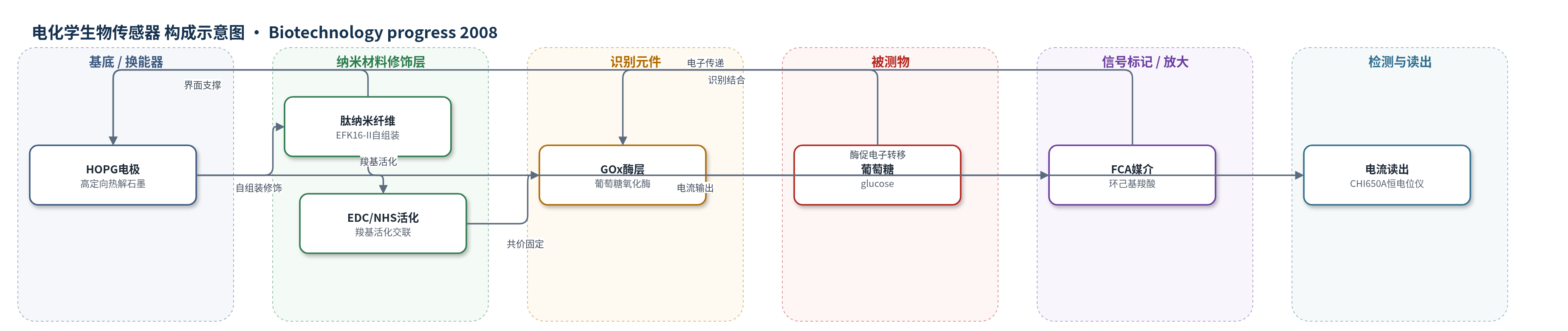
点击图片查看大图 · 依据论文自动绘制
传感器类型
电化学生物传感器
检测对象
葡萄糖(glucose);样品基质:100 mM 磷酸盐缓冲液(pH 7.0),未报道实际生物样品
检测原理
该传感器以 HOPG 为导电基底,EFK16-II 在其表面自组装成纳米纤维,提供含羧基和氨基的生物相容界面。GOx 经 EDC/NHS 与肽层羧基共价固定,保持催化活性。检测时,葡萄糖进入 GOx 活性位点并被催化氧化,产生的还原当量通过溶液中的 FCA 媒介传递至 HOPG 表面。在 +0.45 V(vs. Ag/AgCl)恒电位下,FCA 氧化产生阳极电流。葡萄糖浓度升高时,酶促反应速率增加,稳态电流随之增大,在 0–7.5 mM 范围内呈线性,高浓度下趋于平台,符合 Michaelis–Menten 动力学。肽纳米纤维层在慢扫描下不显著阻碍电子转移,但高扫描下增加界面电阻,因此信号主要受酶催化速率和媒介电子传递控制。
检测灵敏度
线性范围: 0–7.5 mM;灵敏度: 11.3 ± 1.0 nA/(mM mm2);Imax: 142.0 ± 7.3 nA mm−2;Km: 6.8 ± 0.9 mM;r^2 = 0.96
效应效果
该葡萄糖酶电极在 0–7.5 mM 范围内线性良好,覆盖临床常用 3.5–6.5 mM 范围。表观 Km 为 6.8±0.9 mM,低于巯基和 CaCO3 纳米颗粒修饰 Pt 电极报道的 21–24 mM,表明固定化 GOx 对葡萄糖亲和性较高。灵敏度 11.3±1.0 nA/(mM·mm2),约为 GOx 修饰巯基修饰金纳米管和金电极(约 4 nA/(mM·mm2))的三倍。稳定性方面,4℃磷酸盐缓冲液中存储 1 个月后电流保留约 87%,优于 FF 二肽修饰金电极 2 周损失 40% 的报道;50 次 0–0.5 V 循环伏安扫描后峰值电流变化可忽略。作者认为离子互补肽纳米纤维可作为抗体、DNA 等识别元件的通用修饰平台,并有望扩展至碳纳米管等纳米电极以提高灵敏度。
传感器的构成
- 基底/换能器电极:高定向热解石墨(HOPG)电极,提供导电基底与电子转导界面
- 纳米材料修饰层:离子互补肽 EFK16-II 自组装纳米纤维,提供生物相容界面、羧基/氨基功能基团并改善润湿性
- 交联活化层:EDC/NHS 活化 EFK16-II 羧基形成 NHS 酯,用于与酶氨基形成酰胺键
- 识别元件:葡萄糖氧化酶(GOx),特异性催化葡萄糖氧化
- 信号标记/电子媒介:环己基羧酸(FCA),作为电子媒介传递酶反应电子至电极
- 电解液/缓冲体系:100 mM 磷酸盐缓冲液(pH 7.0),维持酶活性与离子导电
中文摘要
离子互补肽是具有生物纳米技术潜力的新型生物材料。本研究采用典型离子互补肽 EFK16-II 修饰高定向热解石墨(HOPG)电极。修饰后,肽纳米纤维在 HOPG 表面形成平行或呈 60°/120° 排列的结构,电极润湿性提高,水接触角显著降低。对铁氰化钾/亚铁氰化钾氧化还原对的电化学表征表明,慢扫描(2 mV/s)下肽纳米纤维未明显阻碍电子转移,高扫描(100 mV/s)下则产生阻碍。葡萄糖氧化酶(GOx)共价固定于该修饰电极,用于葡萄糖检测。在 +0.45 V(vs. Ag/AgCl)下,电流随葡萄糖浓度线性增加至 7.5 mM,灵敏度为 11.3±1.0 nA/(mM·mm2)。固定化 GOx 对葡萄糖亲和性较高,Km 为 6.8±0.9 mM。该电极存储和操作稳定性较好,1 个月存储后电流仅下降 13%,50 次循环伏安扫描后变化可忽略。结果表明离子互补肽用于电极修饰开展生物分子传感与诊断具有良好潜力。
英文摘要
Ionic-complementary peptides are promising new biomaterials with potential applications in bionanotechnology. In the present investigation, a typical ionic-complementary peptide, EFK16-II, was used to modify a highly ordered pyrolytic graphite (HOPG) electrode. Upon modification, peptide nanofibers, parallel or oriented 60 degrees or 120 degrees to each other, were formed on the surface of HOPG electrode. Surface wettability of the electrode was improved as indicated by a significant decrease in the water contact angle. The electrochemical response of the EFK16-II nanofiber-modified HOPG electrode for the ferricyanide/ferrocyanide redox couple was characterized. Cyclic voltammograms indicated that the presence of peptide nanofibers on the HOPG electrode did not block electron transfer at slow scan rates ( approximately 2 mV/s), but did so at high scan rates ( approximately 100 mV/s). A model enzyme glucose oxidase (GOx) was covalently immobilized onto this nanofiber-modified electrode, and its potential as an enzyme-based biosensor for glucose was examined. At an applied potential of +0.45 V (vs. Ag/AgCl), the current increased linearly with glucose concentration up to 7.5 mM and a relative high sensitivity was obtained at 11.3 +/- 1.0 nA/(mM mm(2)). The immobilized GOx showed high affinity for glucose, with a Michaelis-Menten constant K(m) of 6.8 +/- 0.9 mM. It also exhibited relatively good storage and operational stabilities, and reflected in only a small decrease (13%) in the current response after 1 month storage and negligible changes upon 50 cyclic voltammetric scans. The results presented here demonstrate an excellent potential of the use of ionic-complementary peptides to modify electrode surfaces for biomolecular sensing and diagnostics.