组成图示
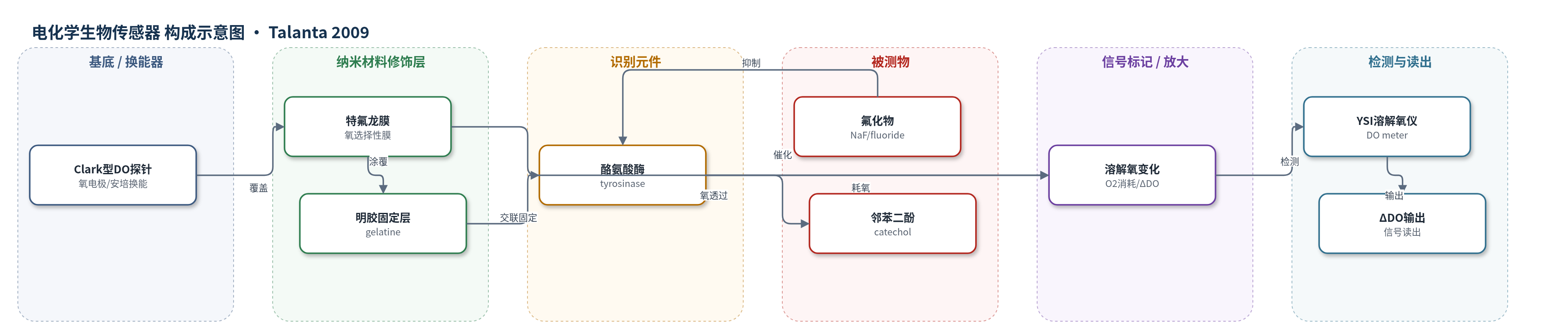
点击图片查看大图 · 依据论文自动绘制
传感器类型
电化学生物传感器
检测对象
氟化物(fluoride, F−;NaF标准溶液)、邻苯二酚(catechol);样品基质:50 mM磷酸盐缓冲液(pH 7.0,反应介质)
检测原理
该传感器利用氟化物对酪氨酸酶的竞争性抑制实现检测。在含氧磷酸盐缓冲液中,酪氨酸酶催化邻苯二酚氧化为苯醌,同时消耗溶解氧:catechol + 1/2 O2 → benzoquinone + H2O。无氟化物时,酶促耗氧速率对应初始溶解氧消耗值DOI;加入氟化物后,氟离子抑制酪氨酸酶活性,使酶促反应速率下降,界面溶解氧消耗减少,得到DOII。两者差值ΔDO=DOI−DOII随氟化物浓度增加而增大。Clark型DO探针通过特氟龙膜感知氧浓度变化,并以安培电流形式输出信号。方法无需额外标记或放大,酶催化耗氧本身提供信号,响应时间约3 min。
检测灵敏度
线性范围: 1.0–20 μM;回归方程: y = 0.0031x + 0.005(y为ΔDO, mg/L;x为NaF, μM);R^2 = 0.9934;响应时间: 3 min
效应效果
在优化条件下,传感器对氟化物在1.0–20 μM范围内线性响应,回归方程为y=0.0031x+0.005,R^2=0.9934,响应时间3 min。重现性方面,对10 μM NaF和2.5 μM邻苯二酚进行8次测定,平均值为10.5 μM,标准偏差±0.57 μM,变异系数5.43%。储存稳定性方面,传感器在4 °C保存18天后,酶活性和氟化物响应仅损失约10%。文中还进行了底物特异性研究,但未给出具体干扰物数据。作者认为该传感器响应快、稳定性好、检测范围合适,可用于邻苯二酚与氟化物的常规同步分析。
传感器的构成
- 基底/换能器:Clark型溶解氧(DO)探针,安培检测氧浓度变化
- 选择性膜:特氟龙(teflon)膜,0.0005 in厚,对氧选择性透过并阻隔干扰
- 固定基质:明胶(gelatine,5 mg,4.21 mg/cm2),承载酶并限制扩散
- 生物催化/识别元件:酪氨酸酶(tyrosinase,69 U,40.7 U/cm2),催化邻苯二酚氧化耗氧并受氟化物抑制
- 交联剂:戊二醛(glutaraldehyde,2.5%),交联酶与明胶实现固定
- 底物:邻苯二酚(catechol,2.5 μM),酶催化反应物,产生耗氧信号
- 被测物/抑制剂:氟化物(fluoride,NaF),竞争性抑制酪氨酸酶
- 读出装置:YSI 58数字溶解氧仪/YSI 5739 DO探针,测量ΔDO
中文摘要
本研究报道了一种基于酪氨酸酶抑制的安培型生物传感器,用于氟化物测定。传感器以覆盖特氟龙膜的Clark型溶解氧(DO)探针为基底,将酪氨酸酶用明胶承载并以戊二醛交联固定在膜表面;该特氟龙膜对氧具有选择性透过作用。在50 mM、pH 7.0磷酸盐缓冲液和30 °C条件下获得最佳响应。检测时,邻苯二酚作为底物,酪氨酸酶催化其氧化并消耗溶解氧;氟化物作为竞争性抑制剂降低酶活性,使界面溶解氧消耗减少,DO下降幅度与加入的氟化物浓度相关。传感器响应在1.0–20 μM范围内与氟化物浓度呈线性,响应时间为3 min。表征结果显示,对10 μM氟化物标准溶液,平均测定值为10.5 μM,标准偏差±0.57 μM,变异系数5.43%。
英文摘要
In this study, a new biosensor based on the inhibition of tyrosinase for the determination of fluoride is described. To construct the biosensor tyrosinase was immobilized by using gelatine and cross-linking agent glutaraldehyde on a Clark type dissolved oxygen (DO) probe covered with a teflon membrane which is sensitive for oxygen. The phosphate buffer (50mM, pH 7.0) at 30 degrees C were established as providing the optimum working conditions. The method is based on the measurement of the decreasing of dissolved oxygen level of the interval surface that related to fluoride concentration added into reaction medium in the presence of catechol. Inhibitor effect of fluoride results in decrease in dissolved oxygen concentration. The biosensor response depends linearly on fluoride concentration between 1.0 and 20 microM with a response time of 3 min. In the characterization studies of the biosensor some parameters such as reproducibility, substrate specificity and storage stability were carried out. From the experiments, the average value (x), Standard deviation (S.D) and coefficient of variation (C.V %) were found as 10.5 microM, +/-0.57 microM, 5.43%, respectively for 10 microM fluoride standard.